
Montgomery Sidecars.
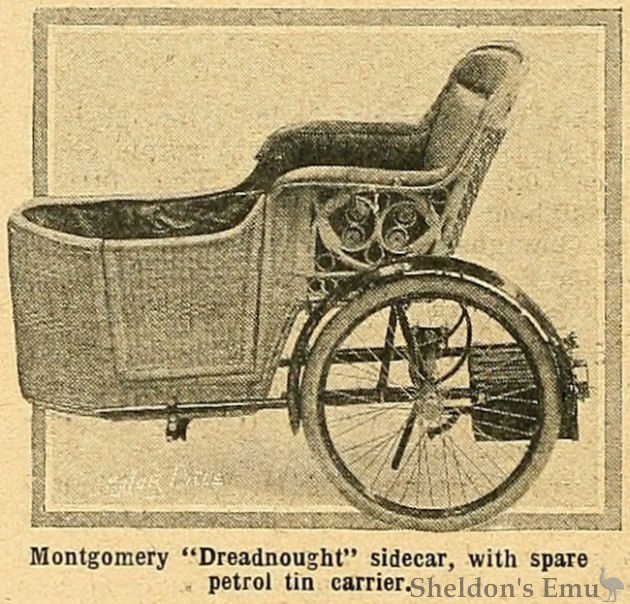
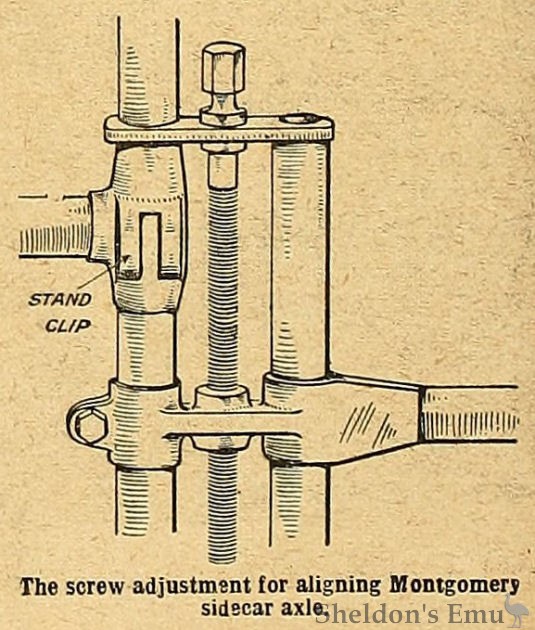
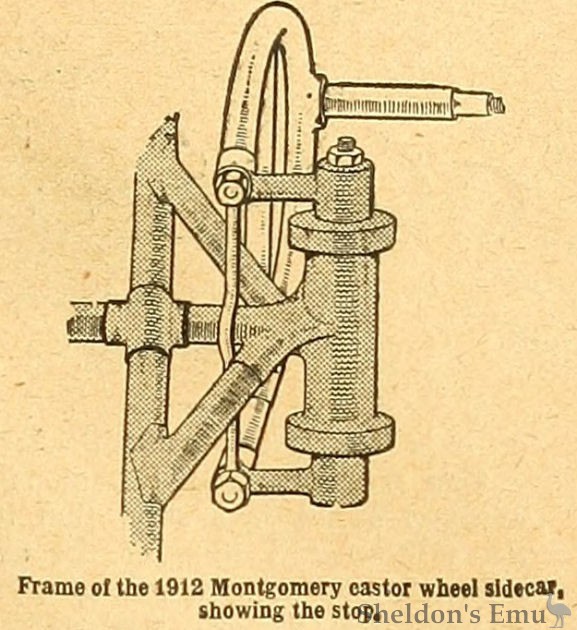
On Stand no. 60 in the Annexe will be shown a full range of the well known Montgomery castor wheel, spring wheel, and rigid sidecars, which have been practically redesigned for next season. One of the features of these sidecars is a patent spring under the foot of the chair, which greatly adds to the passengers' comforts. The Montgomery patent attachments are provided with a security device which prevents the connections working loose, and stands are being fitted to support the car when it is detached from the bicycle; it also facilitates tyre repairs. All except the cheapest model have luggage carrier, petrol carrier, and tool box embodied in the construction of the chair. The castor wheel frame has been considerably strengthened in view of it being used on high powered machines. A new model will be introduced at the Show with sprung frame, but of lighter construction than the 1911 pattern, and for use with standard 3½ h.p. motor cycles, A patented method will also be shown for bringing the sidecar axle in line with the driving wheel of the motor bicycle. Sections of the sidecar hubs, axles, ball races, cups, etc., will be on view. The aim of W. Montgomery and Co. is to make sidecars for use on long journeys, and particular attention is paid to the comfort of the passenger both in seating and springing and protection from the weather. Luggage carrying capacity, general convenience, and ease of steering have all been carefully considered. This exhibit will comprise one of the most representative displays in the Show.
1911 Olympia Show - The Motor Cycle November 16th, 1911. Page 1222
MONTGOMERY, No. 60.
W. Montgomery and Co., Much Park Street, Coventry. – Numerous types of sidecars, the manufacture of which is a speciality of the firm. These are made in three types – castor wheel, spring wheel, and rigid. The castor wheel has been strengthened for high-powered machines. The cross-member, which carries the pivot of the castor wheel, is additionally stayed by members running from the outer of the two main longitudinal stays. All types are fitted with a carrier behind for carrying a petrol tin and a luggage box.
The method of attaching the sidecar to the machine is interesting, the points of, attachment being fastened by means of a screw ring, which when in position is prevented from turning by a clip encircling the sidecar tube, and carrying a stud engaging with the ring. When this stud is placed in position, the thumbscrew is tightened and the ring is securely held in position. The rigid model possesses all the improvements mentioned above, while two grades are made of the spring wheel model, one being for machines up to 3½ h.p., and the other for more powerful motor bicycles. The sprung wheel is carried on a semi-elliptical spring, fastened rigidly at its forward end, and provided with a long shackle at the rear. Among the various types of bodies we may mention one to which straps are fastened for carrying a spare cover.
1911 Olympia Show - The Motor Cycle November 23rd, 1911. Page 1283