
The Puch Motor Bicycle.
It was in 1905 that the writer first met Herr Puch, who had then entered a machine for the International Cup Race at Dourdan. Even in those early days of the industry the sidecar was becoming popular, especially in Austria, and Herr Puch and his assistants found the side-car machine which they brought over from Gratz, where are the Puch Works, to be exceedingly useful preparatory to the race. The machine is one which has established a high reputation for itself on the Continent, and readers will be interested to hear that it is now to be handled in this country. The following will be placed on the market: Two single-cylinder patterns, 3 ½ h.p., 76 by 100 mm., one of these having two-speed gear, free engine and chain drive, and a 6-7 h.p. twin with two-speed gear, chain drive, fan cooling, and sidecar. This model is fitted with 700 by 80 mm. voiturette tyres, and it looks an exceedingly sensible sidecar machine. Probably all these models will be on view at the coming Olympia Show.
The single-cylinder engines are provided with mechanically-operated valves, but in the case of the twin the inlet valves are automatic, a practice which is nearly obsolete in this country.
1911 Olympia Show - The Motor Cycle October 19th, 1911. Page 1100A
PUCH, No. 90.
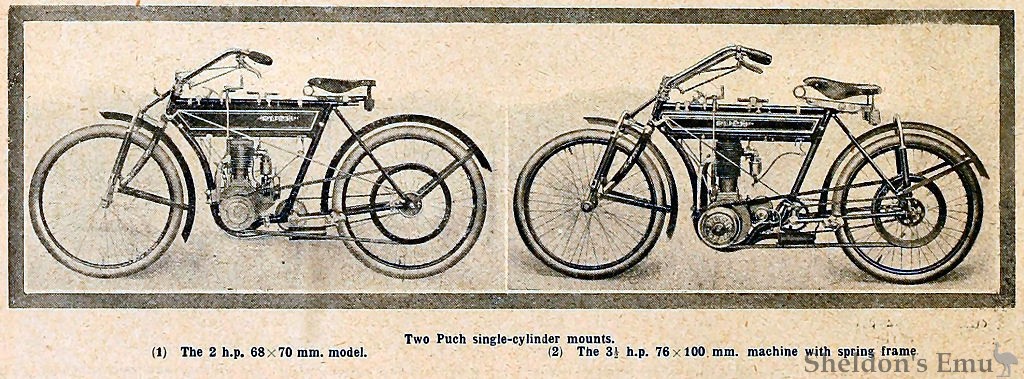
Two Puch single-cylinder mounts. (1) The 2 h.p. 68 x 70 mm. model. (2) The 3½ h.p. 76 x 100 mm. machine with spring frame
The Puch Motor Cycles Agency, Notting Hill Gate, W. - The Puch machine makes its public appearance in England for the first time at this exhibition. The makers, it will be seen, favour the long-stroke engine. The exterior finish is particularly good. An undergeared pulley is fitted, and the tension of the belt may be varied by means of a handle placed at the side of the tank. By the aid of this handle the belt may be so much slackened that the engine is free, and after it has been started by the pedals the pedal on the spring-up stand may be depressed and, while the rider is still in the saddle, the stand will fly into position and the engine may be started by gradually tightening the belt. The frame of this machine is sprung both at the rear and front on spiral springs enclosed in tubes.
The valve, gear, magneto (which in all cases is the Ruthardt), and oil pump are driven by skew gearing, the shaft of which runs at the side of the crank case. It may be mentioned that an additional pump is supplied for injecting the necessary amount of oil into the crank chamber. The transmission is by single chain, and in the rear hub is a multiple disc clutch. A 2 h.p. machine is also shown fitted with direct belt drive and chain-driven magneto. In all cases the magneto is at the rear.
This is quite a practical sidecar machine. A pulley is fitted to the end of the engine-shaft for the purpose of driving the fan, which is enclosed in a casing, the outer part of which is covered with wire netting. The frame of this machine is rigid at the rear. The change of speed is effected by a lever provided with a wood handle adjacent to the saddle, while opposite to it is a ratchet brake lever controlling an external band brake on the rear hub. The sidecar is provided with a motor car type of wing, capacious cylindrical petrol tank at the back, and a sprag which may be used as a stand. The two cylinders exhaust into an expansion chamber, and thence runs a long pipe in easy curves, which is bolted to the sidecar frame, and terminates in another expansion chamber. The handle-bars are of great length and are supported by means of additional stays. The machine is a distinct departure from English ideas, and is well worth a close inspection.
1911 Olympia Show - The Motor Cycle November 23rd, 1911. Page 1256