
Millford Sidecars.
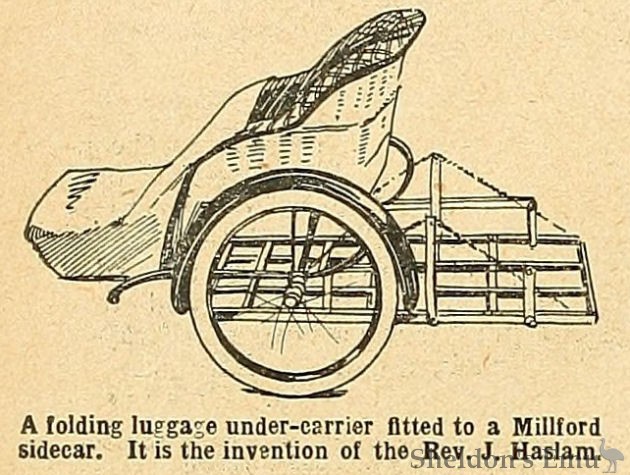
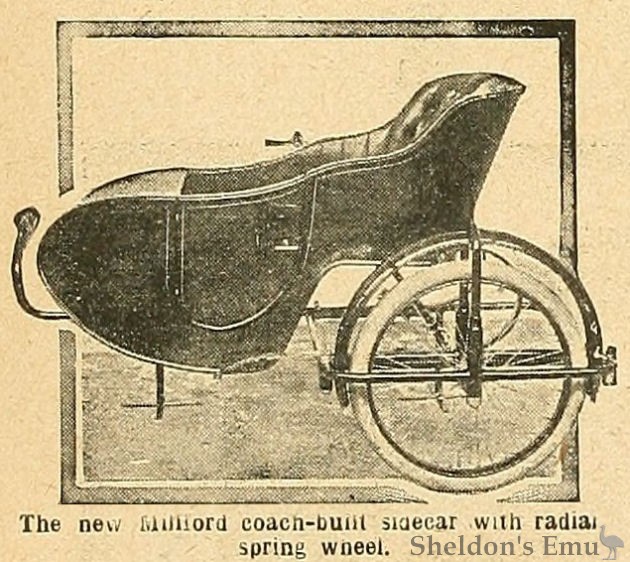
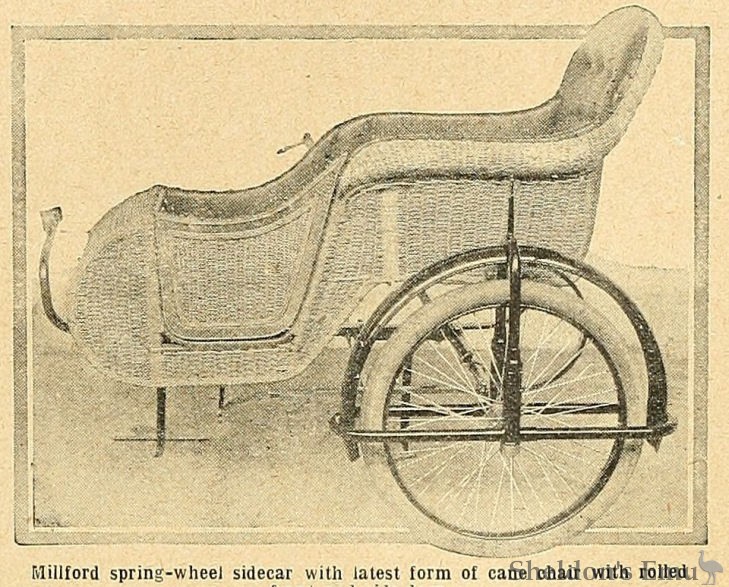
Mills and Fulford will exhibit at Stand 65 examples of all their Millford sidecars. These will be found suitable for all pockets, as their range of designs starts with a very low-priced sidecar called the Herald, the most expensive one embodying all the latest ideas such as the radial castor wheel, with spring wheel and coach-built body. Among the other designs which will be exhibited are the rigid Millford sidecar with several distinctive designs of chairs in cane and wickerwork. Several will be specially made to enable a child as well as the passenger to be carried. Among the refinements which will be found on these up-to-date sidecars for 1912 are wind screens, luggage carriers, petrol carriers, etc.
In the new models it is now possible to bring both sidecar wheel and motor bicycle wheel absolutely parallel. This is provided for by all-round adjustability, which allows the sidecar to be lined up with the bicycle in any direction, both vertically and horizontally.
Wicker and cane chairs with side doors will be quite a feature of the Millford sidecars for next year, the very latest type with torpedo-shaped front and side door being exceptionally taking in appearance. The side-door type of sidecar will be extremely popular next year, as with it all trouble of buttoning up and unbuttoning the apron is obviated. At present few sidecar passengers can leave their seats till the driver has dismounted and unbuttoned the apron at the top and bottom. With side door the passenger can descend whilst the driver remains seated, often a great convenience.
1911 Olympia Show - The Motor Cycle November 16th, 1911. Page 1222
MILLFORD, No. 65.
Mills and Fulford, Ltd., Coventry. - This firm, one of the oldest and best known sidecar manufacturers in the country, have introduced several improvements for this year. As regards the frame, the longitudinal member nearest the bicycle is now made in one piece, with double swan neck bends, which bring it up to the down tube of the machine. This tube is telescopic, and may be adjusted to suit any length of wheelbase, while the clip attached to the machine can be moved backwards or forwards so that the necessary width may be obtained. The clip fastening to the chain stays of the machine is also capable of universal movement. The tube it carries is suspended at two points, firstly on the main longitudinal member nearest the machine, and also on another tube parallel to it. By loosening the necessary bolts it may be slid backwards or forwards on these two tubes so as to adjust itself to the required length. The clip attached to the bolt fixed to the chain stays is capable of up or down movement so as to adjust itself to the height of the machine, allowing a 28in. wheel machine to adapt itself comfortably to a 26in. wheel sidecar. In whatever position this clip may be turned, it is firmly secured by an ingenious device. The securing bolt runs through two tubes halved and grooved to adapt themselves to the diar [sic] of the tubing, so that when the nut is screwed up the two halves grip the tube and lock the holt securely. The bar supporting the body has a cross member brazed to it, so that the body is now supported fore and aft. No fewer than fifteen different types of bodies are shown on the stand. Some are made of wicker, others of cane, whilst several are of the coach-built variety.
1911 Olympia Show - The Motor Cycle November 23rd, 1911. Page 1252