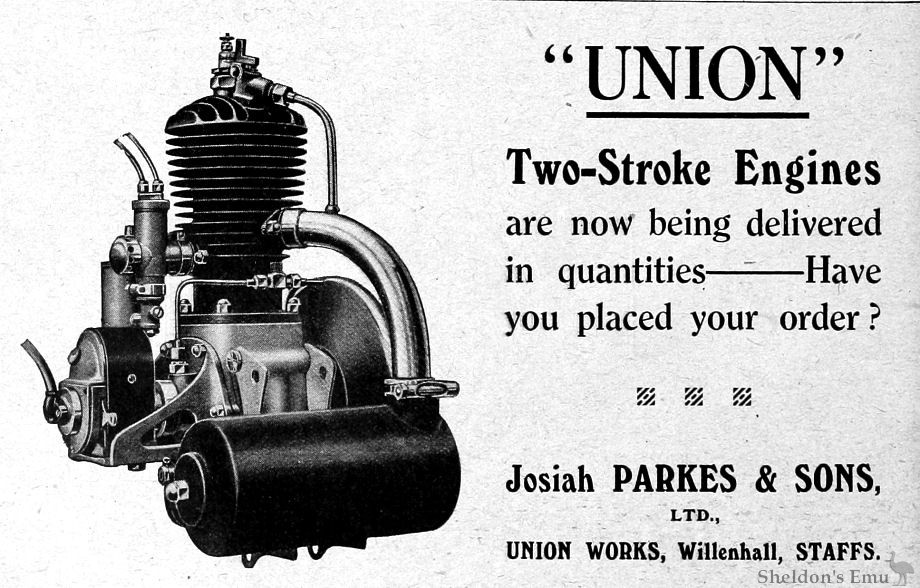

Josiah Parkes & Sons Ltd. of Union Works, Willenhall produced a two-stroke engine of 292cc from 1918 until 1926 when manufacturing rights were acquired by Alfred Wiseman.
Union engines were fitted to Baron, Coulson, De Luxe, Edmund, Macklum, Priory, Reynolds Runabout, Romper, Sirrah (built by Wiseman) and Akkens motorcycles, and to Autoglider scooters.
Enlarged Model of the Union Engine. Detachable Head and Plain Bearings Throughout.
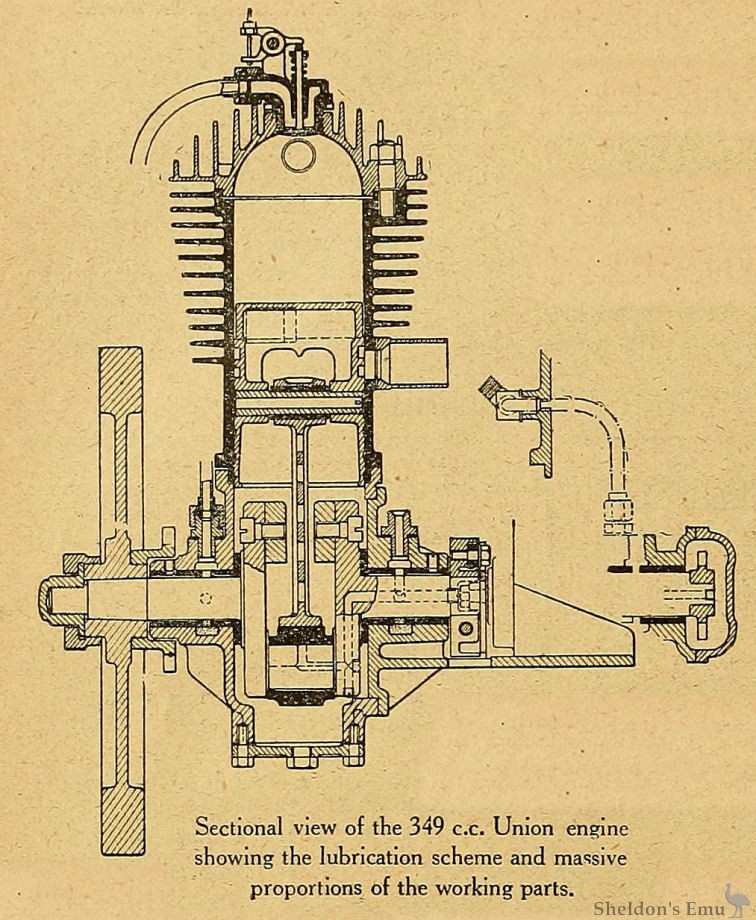
THE Union engine has already made a good name for itself and is now well known in the two-stroke world. A later development has recently made its appearance and takes the form of a 350 c.c. three-port two-stroke engine of very robust construction. Having a bore and stroke of 75 x 79 mm. the engine is of 349 c.c. capacity; its salient features are a one-piece crank shaft and the employment of very large plain bearings, with lubrication leads direct to the cylinder, both main bearings and through the crankshaft to the big end.
The big end is of the marine type, consisting of two bronze castings bolted to a flat connecting rod base; an extremely large outside flywheel is fitted, and the cylinder has a separate cast iron head bolted to it.
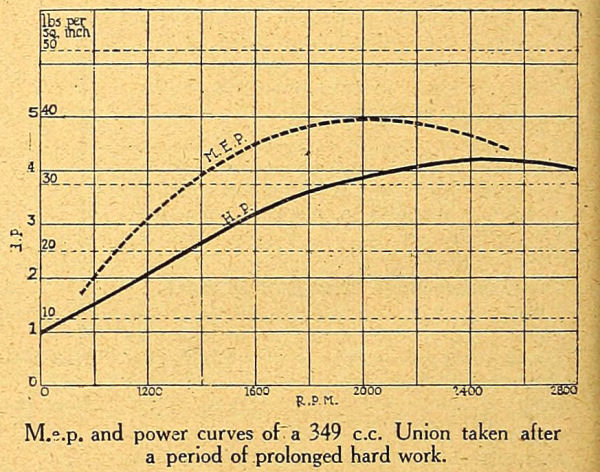
In spite of the fact that only a few of these engines are yet on the road, they are by no means experimental, for in a modified form they have been operating pumping and lighting sets for a considerable period. We are able to reproduce a power curve of a standard engine which had been running for many months continuous use previous to the test though we are informed that a similar engine has maintained 9 b.h.p. at 3,500 r.p.m. for a period of 45 minutes. The main claims for this engine are that it is particularly cool in running and is very economical and flexible; its weight is only 50 lb.
On a machine which was tried by our representative, the engine proved to be capable of propelling the rider over any normal country with a top gear of 5½ to 1. It was possible to start on top gear quite comfortably and to climb a hill of 1 in 9 with the greatest of ease. A considerably higher gear might be used for solo purposes, the gear fitted being suitable for sidecar work, and with a higher gear a reasonably high road speed could have been attained in comfort. Lubrication appears to be perfectly satisfactory, and the engine two-stroked regularly over a wide range, fuel economy being a marked feature of the road running. The magneto drive may be arranged by chain in the normal fashion or may be direct from the crankshaft.
The address of the designer is Mr. E. H. Whaley, Coleridge Chambers, 177, Corporation Street, Birmingham.
The Motor Cycle, August 17th, 1922. Page 236
An Engine-gear Unit to be Introduced by a Firm new to the Motor Cycle Industry.
A NEW engine is always interesting to the motor cyclist, and an engine the production of which brings into the motor world a firm of engine unit manufacturers new to the industry is of unusual interest. The designer of the engine described, Mr. R. S. Whaley, of Edgbaston, Birmingham, is already well known, having been connected with several of the leading motor cycle firms for many years past. He has evolved a simple two-stroke engine and gear unit, and a carburetter which will embody certain departures from accepted practice, but of which the final design is not completed, high-class accurate workmanship in the best of material will be an outstanding feature. This engine will be marketed as a complete unit suitable for building into even the smallest lightweight frames, and at a very reasonable price.
We are not permitted to divulge at the moment the name of the manufacturers of the engine, but they are an old-established firm, and have gained high standing in other branches of mechanical work plant being capable of production on a large scale.
The engine has a bore of 69 mm. and stroke of 78 mm giving a capacity of 292 c.c. It is therefore slightly larger than the average two-stroke lightweight engine. Its nominal h.p. is 2 ½, but on the bench we are told an experimental engine developed a full 5 b.h.p. - a very promising showing for any engine of this capacity. The cylinder is cast with a domed top, and has fins of ample area, which will be finished to a clean thin outline. Transfer, inlet, and exhaust ports present no new features, except that a small baffle is formed at the bottom of the transfer passage to prevent oil being thrown up on to its walls...
The Motor Cycle, March 13th, 1919. Page 246.
Sources: History Website UK, The Motor Cycle, et al.
If you have further information or a query related to this page, please contact us