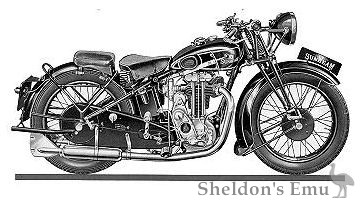
A Bright "Sunbeam" at Olympia.
Great public interest is being shown in the seventh Olympia motor cycle show in the Melbourne Town Hall. This brilliant display was opened last Wednesday, and traders report excellent business, particularly on new models. The show will remain open to-night and to-morrow.
More than 150 machines, which embody the latest developments in this branch of automotive transport, have been subjected to a keen examination each day by a steady stream of spectators. When the show concludes it is expected that all attendance records will have been shattered.
This display is thoroughly representative, and road and racing machines, solo and sidecar outfits, are included in the various classes of cycles in the general exhibition. These, with frame and engine designs and colour schemes, make the entire exposition modernistic and attractive.
Working models, cut-away engines, and the exhibition of record-breaking machines give added interest.
Developments Summarised.
Without definite direction it will be difficult for many of the crowds to-night and to-morrow to notice the mechanical and other changes that have occurred since last year, and to supplement the souvenir catalogue which will be given to each visitor, a summary of the main features has been prepared.
One make of cycle has reached the stage of having enclosed inlet valve mechanism and exposed exhaust springs and stems.
Twin exhausts are common now on overhead valve touring machines, but on racing jobs a single exhaust pipe is general.
Downswept inlet ports, providing an almost straight flow for the in-going gas, are now the rule on over-head valve motors.
250's Popular.
Coil ignition and the 250 cc. engine have advanced in popularity. With every advance in engine speed there arises the need for lightening the weight and increasing the strength of moving parts. Definite efforts in this direction are clearly discernible.
With increased speed greater stress is thrown on brakes, and brake drums are ribbed now to dissipate braking heat. Most brakes also have an annular lip to prevent ingress of water inside the drum.
Whereas a few years ago three speed gearboxes were the rule, to-day more than half the machines have close ratio four-speed boxes. Foot change is ousting hand change in popularity.
Two-stroke and four-stroke engines are examples of the survival of types each with distinctive advantages, so that different firms have become renowned for each type.
Even on small machines big section soft tyres are fitted.
Overhead camshafts, which, at some trouble and expense, make for increased efficiency, are on the way.
Unit construction has made headway, and most motor cycles feature an oil bath case to lengthen the life of the primary chain.
Progress Lacking.
Hairpin valve springs have not made much progress.
Two, three and four valve engines each have their manufacturing devotees, and the side-valve, greatly outnumbered by the over head valve, has staunch supporters in the trade and among riders.
A reverse and three forward gears on one standard machine is an outstanding feature.
One of these days the shaft drive may come to stay. Several times previously it has come, to retire again, and the chain drive, with all its objections, has continued to hold the held for popularity.
Quickly detachable rear wheels are more general, and one make features a quickly detachable front wheel.
New battery mountings use rubber to insulate the battery from vibration and shock.
Baby motor cycles can be purchased at little more than the cost of a high-grade bicycle.
About the Leading Exhibits
Inspecting the stands at Olympia yesterday technical and other information regarding the models displayed was obtained from the traders. In the following comments, which are quite apart from the stand to stand description to be published in a supplement with the April issue, the trend of the design of principal machines is apparent:—

A Creation by Veloce Ltd., England.
Four Makes on Stand 1
Machines exhibited on Stand No. 1 at this week's Olympia by Messrs. Stillwell and Parry include Velocette, A.J.S., Scott and Wolf models.
The crankcase and gearboxes of all Velo. models are highly buffed and fitted with four-speed gearboxes and foot change. In the range the outstanding jobs are the K.S.S. (350 camshaft), MAC (350 o.h.v.), and G.T.P. (250 two-stroke). The MAC was introduced last year, and has proved a most serviceable machine.
The surprise packet of the A.J.S. range is the 35/2 9.9 h.p. twin A.J.S and sidecar, which has three forward and REVERSE gears, interchangeable wheels, interchangeable cylinder heads, pan saddle and foot clutch.
An entirely new A.J.S. model (35/12, 250 cc. o.h.v. single-port, four-speed, foot change) is this year selling at £75, compared with the cost of £89/10/ for its last year's sister. Other models in this range included 35/5 (350 s.v.), 35/8 (498 De Luxe two-port 0.h.v.) and 35/9 ( 498 De Luxe s.v.). The latter machine has an aluminium detachable head, and it is optional to have a four-speed gearbox fitted.
The famous water-cooled 5.96 twin "Flying Squirrel" Scott and sidecar is now fitted with detachable cylinder head, and with the 98 "Cub" and 196 "Super Sports," "Wolves," "Velos" and "A.J.'s," "S. and P." decidedly have a range to meet the requirements of any class of rider.
Popular Levis
The most popular member of the Levis range, the 346 cc. o.h.v. model, takes on an even more refined appearance for 1935.
The cylinder is a particularly clean casting and well finned. A two-port exhaust system incorporates tubular silencers and rubber-faced leg protectors. The primary and dynamo chains are enclosed in a fine one-piece aluminium casting, while a feature of the diamond frame is a duplex top rail.
There are also 498 cc. and 24" cc. o.h.v. models with similar specification, but perhaps the greatest interest centres in the 247 cc. over-head camshaft model. This, again, is of very clean design, and is intended for high-speed work. The engine has a compression of 8 to 1, and employs chain drive for the valve gear.
New Rudge Jobs
It is safe to say that Rudges have never produced nicer-looking machines than those to be seen on the stand at Olympia this week. The detail work is very well carried out, the components are housed exceptionally neatly, the equipment is unusually complete, and the finish and appearance are most pleasing.
In the new 250 cc. Tourist model the type of overhead valve gear associated with the Rudge gives place to the conventional inclined single inlet and exhaust valves with a single exhaust port.
The engine is vertically mounted, and the Maglita ignition and lighting unit is set behind the cylinder, with a chain drive from the engine shaft enclosed in the aluminium oil-bath primary chain case.
A very neat hand control for the four-speed gearbox is arranged with the quadrant actually inside the knee-grips.
Forks with a central open spring are fitted, to this model; the links, however, follow Rudge practice, being within the fork blades.
On all Rudges the brakes are interconnected, and have finger adjustments.
Lightweight Cotton
Lightweights with a comparatively high performance are much to the fore at the present time, and the 150 cc. J.A.P. engine Cotton is a good example of the type.
Care has been given to the matter of accessibility, and the whole lay-out is practical. It has, of course, the well-known Cotton triangulated frame, and is produced in its standard form fully equipped.
There is also a 250 cc. machine, with a J.A.P. engine and three-speed gearbox.
Page 246.
O.K. Supreme Appeals
There are many features on the O.K. Supreme stand which appeal to the discriminating rider.
In the first place there is the casing which encloses both the crankcase and rear engine plates of the 246 cc. Flying Cloud models. The lowest-priced of these has coil ignition, the dynamo being housed out of sight in the rear engine plates.
Others have the latest B.T.H. mag-generator, while the Lucas rubber-cushioned accumulator is mounted on a patent mounting, whereby it can be easily swung outwards.
Interest centred round the Dauntless model, with its 250 cc. J.A.P. engine, with down-draught carburetter. This is a particularly attractive unit, enhanced in appearance by a finned exhaust pipe nut.
A touring version of the 490 cc. single-port Britannia is also on view; it is equipped with a balanced front mudguard, deep-sectioned rear mudguard, carrier and huge pannier bags.
All the O.K. range, except side-valve models, are on view. Findlay Motors are distributors.
Diverse and Attractive
The range of Triumph models exhibited by Rhodes at the Show are both diverse and attractive. There appears to be a Triumph for every conceivable purpose.
The gallant little 175 cc. o.h.v. begins the solo end of the range, and it has to its credit the 250 cc. and 350 cc. Sydney-Melbourne road speed records! The entirely new L2/1 is a snappy 250 cc. o.h.v. for fast and economical solo work. Proving very popular is the 350 cc. side-valve, and Triumph's model "3/1" is a very fine example of this type. In the 5/1 you see a duplicate of the Triumph which put up the new world's road endurance record. It is of 550 cc. capacity. The 5/4 is the sportsman's mount, fast and lively, of 550 cc.'s, with enclosed, self-lubricated o.h.v. rockers and gear.
Probably the most beautifully-made machine in the Show is the Triumph "6/1," i.e., their very interesting vertical twin of 650 cc., with overhead valves.
By the way, have you noticed the finish on Triumph machines?
Valve Enclosure for B.S.A.
Recent years have seen the trend towards cleaner motor cycling, and this year further developments are evident.
B.S.A.'s 1935 programme can be summarised as having totally enclosed inlet valve mechanism on its new 250 and 350 cc. models, and improved front forks.
Enclosure for the valves is general with new machines, and is going to mean a longer and more efficient life for motors. Worn valve guides will be less common, as the enclosure means efficient lubrication.
The two new small B.S.A. models have several features in common with the 498 cc. twin. The valve gear is operated by push-rods, which are carried between upper and lower rockers, without tappets.
Finlay Bros, are agents.
Stevens Features
Of more than ordinary interest is the re-entry of Stevens Brothers, of Wolverhampton, into the motor cycle manufacturing business. This firm formerly made a popular brand, and is now manufacturing the Stevens machine.
250 cc. and 350 cc. jobs are the models on which the distributors, Messrs. Rogers Bros., pin their faith.
The following are the outstanding features of the 350 model, the main seller of the range:—
Handlebars are mounted in rubber to reduce vibration, and foot rests are so pivoted that if they strike the ground when cornering, they will swing round and damage to them will be unlikely. Oil is pressure fed to the valve guides.
Other features are down-draft Amal carburetter, oil bath chain case, and rear stop light.
A novelty is a knurled ring on the handle bar, the turning of which dips the headlight.
Greatest Owner Loyalty
On Rhodes' stand at the Show are the new Indians—the machines which, probably, enjoy the greatest owner loyalty. It is claimed that once an Indian rider always an Indian rider. Judging by the repeat sales of the famous "redskins" there must be a lot in the claim.
Indian is represented by the powerful 12 h.p. Chief, the well-known Super Scout and the entirely new model, the Sport Scout. This latter is reminiscent of English practice in the frame and forks, with a typical "hot stuff" Scout motor.
Pressed Steel Cov. Eagle
On Stewart and Co.'s stand every catalogued Coventry Eagle is exhibited.
In the main the Coventry Eagles are of the two-stroke type, with Villiers engines of either 148 cc. or 247 cc., but one—the most expensive —was a 250 cc. o.h.v. double-port, with J.A.P. engine. Frames and forks of pressed sheet steel, with an easily cleaned exterior, still re- mains the features of these machines.
Leg guards are embodied in the frame, while the exhaust is led into an expansion chamber that covers the front of the crankcase; thence the gases pass to two large silencers, one on each side of the rear wheel.
The pipes are up or down swept on varying models.
Also on this stand was the O.E.C. 8 h.p. twin machine, four of which have been ordered by the Victorian Police Force.
J.A.P. for 1935
With engines to suit every type of motor cycle, and three-wheeler, the J.A.P. range for 1935 is an extensive as last year, and includes 28 different models, ranging from a 175 cc. racing motor to a 1100 cc. water-cooled twin.
Most alteration has been made to the popular 250 cc. o.h.v. engine, which now has a crankcase similar to the 1934 350 cc. models and a lubrication system that feeds oil to the rocker gear.
All o.h.v. motors have a 14 mm. plug, to assist cooling, and both side valve and o.h.v. types have had the fins deepened, and now carry five vertical stalks linking the finning. These stalks not only give more rapid cooling, but they lessen distortion and deaden cylinder ring.
New Lightweight Calthorpe
As handsome as ever, the 1935 Calthorpes have a new timing case and altered lubrication system on its larger machines.
The range has been added to with a 348 cc. model, which is identical with existing 493 and 247 cc. jobs. The rear part of the sump on the big model has been eliminated to make room for a four-speed gearbox, foot gear change is optional, the oil baths have been modified to make room for the chains, and the oil feed is adjustable.
Hubs have been altered and heavier spindles employed.
Australian Cycling & Motor Cycling, March 8th 1935, pp 244-246 Trove NLA
Notes
1. Illustrations are not from the original article.
2. Information on dealers mentioned may be found here: Australian Motorcycle Dealers