

Notes on some of the rarer British marques
This page lists brands for which we currently have only an historical precis.
For a more complete listing visit the British Index.
A.F. Cars
The first of these Morgan-style three-wheelers were created by Alexander Fraser in 1969 "in his kitchen" Based on a BMC mini chassis, production models were powered by BMC engines of 850cc to 1275cc some of which were fitted with a Shorocks supercharger and were capable of 140mph. They had a wooden body. Production ended in 1980, with some 7 Spiders and 5 Grand Prix models built.
Source: 3-wheelers.com.
Aleywood c.1966-1969
Allen-Bennett 1922-24
Anson
Anson Classic Restorations Limited, Shepshed
Sell sidecars and accessories, plus provide a fitting service. Based in Shepshed, Leicestershire.
"We have everything onsite to keep your sidecar outfit on the road. We have new and used sidecars for sale for both modern and classic bikes."
ansonclassic.co.uk
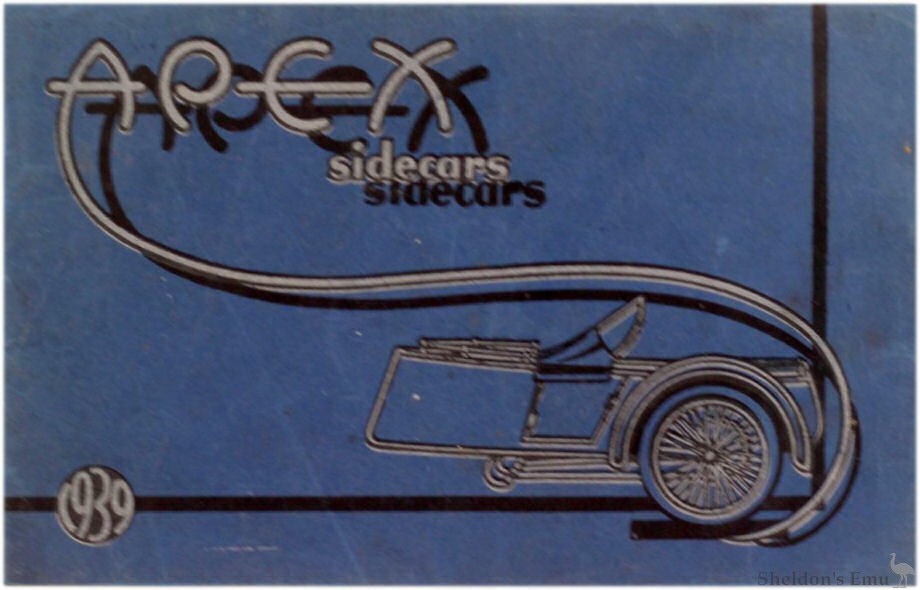
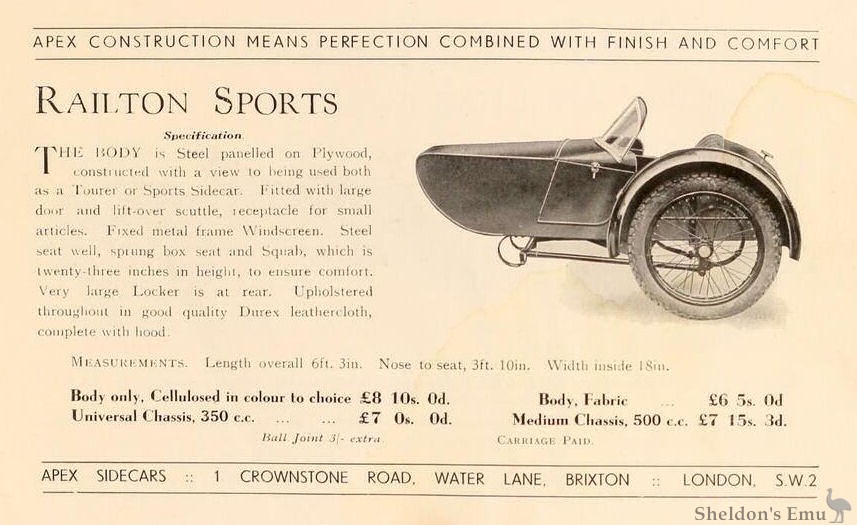
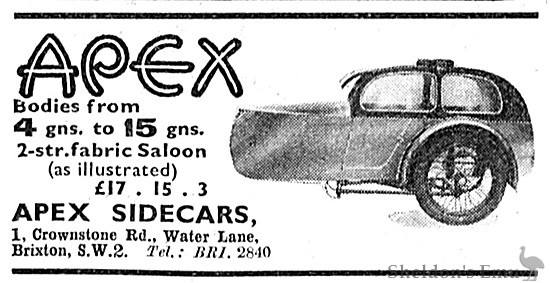
Apex Sidecars
Manufactured in 1939
1, Crownstone Rd., Water Lane, Brixton, S.W.2.
Source: Period Advertising
Armac Cub
Classic trials machines based on the Triumph Cub, these were originally built by Duncan McDonald. Components are manufactured by R.E.H Forks Ltd of Yorkshire, armac-design.com.
Armstrong Sidecars
Manufactured by Armstrong Cycles Ltd., Sherborne Street, Birmingham 16.
Built in the 1930s, their advertisements show bicycles with sidecars, and compare these with motorcycle sidecars. It appears they only made sidecars for bicycles.
Aspin
Aspin rotary valve engines were built by Frank Aspin in Lancashire, beginning in 1937. A 250cc version would rev to 14,000 rpm, but sadly it was plagued by heating problems and before a solution could be found, war came.
The engine was apparently used in speedway, as mentioned here. It was developed along similar lines to the Cross engine.
Not for many years has an unorthodox design of a new power unit for automobile and aero work created so much interest in the automotive engineering field as the "Aspin" engine evolved by the Aspin Co. Ltd. (Eng.) So remarkable is its performance in initial bench tests that one well-known English automotive expert, in Mr. L. Mantell, who is usually very conservative and not prone to over-enthusiasm at any new invention allied with motors, says that the "Aspin" power unit almost merits the word "astounding."
In discussing this engine, Mr. Mantell states that there are at the moment, two working models, one a single cylinder motor cycle engine (57 m.m. bore and 70.5 m.m. stroke) and a 4-cylinder horizontally opposed aircraft engine of 83 m.m. bore and 80 stroke. The Aspin power unit may be described as a rotary combustion head motor, because the combustion head, at least that part of it which is exposed to the flame, takes the form of a large heavy cone, shaped like an old-fashioned candle extinguisher. It terminates above and externally in a central vertical shaft which extends upwards to a suitable housing, where a double row of Timken bearings provide for its free rotation and central location. Inside this cone works an inner cone which forms the roof of the combustion chamber. As the cone is revolved, inlet and exhaust ports are i opened. First, the cone passes the inlet port, whence it receives its charge, thence to the plug aperture, where the charge is fired, then there passes a blank surface while the combustion and power stroke takes place and finally comes to exhaust port. During the cycle, the spark plug is not exposed to the full force of the explosion as in the conventional engine. The top of the pistton is crowned similarly to the shape of the cones. There are no valves or projecting points to cause hot spots, consequently abnormally high compressions can be used.
The test results from the Aspin power unit were so remarkable that one cannot do better than quote Mr. Mantell's report in the "Light Car" (Eng.) of how the little 250 c.c. motor cycle engine is capable of performing: -
“Its speed ranges from the normal minimum of which such engines are capable to 14,000 r.p.m. The power curve goes straight up to about 9,000 r.p.m. without bending and the peak is at 11,000 r.p.m., where 33 b.h.p. is generated. The consumption of fuel at 5,000 r.p.m., where about 17 h.p. is being generated, is .32 lb. per b.h.p. per hour with a maximum power setting, but. with a leaner mixture - to give a mere 12 b.h.p. at these revs. - the consumption drops to the staggering figure of .25 lb. per b.h.p. hr.
In order to realise how remarkable this is I may mention that it would require a good engine of similar capacity and type, but of orthodox design, to get as low as .5 lb. per b.h.p. hr. The compression ratio is 14:1, but there is no detonation whatever; this is impossible even with a 20:1 ratio and the engine will run almost equally well with paraffin.
Practically the whole of the burning takes place inside the cylinder. One can hold one's hand in front of the open exhaust port when on full load without being burned, and if there Is a pipe fitted It becomes only warm; not only so, but in a dark room no trace of flame can be seen at the exposed port even at the b.h.p. peak. Now comes the most amazing feature of all. The thermal efficiency of a modern production engine is around the 25 per cent. mark. It is only within fairly recent times that 30 per cent, has been attained and then only on very special engines. I do not know the exact present record for a petrol, or, rather. a spark-ignition engine with a carburettor, but it is somewhere in the early 80’s. In the Aspin engine, the full power setting produces nearly 50 per cent and the economical setting (i.e., the one giving 12 b.h.p. at 5,000 r.p.m.) rises almost to 60 per cent. I think, in fact, that "astounding" is not an ill-chosen adjective here, especially as the engine appears to be able to carry its full load for very long periods without of wear."
Needless to say, the further development of this remarkably interesting power unit will be awaited with keen interest by all those closely allied with the motor and aviation industries, for if the "Aspin" engine lives up to its early promise under severe road tests, there is little doubt that its future will be no small one, says the Dunlop Perdriau Bulletin.
Australian Cycling & Motor Cycling magazine, Nov 1937. Trove NLA
Austel 1985-1991
Automobilette 1900
A. V. Motors 1902-1903
Avon Tri-mobile Bristol, 1905
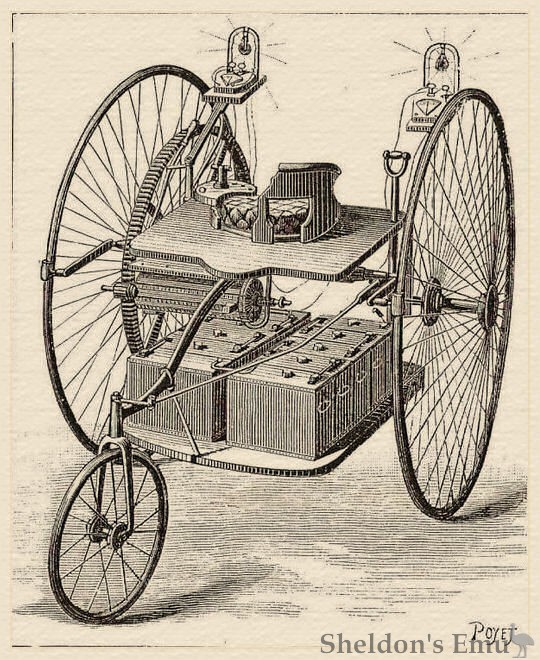
Ayrton-Perry Tricycle
"The first electric tricycle was built by British engineers William Ayrton and John Perry in 1881. It was first driven on Queen Victoria Street in London in 1882.
This image is probably from La Nature ; Poyet was one of its artists."
Source: Dave Richmond - facebook.com/dave.richmond.900
Rarer British Marques