
Bat.
As may be expected, the exhibit of the Bat Motor Manufacturing Co. will be an imposing one. The chief novelty consists of the sidecar machine, which is fitted either with a 5-6 or 7-8 h.p. J.A.P. engine.
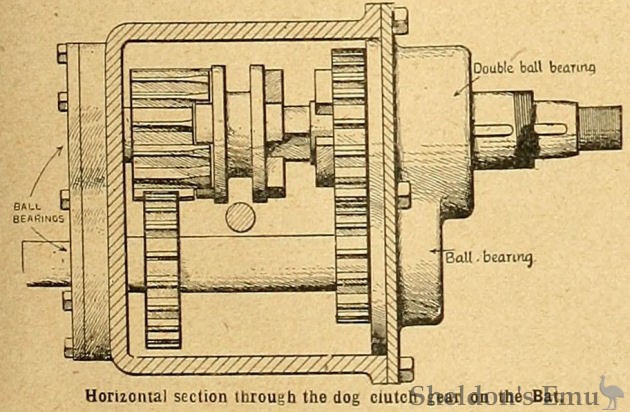
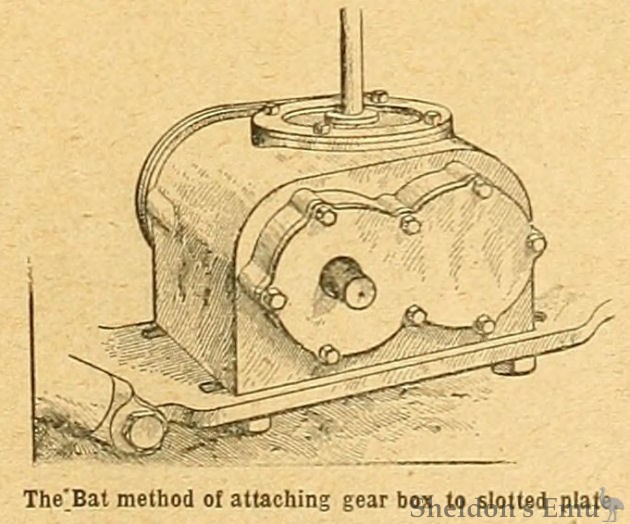
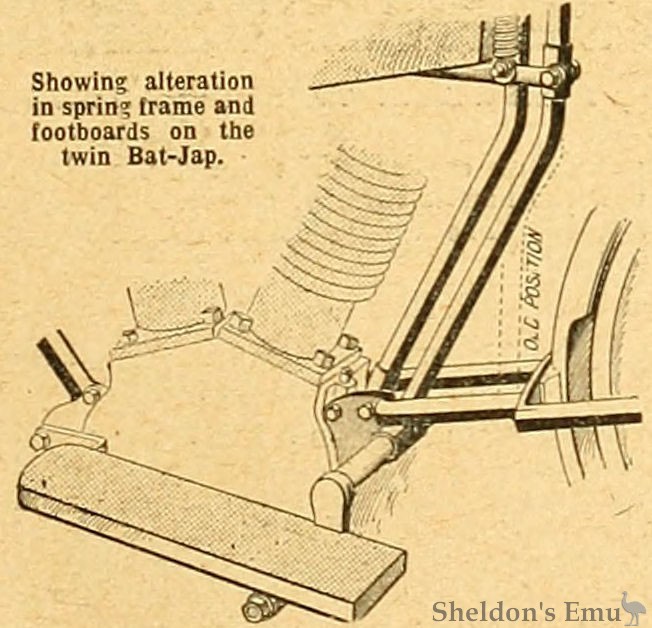
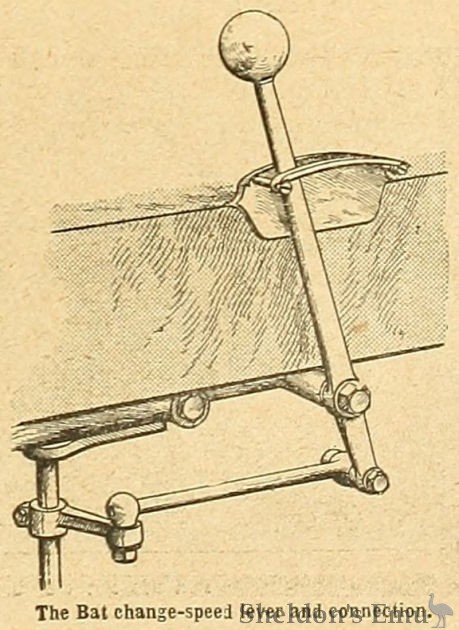
In the first place, the transmission is by chain through a counter-shaft gear box of the sliding dog clutch type. Ball bearings are fitted throughout. and on the sprocket side of the driven shaft double ball bearings are used. The clutch is in the rear wheel, and is one of the internal expanding pattern. The expanding segments are made from tire solid metal and are operated by means of wedges. Powerful spring coils pull these wedges into the splits in the phosphor bronze and expand the segments against the drum on the sprocket. Normally, therefore, the clutch is in engagement. To disengage the clutch the operating mechanism is put into action by means of inclined planes on the exterior of the clutch shaft. A ball bearing thrust is provided. The gears are changed by means of a lever on the top tube, surmounted by a wooden knot working in a quadrant. The clutch is operated by a pedal situated close to the rider's left foot. The attachment of the gear box is interesting. It is suspended on a slotted aluminium plate, webbed to add to its strength, fixed in front to the rear end of the crank case and at the rear by stays running from the ends of the back forks. The engine chain is adjusted by sliding the gear box along the slots, and the back chain by the usual type of chain adjusters A further improvement in this machine is the re-designing of the spring frame. It will be remembered that m the Bat spring frame both saddle and footrests are inter-connected. In the new type the moving portion of the frame is suspended at its lower end forward of the crank case, and it will be seen from the illustration that there is ample provision for large footboards, which provide a very comfortable position. The movable portion of the frame is held on two powerful coil springs, which not only give to the road shocks but also take the rebound. One spring is carried on each side of the top tube. The spring forks have been slightly altered, and the girders are now brazed solidly to the lugs. Side shields are fitted to the front mudguards. A crossbar is fitted to the handle-bar to add to its strength, and for the purpose of carrying accessories. 650 x 65 mm. grooved Dunlops are fitted.
The engine, with its well-known magneto drive, remains unaltered, and the B. and B. carburetter is fitted in all cases. Altogether the machine is well designed throughout, and the finish is excellent.
The single-cylinder 3½ h.p. Bat continues to be fitted with the P. and M. gear, and the latest type control is now employed. On this the spring frame follows the 1911 lines, but a new and improved type of spring is used.
The Bat exhibit will include all the models the firm manufacture, including a new 8 h.p. T.T., 90 x 77 mm., fitted with overhead valves, and a 5 h.p. T.T., 85 x 65 mm. In these T.T. models the magneto is carried low down in front of the engine.
1911 Olympia Show - The Motor Cycle November 16th, 1911. Page 1219
BAT, No. 63.
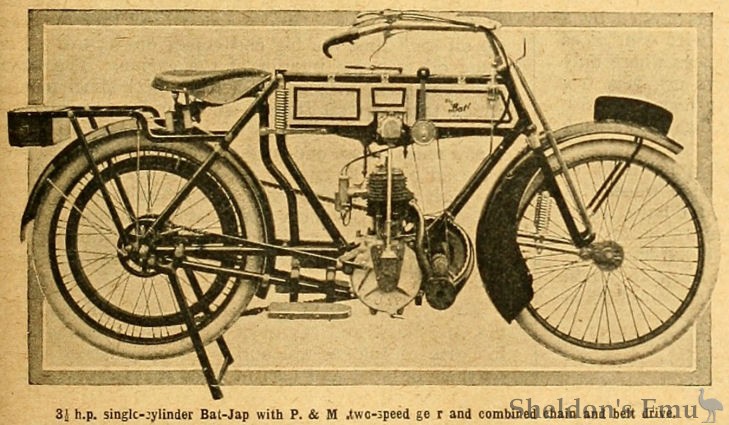
3½ h.p. single-cylinder Bat-Jap with P. & M two-speed gear and combined chain and belt drive.
The BAT Motor Mfg. Co., Kingswood Road, S.E. – The chief improvements in the Bat were described in our last issue. Among these we may mention the latest type of control and the P. and M. gear, while it must be recorded that the chief features in this and other Bat models are the insulating of the rider from road shocks by means of the well-known Bat spring seat and footrests, the neat method of carrying the magneto in a compartment of the tank, and driving the armature by means of a vertical shaft and bevel gearing.
Similar to the above is the standard model, which is single-geared.
The T.T. model has a 3½ h.p. J.A.P. engine, 90 x 77½ mm., and other particulars as above. In this type of machine the magneto is carried in the front of the engine and is chain-driven. The frame is dropped at the rear, while a cylindrical tank and rigid forks are fitted.
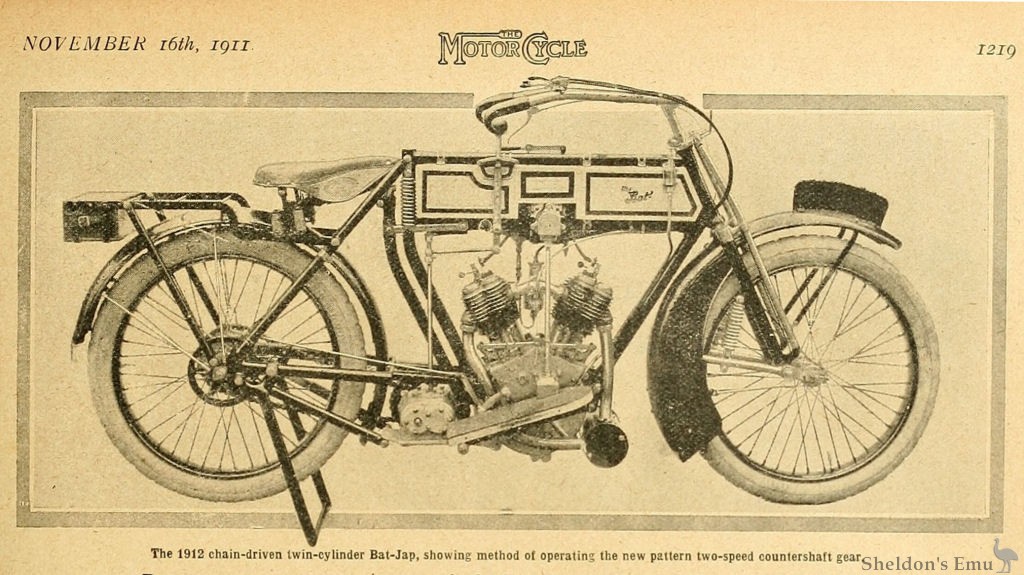
The 1912 chain-driven twin-cylinder Bat-Jap, showing method of operating the new pattern two-speed countershaft gear.
The 5-6 h.p. and 7-8 h.p. twins are similar in detail. The latter model was fully described in our last issue, and is especially designed for sidecar work.
Particularly to be noticed in the chain-driven model is the improvement in the Bat spring frame.
As regards the twin T.T. machine, there are two types, the 5 h.p. and 8 h.p. T.T. models, 85 x 60 and 90 x 77½ mm.; inlet and exhaust overhead; B. and B. carburetter; belt drive. The firm are especially to be congratulated on the efficient manner in which their machines are displayed. Placed as they are on special stands, they may be inspected with the greatest facility. Altogether the Bat exhibit is a most imposing one.
1911 Olympia Show - The Motor Cycle November 23rd, 1911. Page 1260