

Old Machines and Their Performances
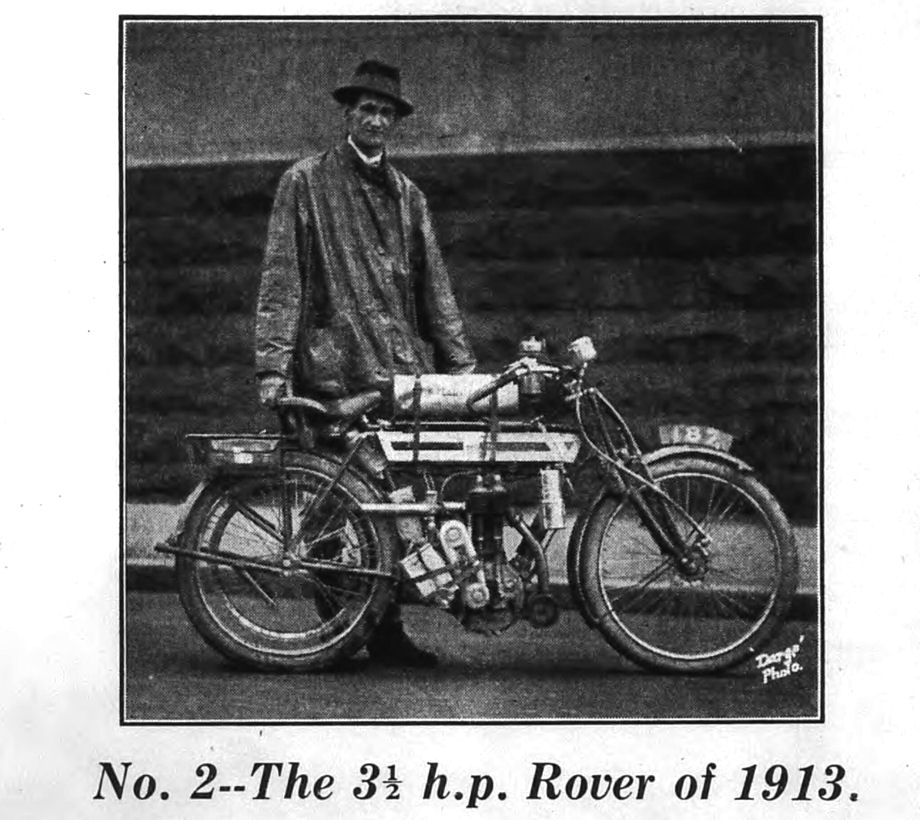
HOW would you like to ride from Sydney to Melbourne on this iron steed - the 3½ h.p. Rover of 1913? Well, Eric ("Longy") Tyler (pictured above with the Rover) did it in Feb., 1913, and smashed the then existing Sydney-Melbourne record by 1 hr. 15½ min., his time being 24 hr. 39½ min.
The Sydney-Melb. record now stands to the credit of W. Ousley (Indian Super-Scout) at 13 hr. 41 min., while the Melbourne-Sydney record is held by Ces. Weatherby (A.J.S. Twin and sidecar) at 13 hr. 31 min.
The 3½ h.p. side-valve Rover, piloted by Tyler, was a very much different mount to the modern motor cycle. Its specifications indicated fixed engine, direct drive, 26 x 21 high pressure tyres, and band-shoe rear wheel brake. The oil feed was effected by hand pump, which had to be operated every two miles, while the flat out speed was 40 m.p.h.
Tyler's record ride was certainly an epic in human endurance. The roads between the two capital cities for most of the way were little better than bush tracks, and the trip gave Tyler a buffeting that he will never forget. The riding "comfort" was of such a nature that on arriving at Benalla Tyler had to rest for half an hour an account of his aching back. He later experienced partial engine seizure, and beneath the blazing sun had to take the engine down and reassemble it on the roadside. He pushed the machine up practically every rise which really could be called a hill. Just imagine what a time Tyler had on that blistering day in February - with the fixed engine!
The Rover, however, despite its now comparative bad points, was a gallant old stager in those days, for Tyler also rode it in the Sydney to Melbourne reliability trial, finishing with full points, and also piloted it to victory in several notable speed events.
Australian Cycling & Motor Cycling magazine, May 28th 1931. Trove NLA
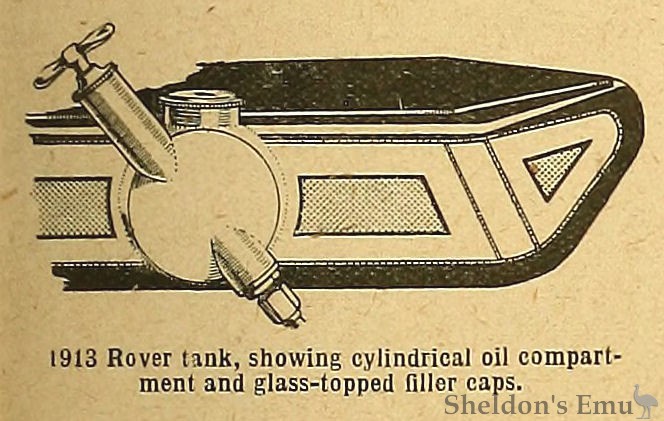
1913 Rover tank, showing cylindrical oil compartment and glass-topped filler caps.
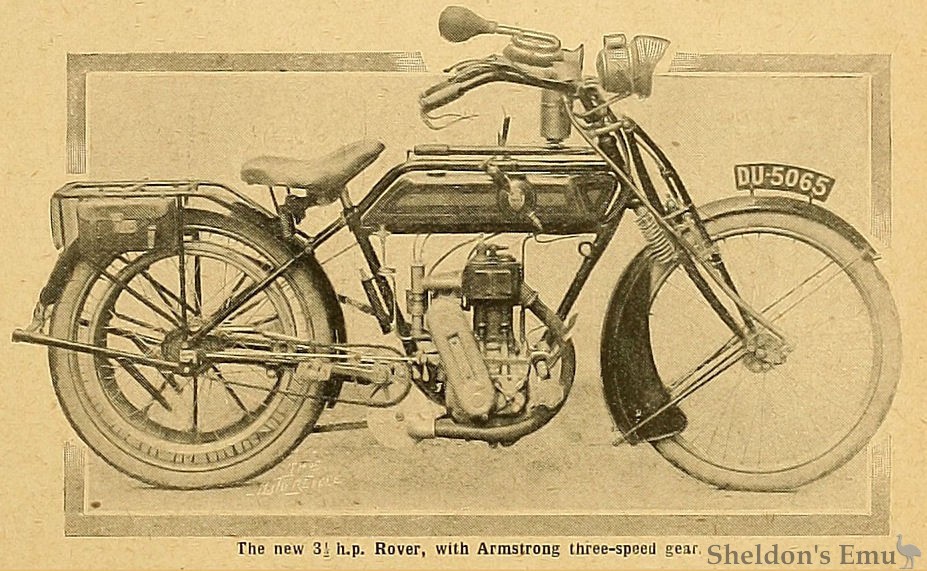
THE Rover Co., Ltd., have found their present models so satisfactory, as proved by achievements in competition, that they do not intend to make any radical changes; they are, however, modifying all their types. We have been privileged to examine the first of the new touring 3 ½ h.p. models, and found that several minor improvements had been carried out.
The petrol tank has an increased capacity and neatly rounded corners, the top and bottom edges being enamelled black with the usual Rover red panel on aluminium ground between. The tank is now supported by two brackets from the under side, and a steel pressing let into it forms a non-leakable oil compartment. The top bar of the frame has been slightly raised to accommodate the larger tank, but the saddle height remains the same.
Sidecar lugs are now brazed to the frame, and the company are constructing a sidecar of their own. The 85 x 88 mm. engine remains practically the same, though some of the bearing surfaces have been increased, and the machine we inspected was fitted with a neat Rover leg guard round the valve chest. A large diameter silencer is fitted under the bottom bracket, to which the gases are led by a long pipe and have their egress through another pipe of smaller diameter on the opposite side. This silencer is, however, at present in its experimental stage, and may be somewhat modified.
The new Armstrong gear is fitted to the rear wheel, which is covered by a wide, quickly-detachable mudguard attached to the carrier. Substantial stands are fitted to each wheel. Great care has been bestowed on the design of the brakes; the front has an improved type of shoe fitted, while the leverage to the rear brake has been materially increased.
The model illustrated is not finished in the standard colours, but gives a good idea of the lines of the Rover Company's latest production.
The Motor Cycle October 31st, 1912. Page 1225
Notes
The photograph of Eric Tyler is by Algernon Darge, using a glass-plate negative. Some 19,000 of his negatives are in the possession of the Australian War Memorial, and more are at the State Library of Victoria. Darge was a keen motorcyclist, and the quality of his photography was of a very high calibre. The clarity of the original (this is a copy of a copy of a copy) would show the man and machine in fine detail.
If you have further information or a query related to Rover motorcycles, please contact us