
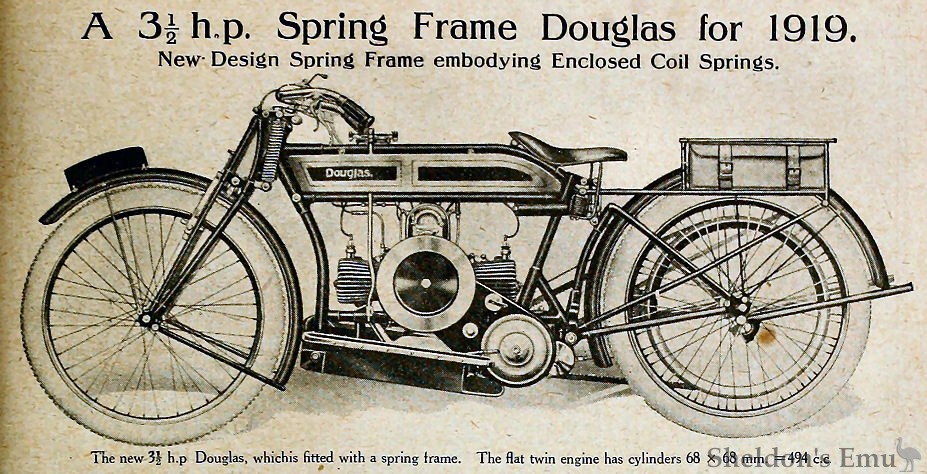
The new 3 ½ h.p Douglas, which is fitted with a spring frame. The flat twin engine has cylinders 68 X 68 mm. = 494 c.c.
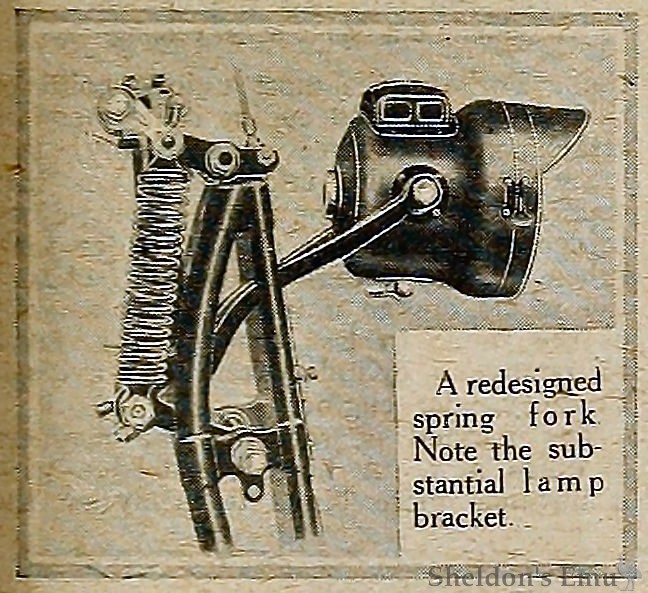
A redesigned spring fork. Note the substantial lamp bracket.
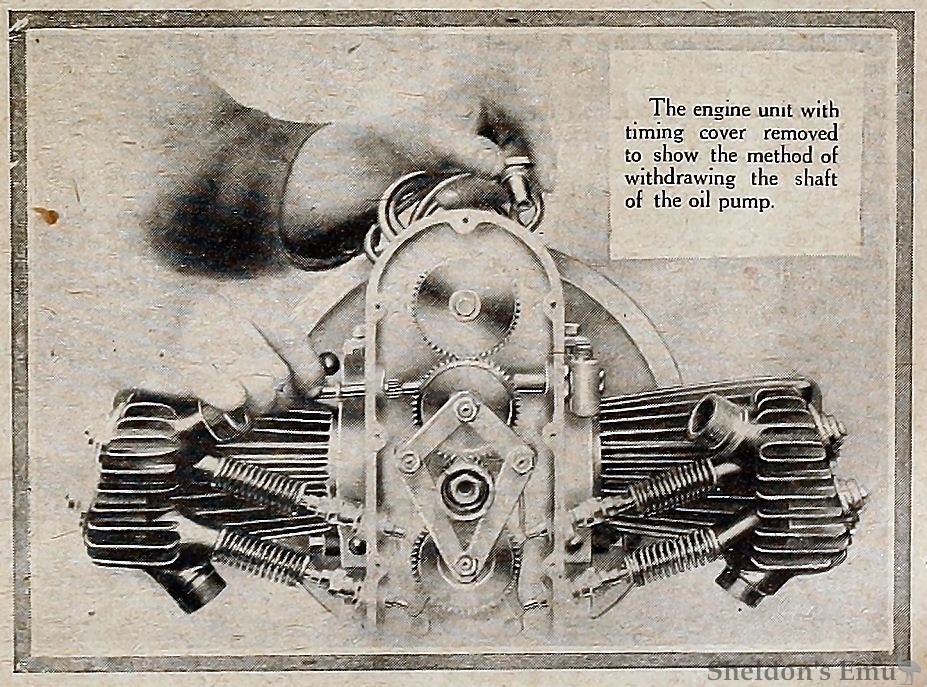
The engine unit with timing cover removed to show the method of withdrawing the shaft of the oil pump.
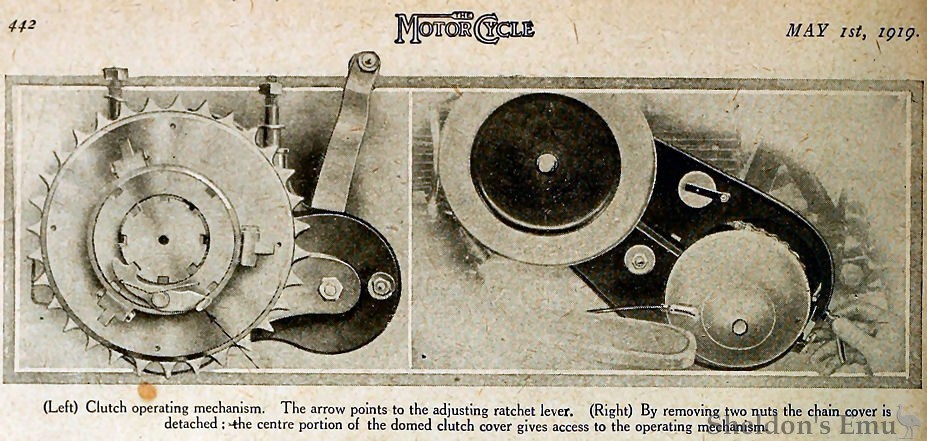
(Left) Clutch operating mechanism. The arrow points to the adjusting ratchet lever. (Right) By removing two nuts the chain cover is detached ; the centre portion of the domed clutch cover gives access to the operating mechanism.
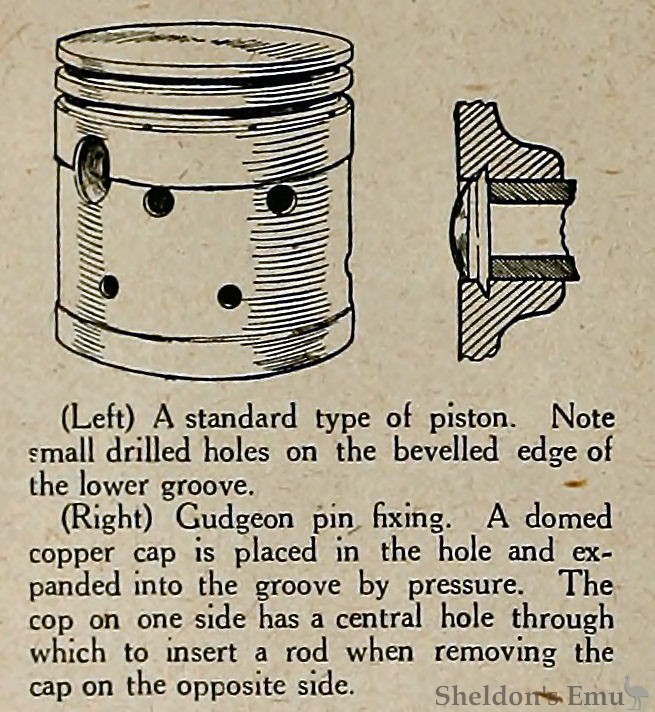
(Left) A standard type of piston. Note small drilled holes on the bevelled edge of the lower groove.
(Right) Gudgeon pin fixing. A domed copper cap is placed in the hole and expanded into the groove by pressure. The cap on one side has a central hole through which to insert a rod when removing the cap on the opposite side.
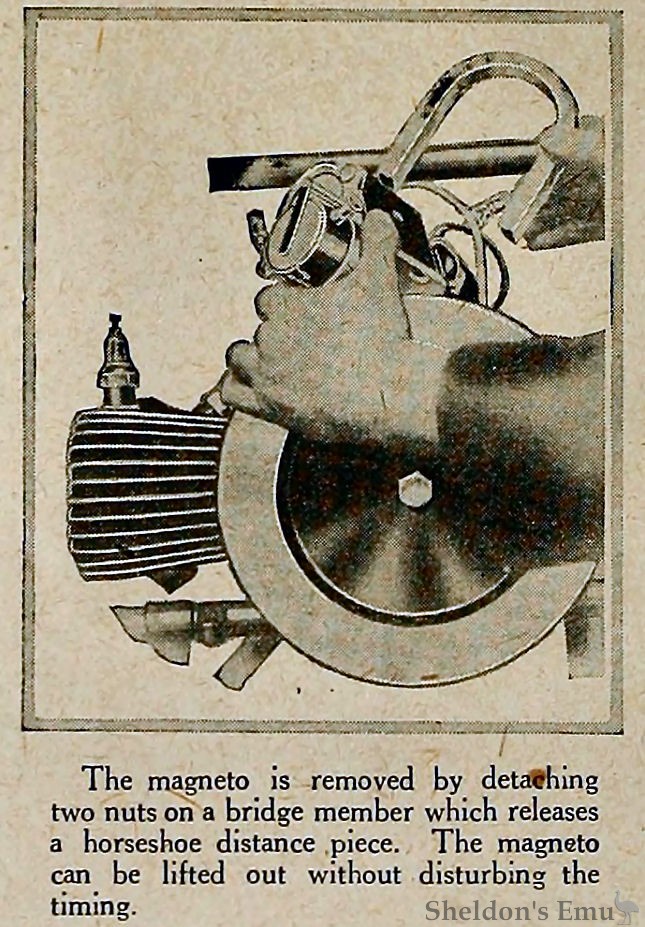
The magneto is removed by detaching two nuts on a bridge member which releases a horseshoe distance piece. The magneto can be lifted out without disturbing the timing.
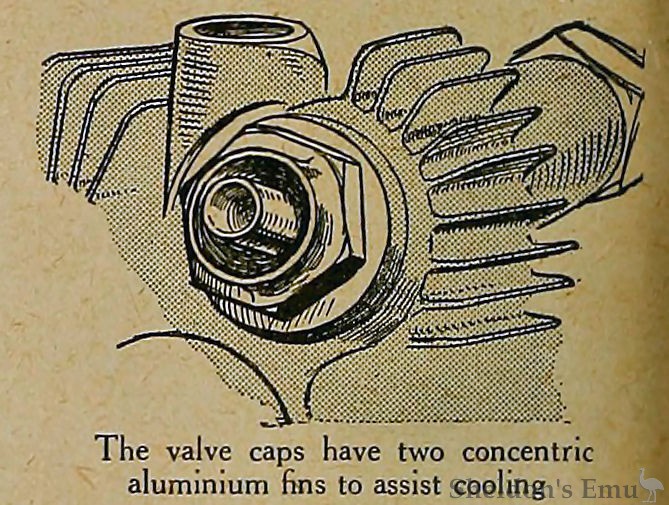
The valve caps have two concentric aluminium fins to assist cooling.
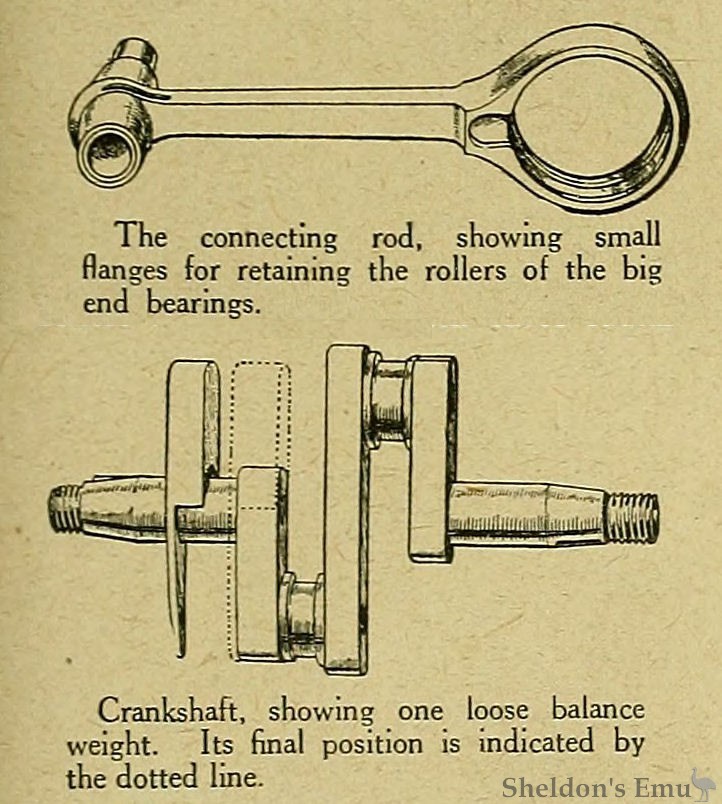
The connecting rod, showing small flanges for retaining the rollers of the big end bearings.
(Below) Crankshaft, showing one loose balance weight. Its final position is indicated by the dotted line.
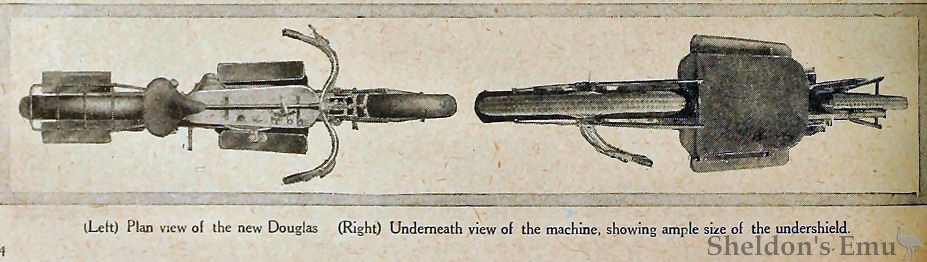
(Left) Plan view of the new Douglas (Right) Underneath view of the machine, showing ample size of the undershield.
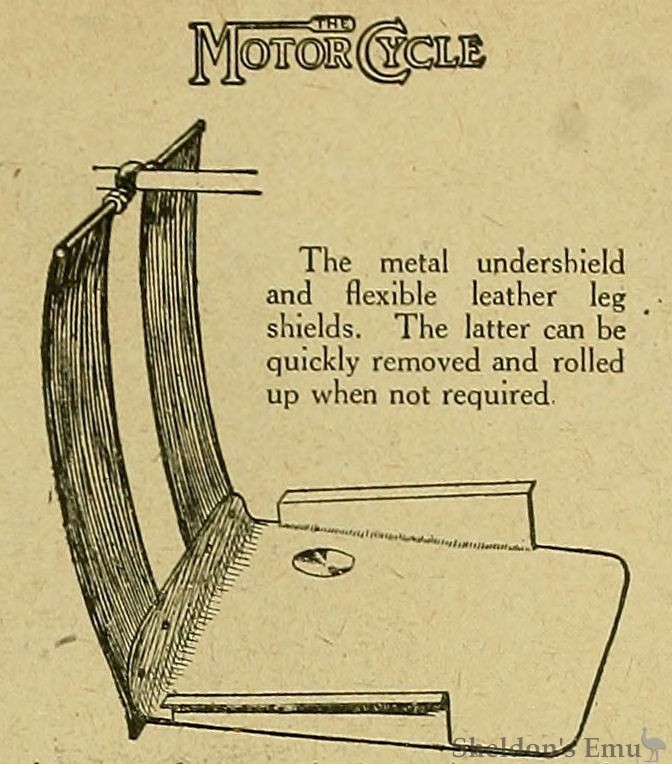
The metal undershield and flexible leather leg shields. The latter can be quickly removed and rolled up when not required.
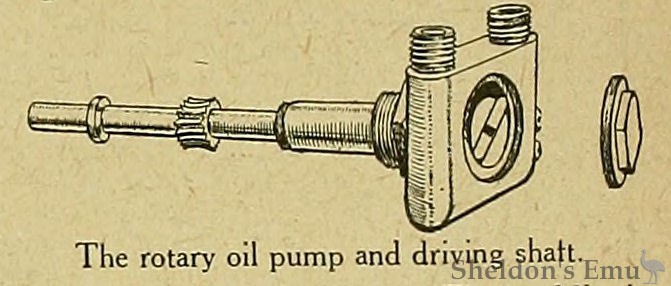
The rotary oil pump and driving shaft.
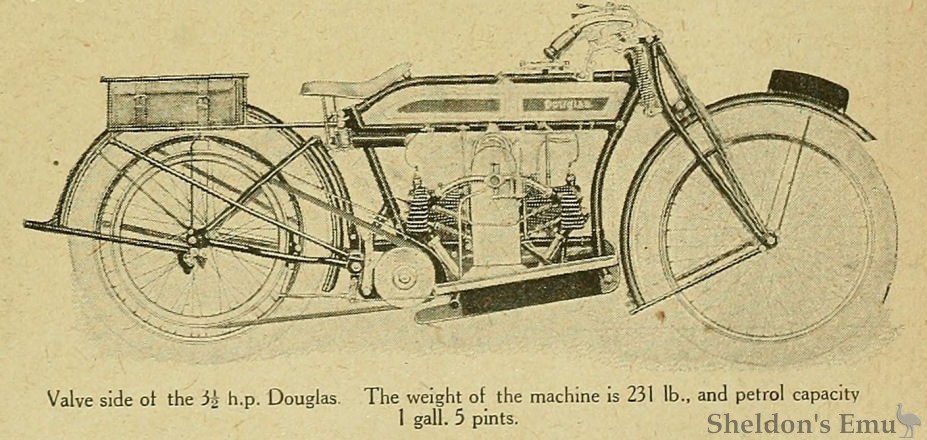
Valve side of the 3 ½ h.p. Douglas. The weight of the machine is 231 lb., and petrol capacity 1 gall. 5 pints.
New Design Spring Frame embodying Enclosed Coil Springs.
WORLD-WIDE is the reputation enjoyed by Messrs. Douglas Motors Ltd., of Bristol, the pioneers of the flat twin. A general engineering business, with a speciality in boot and shoe machinery, and an intelligent anticipation of the motor cycle needs of the public in taking up a small flat twin lightweight proved to be the foundation of the present important branch of the motor cycle industry. Then followed a remarkable run of success in competition on road and track, culminating in a still more notable success on war service on all fronts. Such in brief is a summary of the qualifications and experience behind this latest production, the 3 ½ h.p. Douglas.
It is extraordinary how, in the early days, environment considerably affected the design of motor cycles. In this connection the firm claim that their factory, situated as it is in the hilly West, gives them a considerable advantage over many other manufacturers in the matter of testing. They argue that if a motor cycle will give efficient service in the West Country it may be relied upon to do so anywhere, and many who know the Bristol district well will agree.
Though retaining the general Douglas outlines, the 3 ½ h.p. mount introduced for 1919 is in fact a complete redesign in every part. New as it is to the ordinary rider, the firm have subjected the model to extensive road tests during many months, and now offer the 3 ½ h.p. as a proved design, representing the result of their accumulated and unique experience.
The Engine Unit.
The volume swept by the pistons is a shade under 500 c.c, each cylinder being 68x68 mm., and it is to be nominated 3 ½ h.p., but, of course, develops more. The valves, inclined side by side on the right hand of the unit (differing from the 4 h.p. models, which are on top), are operated through links by single cam wheel, one cam lifting the exhaust valves and the other actuating the two inlet valves. An intermediate wheel carries a worm driving, at right angles, a small rotary lubricating pump running at one-twentieth engine speed, situated on the side of the crankcase near the top, thus admitting of very short oil pipes being used.
A hand pump and sight feed is interconnected with the rotary pump, and one lead only is given, that being to the front cylinder.
The magneto pinion wheel, independently mounted, drives the magneto by a single dog ; removal is facilitated without disturbing the timing, and it is impossible to replace the magneto incorrectly.
It is interesting to observe the position adopted for the plug, i.e., between the inlet valve and cylinder head.
The cylinders differ slightly from former models, the horizontal fins tapering towards the base, whilst unusually large cylinder ports are provided. The extent of the offset is not so pronounced as hitherto, a little wider offset at the small end of the connecting rods being necessitated thereby.
Douglas standard type pistons are employed with two top rings only. On the lower edge of the lower groove a bevel is formed, through which is drilled a number of small oil holes leading to the interior of the piston. The interior of the piston is webbed.
Main shaft and connecting rods form a very neat item ; the roller bearing big ends are ingeniously constructed with small flanges to retain the rollers, a depression being provided on the rod to assist assembly ; the addition of loose flanges is thus obviated. Balance weights are fitted and absolute tightness is ensured by wedging surfaces and one bolt in each web. The main bearings may be either ball or roller, provision being made for either type.
Concentric aluminium fins are fitted to the valve caps to assist cooling, and very light, easily adjustable tappets are another good point.
An Amac carburetter of the type favoured by this firm, i.e., with exhaust jacketed vaporising chamber, is coupled up to external induction pipes ; the incorporation of an induction chamber is the timing case was made the subject of experiment, but did not offer advantages to balance the increased cost of production. Perhaps the most unique point of this newly designed engine is its mode of attachment at three points only, two lower frame bolts and one upper bolt connecting the magneto holding-down bridge to the centre of the under tank tube. The advantage lies in the fact that the whole engine unit can be taken out of the frame in less time than it takes to remove a cylinder from the average single-cylinder engine.
The method of securing the magneto is quite new. A horseshoe bridge with a distance piece binds it firmly on the top of the crank case, and also represents the third point of engine attachment just mentioned. Each of the three nuts is instantly accessible.
Provision is made for the installation of a Lucas lighting dynamo, the drive being taken from the magneto pinion ; a new timing case cover and magneto bridge are necessary with an extension to cover the dynamo drive. This item forms an extra to the standard specification.
Combined chain and belt transmission is still used, not without due consideration of the claims of chain, belt, or shaft drive. A Renold ¼in x 5/8in pitch chain is employed between engine and countershaft, the enclosing chain case being oil tight, yet very easily detachable ; whilst both chain and clutch run in an oil bath.
Countershaft Three-speed Gear.
The ratios adopted are : Top gear 5.1 to 1, middle 7.8 to 1, and low 11.9 to 1. The gear has been completely redesigned, but on the same principles as that formerly fitted on Douglas models ; the chief innovations are the clutch and enclosed kick starter. The clutch is of the cone type, cast iron to mild steel, running on a ball bearing. The chain wheel carries six cone taper surfaces, three on each side, engaging with corresponding surfaces on the inner and outer plates, whilst each face has oil conveying grooves formed upon it. A 50 lb. double central helical spring engages with three radial levers on a floating ring ; these provide a 3 to 1 leverage, and the operating mechanism provides a 4 to 1 leverage, thus giving very easy control. No tools are necessary for adjustment, a ratchet lever, operated by hand, remaining in situ on the clutch. The domed cover and the gear box casting are in aluminium with dull smooth finish. The combined attachment for the clutch control lever and exhaust lifter to the handle-bar is particularly neat. The final drive is by a 7/8 in. belt, which is protected by a metal shield.
P443
The New Spring Frame.
Steel lugs are employed, bored from the solid stampings, the head being a particularly strong point. The Douglas spring frame, which we have previously noted as a patent, is a complete departure from their former practice, laminated springs being abandoned in favour of helical springs. The rear frame is pivoted behind the gear box bracket on a very wide, hardened and ground plain bearing ; the upper point is connected through an ingenious pair of levers, whose function is to reduce movement, to a pair of enclosed helical springs placed horizontally on each side of the saddle lug. These springs (each being made up of two concentric springs) act in compression, and adjustment is provided to suit different riders' weights. Approximately, 3in. movement of the wheel is reduced to about ¼ in. on the springs. The carrier is sprung with the frame. Means of lubricating all moving parts are provided.
For three years this spring frame has been under test by the Douglas firm, and so satisfactory is it in the comfort provided, hard wearing capabilities, and absence of lateral movement, that it takes a definite place in their future programme. Wheels and tyres are 26in. x 2 ¾ in.
Mudguarding.
Special consideration has been given to mudguarding. There are deep valances on wide guards to both wheels, a substantial undershield with side valances fitting to the inner edge of the footboard, and, if required, flexible leg shields attached to a cross bar on the top tube. This cross bar is only dropped on, no fastening, the shields being buttoned down tightly to the front flange of the undershield.
The rear brake operates on the belt rim from a right pedal through a compensating lever, whilst the front brake is of the conventional stirrup type. The saddle is fixed to the frame, adjustment for riding position being at the footboards.
The new tank, a variation of the 4 h.p. type, has a petrol capacity of one gallon five pints, and of lubricating oil two and threequarter pints. The gear control lever is in the usual Douglas position over the tank, and the vertical control rod passes through the tank.
As a solo mount with empty tank the machine scales 231 lb.
We hope shortly to avail ourselves of a proffered trial of one of these new 3 ½ h.p. machines, which, combined with a redesigned 2 ¾ h.p. lightweight and the 4 h.p. sidecar model, will form the Douglas range in 1919.
The Motor Cycle May 1st, 1919.
See also: Douglas 1919 6 h.p.