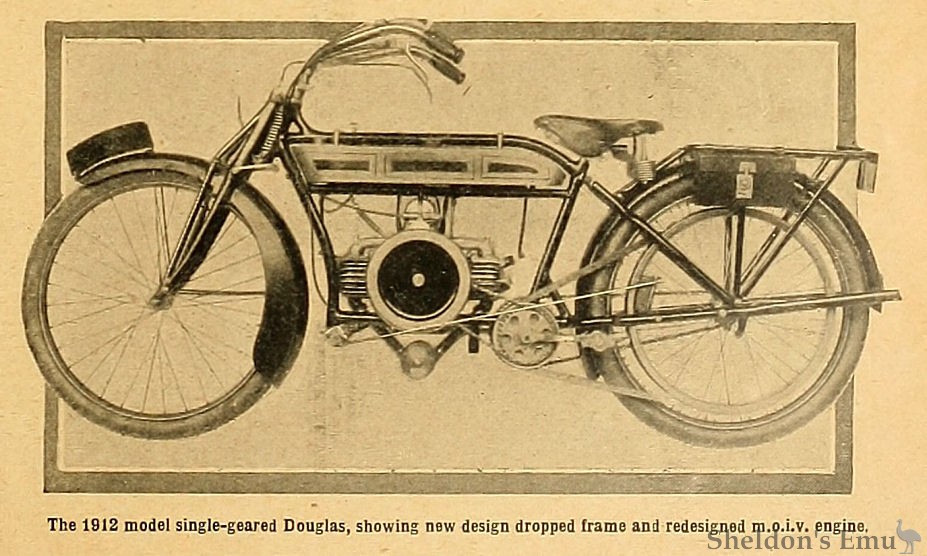
The 1912 model single-geared Douglas, showing new design dropped frame and redesigned m.o.i.v. engine.
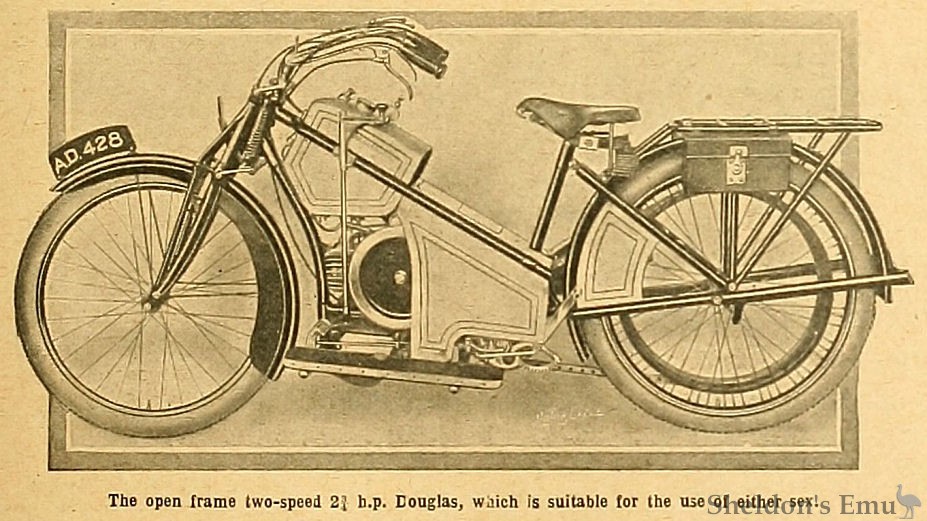
The open frame two-speed 2 ¾ h.p Douglas, which is suitable for the use of either sex.
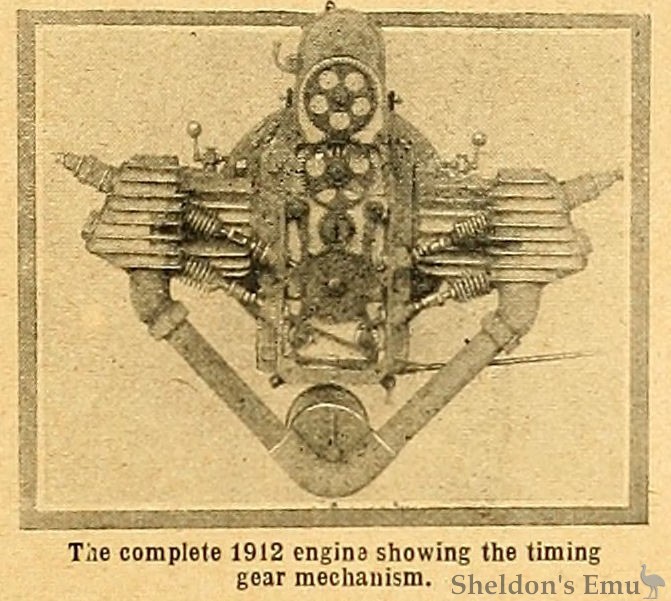
The complete 1912 engine showing the timing gear mechanism.
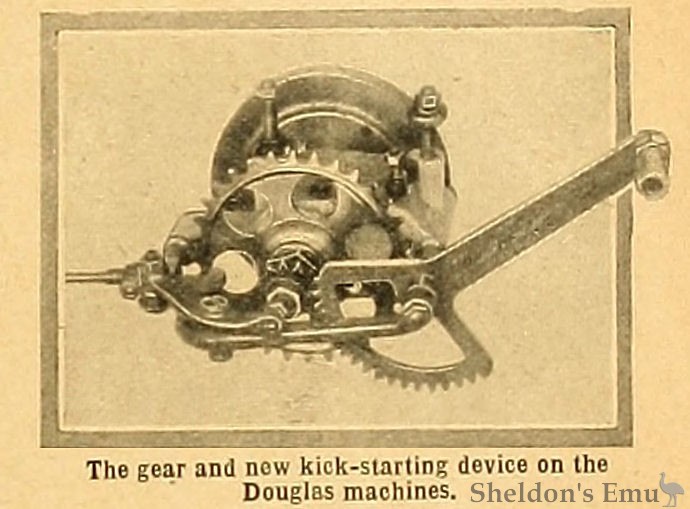
The gear and new kick-starting device on the Douglas machines.
2 ¾ h.p. Engine, Side-by-side m.o.i.v. standardised for 1912.
LAST week we examined the new model Douglas machines, which possess a number of novel features which should gain for these popular little mounts a still bigger vogue. Briefly the improvements consist of a gracefully dropped frame, enabling an exceedingly low saddle position, and an entirely new engine with side by side mechanically operated valves. Again. Messrs. Douglas Bros. have adopted the wise plan of specialising on one model engine, that is the 2 ¾ h.p. horizontal twin-cylinder, which they have found to answer all requirements, for, in conjunction with the excellent two-speed gear, which long ago proved its worth, the 2 ¾ h.p. stops at nothing, and it will be remembered repeated its consistent successes in, probably, the most severe trial on record, viz., the Yorkshire six days' trial.
We mentioned some weeks ago that Mr. W. W. Douglas had had a 5 h.p. twin built for his own use from one of the engine sets which are made specially for the Marconi Co., but. despite statements to the contrary, we have the assurance of the makers that it was never their intention to market this machine. Nor would such a policy be justified in view of the sustained and constantly increasing demand for the 2 ¾ h.p. model.
Four different types in all will be listed, each with identically the same power unit. These are: 1, a single-speed mount; 2, two-speed, 3, two-speed and free engine: and 4, an open frame mount with two-speed gear.
The New Design Engine.
The engine has been redesigned throughout, but remains of the same capacity as heretofore, i.e.. 60x60 mm. = 340 c.c. The advantages of mechanically operated inlet valves in the matter of slow running and reliability have not been lost sight of, and in the 1912 engine we have a clean design with a noticeable absence of push rods and bell cranks. Instead there is a central cover devoid of excrescences which encloses the valve gear, magneto transmission, and exhaust lifter mechanism, and emerging from each side of the casing are sloping tappets, adjustable by means of locknuts. The valves, as will be seen, are also inclined.
In previous Douglas engines, the timing gear was carried inside the crank case, so that this exterior box may be regarded as an outstanding improvement, for by merely taking out five screws the cover plate may be removed, exposing all the parts ever likely to need adjustment. The valves themselves are larger in diameter and tapered at the most vital point under the head. The crankshaft is mounted in Hoffmann ball bearings.
A single silencer will be used in future, and its position, immediately under the crank case, exactly balances to the eye the position of the magneto on the top, giving the tout ensemble a most symmetrical appearance. The new method of fixing the induction pipe on the top of the cylinders and the inclined sparking plugs at the upper portion of the head, where they have been rendered more accessible, will he noted from our illustrations. The cylinders are now detachable without the necessity for dismounting the crank case from the frame.
Other 1912 Innovations.
There will be no direct drive Douglas in future. It has been found with the two-speed model that the large pulleys render belt adjustments so infrequent that the single-geared mount will have a chain reducing gear from engine-shaft to counter-shaft to permit of a large diameter belt pulley. A notable departure in connection with the two-speed mount is the provision of a kick starting apparatus. A rearward dig of a crank with a toothed quadrant meshing with a small pinion gives several revolutions of the engine which should be an ideal arrangement; ease of starting was always an attractive feature of the Douglas. The operation of the clutch is much more convenient on the two-speeder. Instead of a pedal in the region of the crank bracket a toe and heel pedal is mounted on the front footrests, or at the front footboards as the case may be, the foot brake having been transferred to the right hand side. To enable this method of operation, the leather to metal clutch has been redesigned and fitted on the right hand side of the machine, the final belt drive also being on that side.
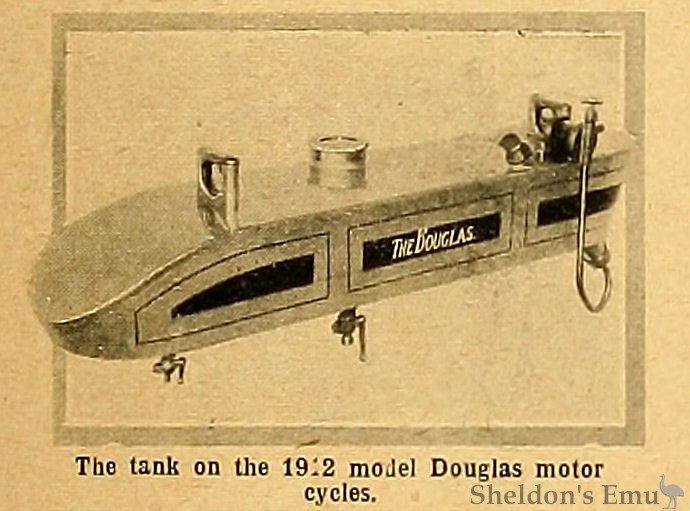
Further modifications are an oil pump, the working of which may be seen at a glance, for after leaving the pump barrel the oil is delivered through a glass gauge mounted on the top of the tank. Further, it is not necessary to press the plunger down after drawing in a charge of oil, for an enclosed spring gradually returns the plunger to its normal closed position, its action forcing the oil, via the sight feed, to the engine. A glass top petrol filler cap of large dimensions is used. Lycett pannier bags with an improved locking arrangement complete the equipment of the 1912 Douglas.
The Motor Cycle October 26th, 1911. Page 1129
DOUGLAS, No. 144.
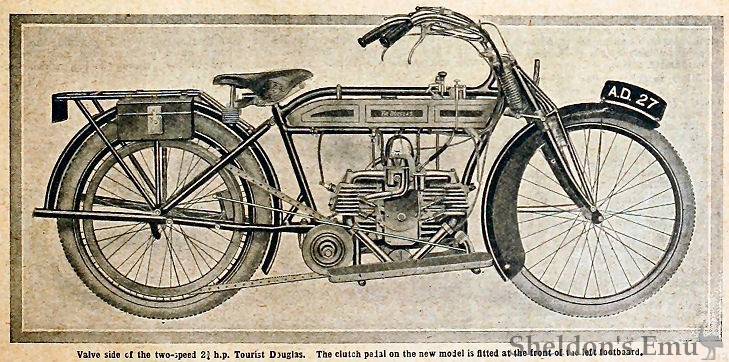
Valve side of the two-speed 2¾ h.p. Tourist Douglas. The clutch pedal on the new model is fitted at the front of the left footboard.
Douglas Bros., Kingswood Bristol. - Most of the many Douglas improvements have been fully illustrated and described in recent issues. Two models in addition to the above are shown, viz., a fixed gear machine with chain drive to the counter-shaft, and belt drive to the back wheel, the belt in all models being carried on the right-hand side of the machine. The third model is of the open frame type, and is intended primarily for ladies' use. The design is thoroughly neat and workmanlike looking. The frame is considerably strengthened by having a double diagonal tube which in the front supports the oil and petrol tanks and lower down the casing which completely covers the engine. In this casing there is a trap door through which the back cylinder can be primed. The engine cover entirely prevents the possibility of a skirt becoming entangled with the flywheel. This machine has a two-speed gear and foot starter, both of which devices have been thoroughly described. Amongst minor improvements to all models may be mentioned the very sensibly arranged pannier tool-bags, which are set below the carrier so as to facilitate access to the bags when a suitcase is on the carrier. A generator bracket is brazed to the centre of the handle-bars, large filler caps with glazed lids are provided, and the lubrication is by drip feed through a glass barrel. The Douglas machines have earned an enviable reputation for reliability in all the long distance trials, particularly in the A.C.U. Six Days' events.
1911 Olympia Show - The Motor Cycle November 23rd, 1911. Page 1257
If you have a query or information about Douglas motorcycles please contact us