At the age of 12 Bruno Rossati began working eleven hour days.
"Now, approaching 91, I find myself reminiscing about my youth, still riding my motorcycle every day.
Letter re Ladetto

This page lists brands for which limited information is available. For a more complete listing visit the Italian Index.
See also Obscure Italian Marques.
Carpio
Manufactured 1930-1935
Used 98cc and 124cc Aubier-Dunne and Stainless engines
Source: Tragatsch p101
Cavallino Bologna & Milano, 1950s
Cerbiatto

Manufactured in Bologna by M. Ceneri
Late 1940s to early 1950s, these were cyclemotors using Mosquito engines.
Cerbiatto = fawn
Sources: BuyVintage.com, et al.
Chizzolini
Built by the brothers Carlo, Emilio, Vittorio and Angelo Chizzolini at Via San Martino, Brescia in 1897, the Chizzolini Vetturetta was powered by a twin-cylinder 211cc De Dion-Bouton engine which gave the 4-wheeler a maximum speed of 12 km/h.
Sources: velocetoday.com, epocauto.it
Ciclominima
Manufactured by Ciclominima, Piazza Italia, 3, Perugia
Technical specifications: Machine weight approx. 26 kg; Engine displacement 49 cc; 2-speed transmission; Top speed 35 km/h; Normal fuel consumption 1 litre per 75 km; Gradient climbing ability (without pedaling) 10%.
Source: velopedia.online
CIMT Gribaudi Sidecar
Displayed at the 1947 Milan Show, as reported in The Motor Cycle December 1947 issue. Superbly styled, the sidecar has adjustable suspension.
C.I.M.T. Gribaudi Sidecar 1947
Source: South-Bohemian MC Museum

City Coco Italia
Via Antonio Gramsci 6, 51037 Montale Pistoia Italy
Associated with Mangosteen, Alrando, Ottobike, Tinbot, Nicot, Ovabike, DoboRacing and Alcor Tecnica.
Website: citycocoitalia.it
FB: fb.com/citycocoharley
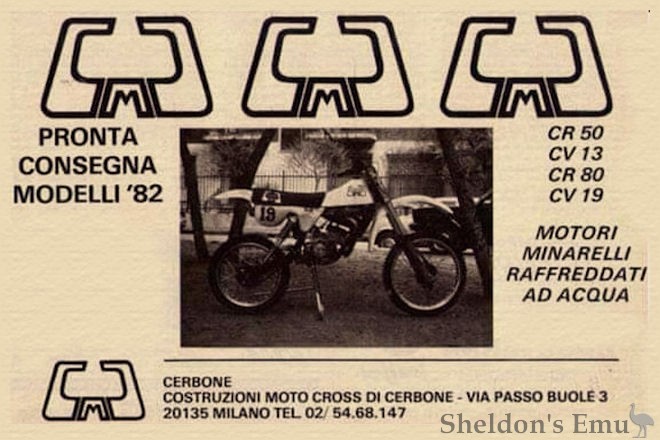
CMC Cerbone
Manufactured by Costruzioni Motocross Cerbone, Milano, c.1979-1989
Italo Cerbone had a small workshop repairing and preparing motocross machines for the junior classes.
The first machines were of 50cc, and did very well in the regional championship in 1979. By 1982 he was offering CR50 and CR80 MX models powered by watercooled Minarelli engines.
New regulations came into force for the 80cc MX class in 1984, and he developed machines which were well suited to the new rules, achieving some reasonable success. He then launched a GP machine, competing in the GP Trophy and the Italian GP 80cc Championship until 1989, the category's final year.
Source: mangiapolvereoldirtbike
CNA Rondine 1923-1935
COM
Manufactured by Carbonero & Schoch, Torino, 1926-1928
Built lightweights using 123 and 173 cc single-cylinder engines.
They are listed as supplying engines to Giacomasso.
Sources: Tragatsch p106, wikipedia.nl, OTTW.
Cremonini
Manufactured by Augusto Cremonini, 1949 to 1952.
Address: San Giovanni in Persiceto (Bo), Via Pio IX Bologna
Established in 1904 as a bicycle manufacturer, Augusto and his sons Alfiero and Bruno developed the business over the years with around twenty employees in three workshops which did the welding, painting and final assembly.
After the war they built, along with bicycles, mopeds powered by Garelli Mosquito 38b and 38, Ducati Cucciolo, Industria Torinese and Meccanica ITCM.
Source: Museo del Patrimonio Industriale, Bologna
Crevimbar
Crescentini, Vimini and Barilari built a 198cc two-stroke in 1924. Only three examples were built before the partners fell out and production ceased. The motorcycles worked well enough - one of them was still performing on the Wall of Death at Togni circus some 20 years later.
Source: Benelli Museum
Rarer Italian Marques