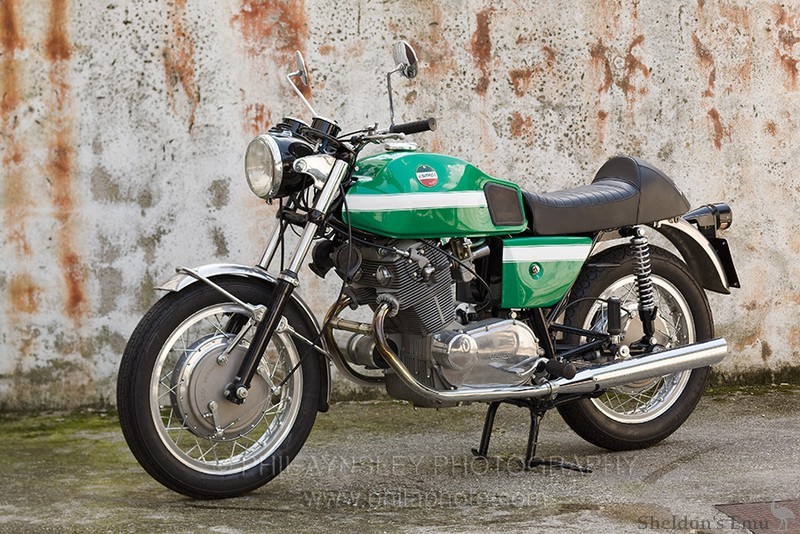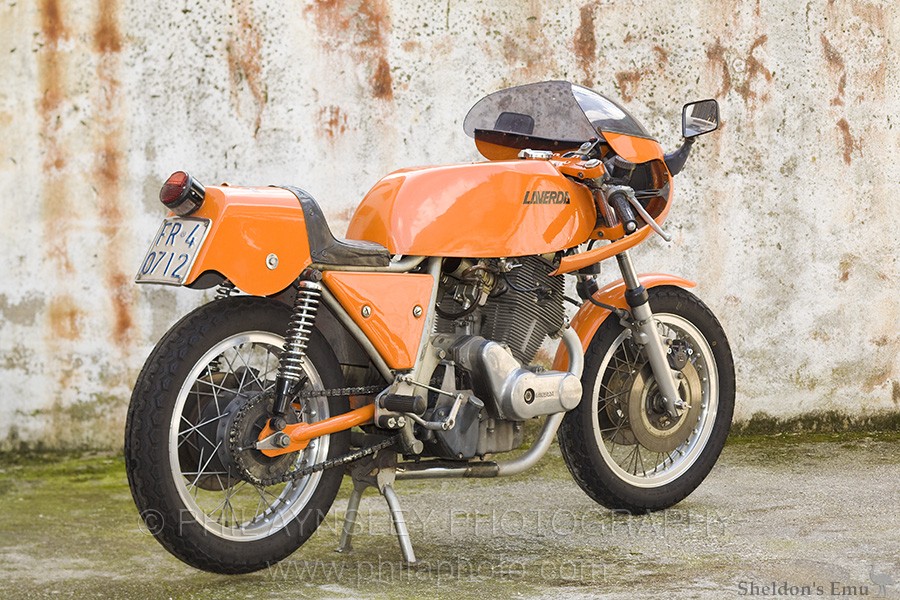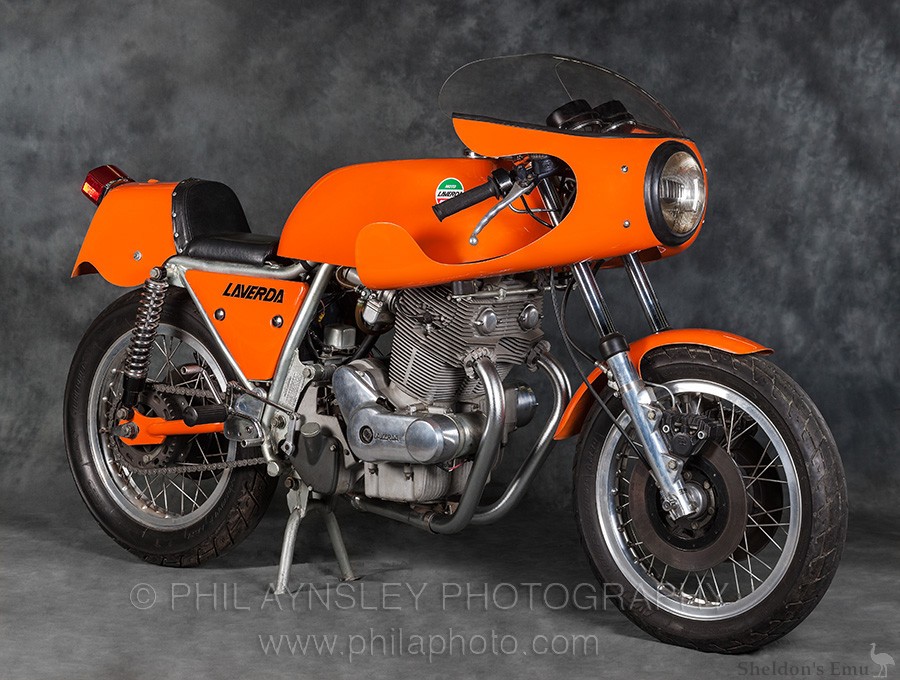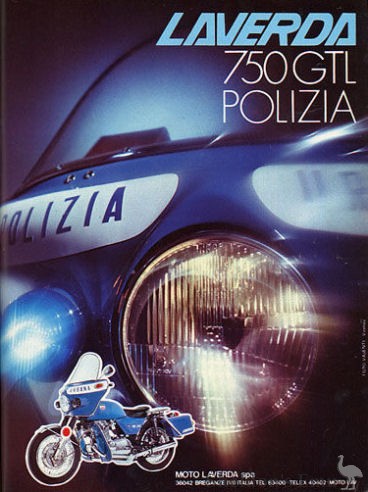
Laverda 750SF Super Freni The SF (Super Freni - Super Brakes) was introduced in 1970. Apart from the Franceso Laverda designed front brake the bike had a new frame and an exhaust balance pipe. Photographed near Bassano del Grappa, Italy. 2007.
1971 750 SFC (5,000 series)
The 1971 '5,000 batch' SFC works racer won the 1971 24 Hours of Oss endurance race in the Netherlands with riders Hans Hutten & Sergio Angiolini. It features a Ceriani 4LS front brake and a Laverda stage 1 rear brake (with rubber band to aid quick release). An aluminium fuel tank was fitted. The 'Campione' megaphones are mounted on short header pipes.
"The fog was cruel! Never before I had been on a bike with visibility of two meters – not even on the Autobahn". De 24 Uur Van Oss, dedicated to Hans Hutten, who died in a accident at the same event in 1975.
1971 750 SFC (8,000 series)
This 8,000 batch bike is in original and unrestored condition. It displays the typical features of this model - the protruding Carello headlight, the exhaust headers that run alongside the engine and the rear brake pedal that is bent to clear the exhaust. Stage 2 Laverda drum brakes are fitted. This batch of 80 bikes were the first SFCs available to the public and were all built in late 1971. Compared to the first, 5,000 series, there were numerous improvements including: new Mondial pistons, modified swingarm, either the Laverda stage 2 or Ceriani front brake, longer headers/shorter mufflers, slightly different tank & front guard plus many other minor detail changes.
1972 750 SFC
One of the two SFCs officially imported to Australia (by Stanco) in 1972. These 11,000 batch bikes were the last of the drum brake models and featured a more tucked in exhaust system compared to the earlier 5,000 and 8,000 batches. Other unique parts included the centre stand, fairing shape, footrest plates & rear brake pedal.
1973 Laverda SF1
Laverda introduced their 750 parallel twin and - against the odds - it proved to be one of the best. They could hardly keep up with customer demand at first but, by 1972, the competition was much hotter and it came with four cylinders. So, for 1973, Laverda's 750 twin had the boost it needed, in the shape of the SF1. By this time, sound-level regulations were intruding so Laverda was faced with the conflicting difficulties of increasing gas flow and decreasing exhaust noise. Laverda achieved both with large-diameter exhaust pipes (1.6 inch) interconnected by a transverse collector box, new-style Dellorto 36mm pumper carbs and a new matching camshaft. These mods lifted power to a claimed 66bhp at 7,300rpm, and top speed rose accordingly to around 117mph.
The bike from that particular year is generally regarded by aficionados as the quickest of the SFs. While their handling was heavy, and this was quite typical of the period, not much else cornered more sure-footedly than did an SF. Despite the apparently modest power increase, the SF1s were noticeably faster on nip-and-tuck riding. SF1 acceleration in normal highway use was undeniably superior to that of SF, thanks to a further-lightened flywheel. The overall look and feel of the SF1 is outstanding and the parallel twin configuration combined with solid predictable handling makes the SF1 a great 1970s classic.
ENG: 750 153 18 1 FRAME LAV750SF 15318 MILEAGE. 68488
Image and text courtesy Webbs Auction House NZ
1974 750 SF2
The SF2 was introduced in 1974 and the most obvious difference to the SF was the use of twin disc brakes in place of the earlier drum (only the very first bikes had a single disc). A different headlight was also used. 65hp at 7,000rpm. Dry weight of 218kg. Top speed of 190kph.
Laverda 750SFC 1974 750cc Twin
The SFC 16,000 series varied from the previous model considerably, boasting triple discs (as did the SF3) and lighter crankshaft.
Laverda 750SFC 1974 17K Series
The 17,000 series machines exported to North America varied from 16k series most noticeably with the fitting of Japanese Nippon Denso instruments.
1975 750 SFC (18,000 series)
The 750 SFC 'Electronica' was built in two batches - 131 in 1975 and a further 33 in '76. The major changes were to the engine which was now fitted with a Bosch electronic ignition, along with an oil cooler. In addition, a redesigned cylinder head featured reshaped combustion chambers, different valve angles & more obviously, flatter angled spark plugs. Higher compression pistons (10.5:1), slimmer, polished rocker arms and a redesigned left hand crankshaft were also new. Frame changes were limited to bracketry. Motorcycles in the second batch were fitted with alloy wheels.
Text and images by Phil Aynsley
1972 750 Egli-Laverda SFC
One of two bikes commissioned in 1972 from Fritz Egli by the Swiss Laverda importer, Roland Borel. The bike was raced in national as well as international events including the '72 Imola 200. Compared to a standard SFC the bike is considerably lower, has a shorter wheelbase (1400mm vs 1470mm), has more ground clearance and at 185kg, weighs about 20kg less. Ceriani GP forks, Lockheed calipers with Scarab discs and a Grimeca rear brake are fitted.
Laverda 1997 750 Range
The 1997 catalog featured images of the Laverda 750S, 750S Carenata, Ghost 750 Strike, Diamante 750 and 750 Formula.
Laverda 1997 750S Formula
The Laverda 1997 750S was a development of a long-running string of relatively modern parallel twins the first of which was the 1977 Alpina which was substantially updated in 1994 with the introduction of the fuel-injected and watercooled 668 machines.
The 750S Formula appeared in 1998 and featured a more powerful engine with Termigoni carbon-fibre exhaust cans, and enhanced suspension, brakes and wheels from Paoli, Brembo and Marchesini.
1998 750S Formula
The 750S Formula was the pinnacle of the long running parallel twin design that started with the 500cc Alpino in 1977. Heavily changed (water cooling, fuel injection) when the 650 (actually 668cc) model debuted in 1994, the 750S was released in 1997. The Formula followed in 1998 and featured hotter cams, revised fuel injection, carbon Termignoni mufflers, fully adjustable Paioli suspension, Goldline Brembo brakes & Marchesini rims. 92hp at 9,000rpm. 187kg.
Unless otherwise stated, images and edited text courtesy Phil Aynsley
If you have a query or information about Laverda motorcycles please contact us