Debenham Sisters
Betty and Nancy Debenham, with their dog, Poncho, were keen motorcyclists. Nancy won a Gold Medal at Brooklands in 1926.
The Debenham Sisters

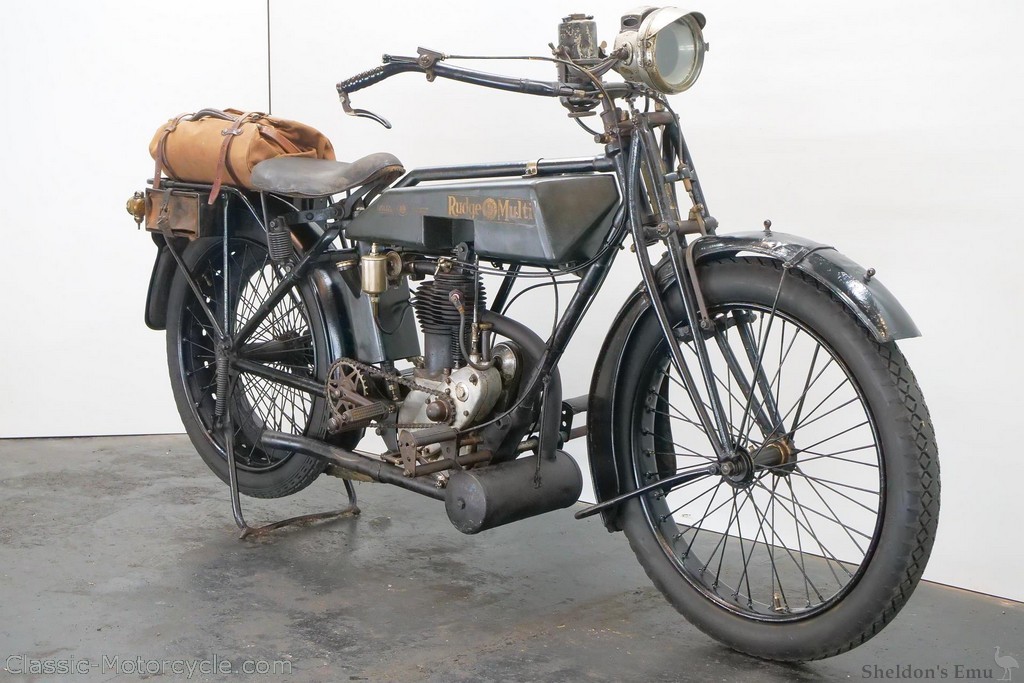
The Rudge Whitworth variable 'Multi' gear first appeared in 1911. It was very successful - in 1914 it became the first single to win the IOM Senior TT with Cyril Pullin clocking an average speed of 49.49mph.
The Multi saw active service in World War I, the Italian Army ordered a batch at the end of hostilities, and the Multi was the model selected for manufacture in 1918 to get production underway, to re-finance the Rudge operation. By 1921 Rudge production was running at 30 machines a day and riders such as Bob Dicker and Bill Lacey kept the Rudge name in the headlines with successes at Brooklands and other events.
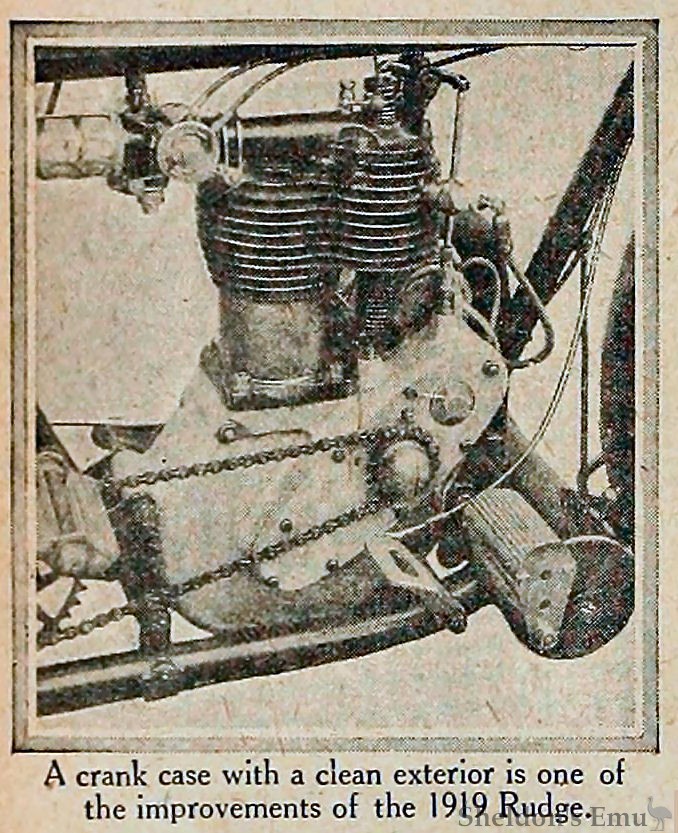
A crank case with a clean exterior is one of the improvements of the 1919 Rudge.
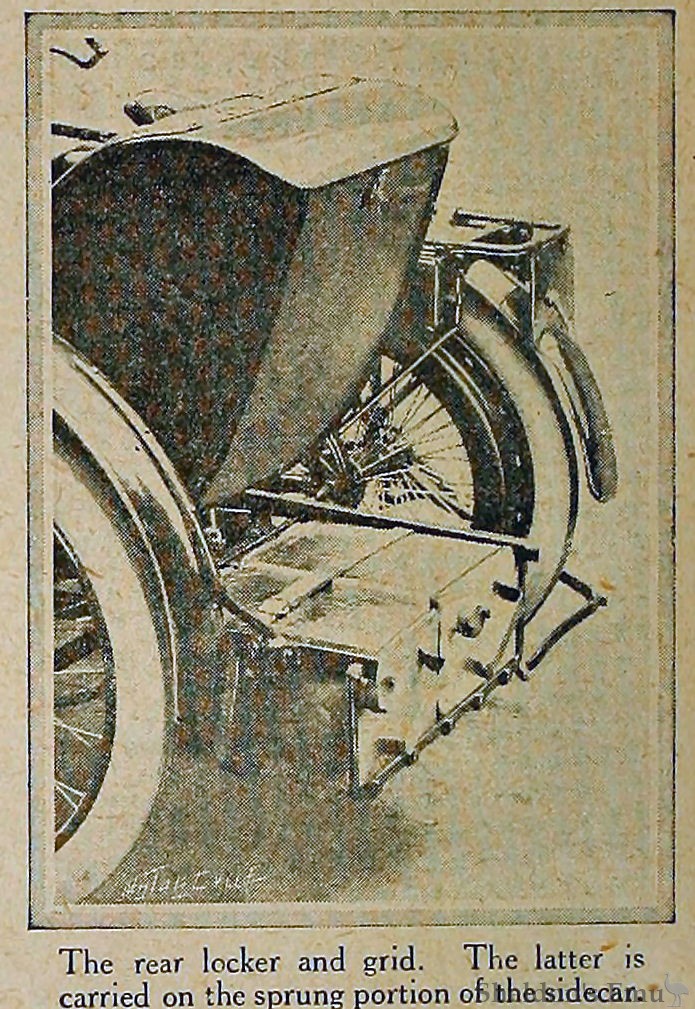
The rear locker and grid. The latter is carried on the sprung portion of the sidecar.
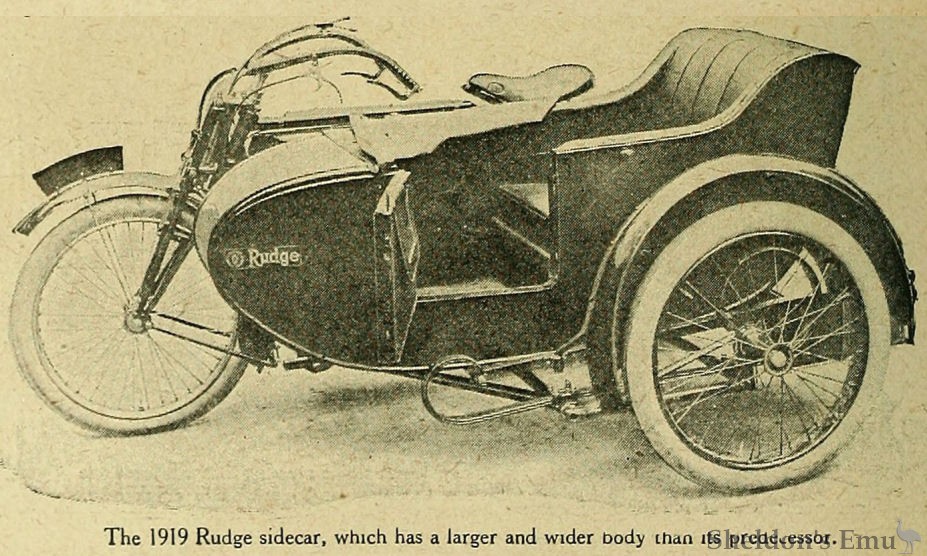
The 1919 Rudge sidecar, which has a larger and wider body than its predecessor.
Modifications and Improvements in a Well-tried Design.
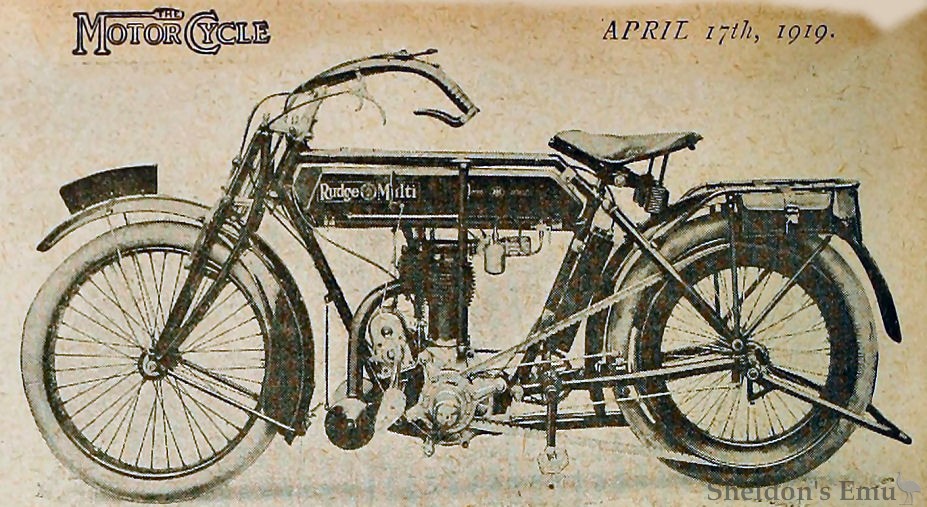
LIKE most of the large motor cycle manufacturers, Messrs. Rudge-Whitworth, Ltd., have taken some time to clear their factory of Government orders before resuming the production of motor cycles. Arrangements are now complete, however, for a fair output of the Multi model, which, as many of our readers are aware, won the last T.T. race.
The 1919 Rudge Multi can be said to be an improved pre-war model, modified in details, but not differing to any large extent from its predecessor. The main alteration is the new crank case, which now has smooth surfaces, all projecting ridges, with which in previous models the crank case was ornamented, having been removed. This has a distinct advantage, as it is much easier to clean, and does not collect mud, as do many crank cases having rings cast upon them. The timing case cover, too, has a smooth face.
As of old, the engine has a bore and stroke of 85 mm. and 88 mm. respectively, and an overhead inlet valve actuated by push rod operated by a cam on the last of a train of gears, from one of which the magneto is driven.
There is another point where the Rudge engine differs from the majority. The pinion for driving the half-time gear has a vernier adjustment. The driving pinion has twenty-two teeth, and is fixed to the crankshaft, having twenty-one serrations. This, multiplied by two for the half-time gear, gives a vernier adjustment for timing the valves with a movement of less than one-half a degree at a time. The reader may work this out for himself as follows:
An interesting feature of the Rudge machine, and one which is appreciated by many riders, is the method of carrying the lubricating oil and operating the pump. The oil tank is a separate unit clipped to the "seat" tube of the frame, and has a pump fitted in its lower end which is operated, through a Bowden wire, by a pedal near the right footrest. This ensures a petrol tank free from oil always.
The Rudge sidecar is a particularly fine piece of work, and is larger all round than the pre-war model. The nose has been broadened considerably, and an adjustable footboard fitted.
Both cushion and back cushions are unusually deep and well sprung, and the height of the seat from the floor is higher than in the majority of sidecars, as will be seen from the accompanying photograph.
In addition to the usual locker under the seat there is a capacious compartment between the rear panel and the seat back.
A grid with accommodation for two petrol cans is supported on a sub-frame which is carried by the two cross members upon which the body also rests. The grid is therefore sprung with the body, although the latter does not support the weight.
As regards the finish, this is as good as any, and far better than most sidecars we have seen. The top panel is of polished aluminium.
650 x 55 mm. tyres are fitted to both machine and sidecar, the prices of which are £80 and £30 respectively.
The Motor Cycle April 17th, 1919. Page 384