
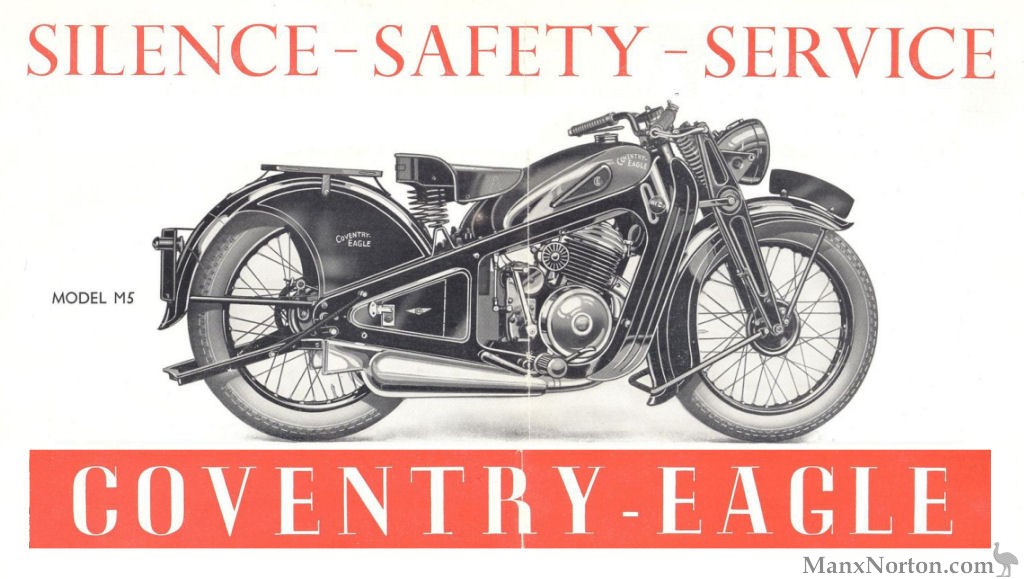
ALTHOUGH DIFFERENT in its general design to the orthodox machine, the 250 cc. two-stroke Coventry-Eagle is in no way freakish. Praiseworthy points to be noted in this right-hand side view are the really adequate mudguards, the height of the leg shields, the luxurious saddle, the size of the tyres, the large tool box —there is a similar one on the other side also —and the neat layout of the silencing system.
TWO-STROKE COVENTRY EAGLE
When the two-stroke Coventry Eagle motor cycle appeared a few years ago, it created a certain amount of interest, mainly on account of its pressed steel frame design, and because constructional orthodoxy was boldly defied. The first point that strikes the eye with the latest K 2 model, which has, of course, a 250 cc. Villiers engine, is the method of mounting the engine and gearbox together on a common platform, so that the two may be lifted from the frame as a unit. This adds to the tidiness of the machine, and also gives the model a compact appearance.
The left hand crank case half is a special casting, which enables a stout aluminium oil bath chain case to be used, a feature which is exclusive to Coventry Eagles. The inner casting is bolted to the crankcase, and it is provided with a slot for easy chain adjustment.
Taking over a selected stock model from Messrs. Stewart and Co., the Victorian distributors of the machine, for a 50-mile run, an interesting point noticeable was the simplicity of the gear change. The gear knob is placed well forward, with the gear positions marked on a rubber bushing of the slot through which the lever projects. Ignition is by Villiers flywheel magneto, and the electric lighting system consists of a Miller six-volt dynamo.
Comfort.
For comfort the Coventry Eagle is hard to beat. For a rider of normal or abnormal stature one could be literally fitted to the machine. The handlebars and footrest have a wide range for adjustment, and the huge, luxurious saddle positively gives armchair ease.
With the help of 3.25 in. tyres and efficient fork springing, comfortable riding is fully appreciated. The Coventry Eagle could be ridden and steered in top gear at very low speeds, and with quick downward change the machine would move off without effort. The engine ran most sweetly, and there was no trace of "two-stroke rattle." The exhaust note was subdued, thanks to the large expansion chamber, which, incidentally, forms a shield for the crankcase.
The pulling capabilities were the outstanding feature of the engine. In the top gear of 5.5 to 1 it would purr along at 10 m.p.h. On the same ratio it could attain a speed of 60 m.p.h. on a flat road and climb steep good road gradients at 40 miles an hour.
Maximum speed in second gear (8.6 to 1) was 42 m.p.h.
Petrol Consumption.
Petrol consumption on a 25-mile run at an average speed of 35 m.p.h. was approximately 95 m.p.g. With lubrication being on the petroil system, half a pint of oil accompanied each gallon of fuel.
About Braking. A word about braking : The 6-in. rear brake, operated by a right toe pedal, and the 5-in. front brake were both well up to standard. Used together, they would arrest motion on a dry surface in 30 ft. from a speed of 30 m.p.h.; using the rear only a distance of 36 ft. from the same speed sufficed. The retarding force was pleasing, it being impossible to lock the back wheel.
Cleaner Motor Cycling.
There is a distinction in the mudguarding of this model. The valancing of the guards is thorough, and with the legshields of adequate height make for cleaner winter riding. At the conclusion of the test it was found that the engine had kept exceptionally clean so far as oil leakage was concerned, and the engine itself, being much better protected than most tubular frame machines, kept remarkably free from dirt. The large side valance of the rear mudguard, and the two toolboxes placed between each pair of the rear frame members, play an important part in the main scheme of mud-stopping.
Complete with equipment, the K 2 model is an attractive utility mount. Its black finish, with gold lining, relieved by the chrome-plated exhaust pipes, and the carmine-nosed petrol tank, make it eminently easy to view. This imposing and attractive machine sells in Melbourne at £59/10/.
Specifications of the K 2 250 c.c. Coventry Eagle
Engine.—Villiers two-stroke. 67 mm. bore, 70 mm. stroke, 249 cc.; detachable alumiinum cylinder head; petrol lubrication: Villiers, two-lever carburetter fitted with air cleaner; twin exhaust pipes leading to a common combustion chamber, with two tail pipes and silencers.
Frame.—Coventry Eagle pressed channel-steel frame; pressed steel forks with single compression spring; hand-operated steering damper.
Transmission. —Via Albion three-speed gearbox, pivotal mounted with drawbolt'adjustment; ratios 15.3, 8.6, 5.5 to 1; front chain enclosed in cast aluminium oil-bath case; rear chain adjusted by tensioners at fork ends.
Handlebars.—Adjustable clean type; clutch and release valve controls on left handlebar: front brake, throttle and mixture control on right handlebar.
Brakes.—5-in. front brake operated by inverted lever on right handlebar; 6-in. rear brake operated by right toe pedal.
Tank.—Saddle type tank; capacity, two gallons; finished in black enamel, with gold lining and carmine nose.
Dimensions.—Overall length, 78 in.; overall width, 31 in.; saddle height, 27 ½ in.; wheelbase. 50 in.; ground clearance, 5 in.: mudguard width, 4 ¾ in.
Price.—Melbourne price, £59/10/.
Distributors.—Victoria: Messrs. Stewart and Co.. 451 Elizabeth street, Melbourne. Vic.; Adelaide: Messrs. E. T. Fisher and Co.. 65-67 Grote street, Adelaide, S.A.
Australian Cycling & Motor Cycling, June 15th 1934. Trove NLA
N.B. The article describes the model as the "K2", but the illustration published with is the "M5", derived from the 1934 factory catalogue. A "1934 K2 250" was sold in Victoria in recent years.