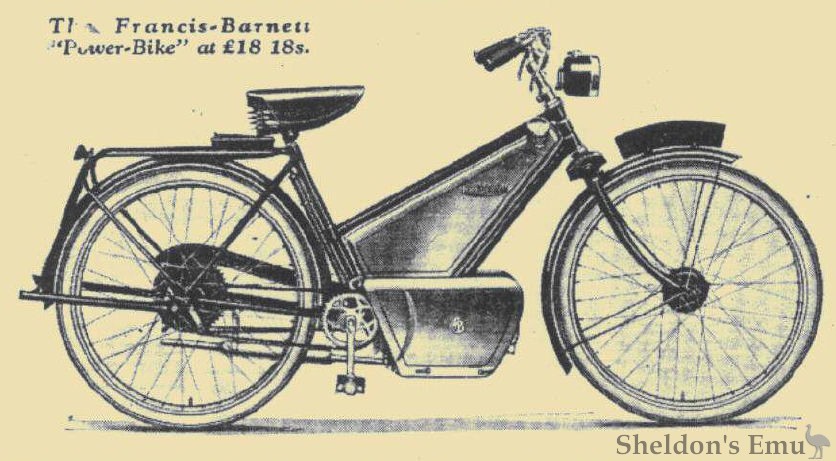

1939 J50 Powerbike has a rubber compression front suspension system, petrol tank and full engine shielding finished in silver with blue coachline, and a flat toolbox at the front of the rack
1940 K50 Powerbike had a Junior De Luxe motor, replacing the earlier Villiers Junior
1949 Powerbike 56. Production ceased in 1951
Luxury Lightweight With Novel Rubber-sprung Forks
Francis-Barnett Power-Bike £18 18s
FRANCIS AND BARNETT, LTD., famous as manufacturers of high class two-stroke machines, are introducing a "Wilfred" which incorporates several novel and ingenious features. Simplicity is the keynote of the design, but the comfort and cleanliness of the rider have received the most careful consideration by fitting a spring front fork and totally enclosing the power unit. The new model will be known as the "Power Bike" and will cost £18 18s. fully equipped The power unit is the famous 98 c.c. Villiers job with a bore and stroke of 50 mm. and the primary chain and clutch are enclosed in an oilbath. Separately adjustable chains are used for the pedal gear and the final drive from the engine.
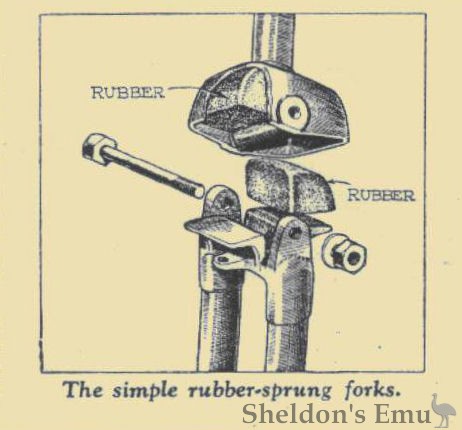
A cycle-type frame is employed, but all the tubes and lugs are of tandem strength. Rubber cushioned front forks allow the front-wheel spindle a movement of 3/4 in.; the single pivot pin is fixed in the fork ends and free to rotate in the bottom steering head lug. Lubrication is carried out from the top of the steering column.
A pair of neat shields, which enclose the engine, are secured by a spring at the top and wing nuts at the bottom, and the 11-gallon tank permits a long period of running without any need for refueling.
Both front and rear brakes are of the internal expanding type, the latter of 4 ins. diameter and operated by a back-pedaling gear, which has a clever device to hold the brake off when the machine is being wheeled backwards. Other items of equipment include a Terry spring-top saddle, 26-in. by 1 ¾ in. Dunlop tyres, a tubular carrier, a metal tool box situated under the saddle, a clip-up rear stand, a bulb horn and a licence holder. The tank and shields will be finished in an attractive dull silver with a blue line.
Everything about this new Francis-Barnett is most sturdily constructed.
Motor Cycling November 9, 1938.
SPECIFICATION
ENGINE. 98 c.c. Villiers Junior Unit. 50 m/m bore x 50 m/m stroke. Large expansion chamber and final silencer.
CLUTCH. Running in oil, incorporated in engine unit. Rachet lever control on handlebar.
CARBURETTER. Villiers automatic, controlled by single lever. Air strangler for starting.
TRANSMISSION. Renold chains. ½" x 3/16". Independent adjustment.
LUBRICATION. Petroil system. ½ pint of oil to one gallon of petrol.
LIGHTING. Villiers Direct Lighting from Flywheel Dynamo. Parking battery in headlamp.
IGNITION. Villiers Flywheel Magneto.
FRAME. Cycle type, built with tandem strength fittings.
FORKS. Rubber cushioned (patented).
BRAKES. Internal expanding, 4" Rear and 35/8" Front. Rear brake, pedal operated by patented mechanism. Front controlled by handlebar lever.
TANK. Steel welded. Capacity 1 3/4 gallons.
TYRES. 26" x 17* Dunlop.
SADDLE. Terry.
STAND. Rear. Clip up type.
CARRIER. Large tubular rear carrier fitted with neat metal tool box.
EQUIPMENT. Bulb Horn. Licence Holder. Inflator and Tools.
PRICE: £18. 18. 0.
FRANCIS & BARNETT LTD., COVENTRY
Advertisement, 1939.
Source: Graces Guide
If you have a query or information about Francis-Barnett please contact us