Debenham Sisters
Betty and Nancy Debenham, with their dog, Poncho, were keen motorcyclists. Nancy won a Gold Medal at Brooklands in 1926.
The Debenham Sisters

THE A.J.S. OVERHEAD CAMSHAFT MODELS
Two overhead camshaft machines are listed for 1928, Models K.10 and K.7, the former being of 4.98 h.p., and the latter 3.49 h.p., and their prices solo are £76 15s. and £65 respectively. The overhead camshaft machine was first introduced in the 1927 T.T. races, and since then has given proof of its efficiency by winning such important Continental events as the 350 c.c. Grand Prix d'Europe, the Belgian Grand Prix, the Swiss Grand Prix, the Austrian Grand Prix, the Brooklands Grand Prix; and it has also figured conspicuously in the Grand Prix de Nations and the Ulster Grand Prix.
The 1928 camshaft engines are the latest development of the original T.T. design and retain all the outstanding features. The overhead camshaft is chain-driven and fitted with a patent leaf spring tensioning device and a re-action damper is added to steady the drive, which after exhaustive tests has proved to be the last word in reliability and is undoubtedly the most efficient, simplest and most silent form of drive for an overhead camshaft. The automatic mechanical lubrication of the engine is on the "dry sump" principle. A gear-driven double Pilgrim pump draws oil from the tank on the down-tube and supplies a pre-determined quantity to the cam box and to the big end. After lubricating the cams and rocker gear, the oil flows into the chaincase and lubricates the chain and half-time gears, and then falls into the sump by gravity. Oil is pumped to the connecting rod big end via passages in the driving-side main shaft and web of fly-wheel, and oil thrown from the big end by centrifugal force lubricates the cylinder walls and the small end of the connecting rod. Surplus oil flows by gravity into the sump, whence it is pumped back into the tank, so that oil is constantly being circulated throughout all the working parts of the engine. Every moving part of the engine is enclosed, and automatically and mechanically lubricated. It is interesting to note that with this system ¾ gall. of oil passes through the big end bearing every hour when running at a road speed of 60 m.p.h. For very high, continuous all-out speeds, a pre-determined quantity of oil may be passed direct to the cylinder walls by the turn of a needle valve. Other than periodically draining the sump and tank, and cleaning the filter, instructions re lubrication are – "Fill the oil tank with oil, then forget lubrication until the tank requires replenishing."
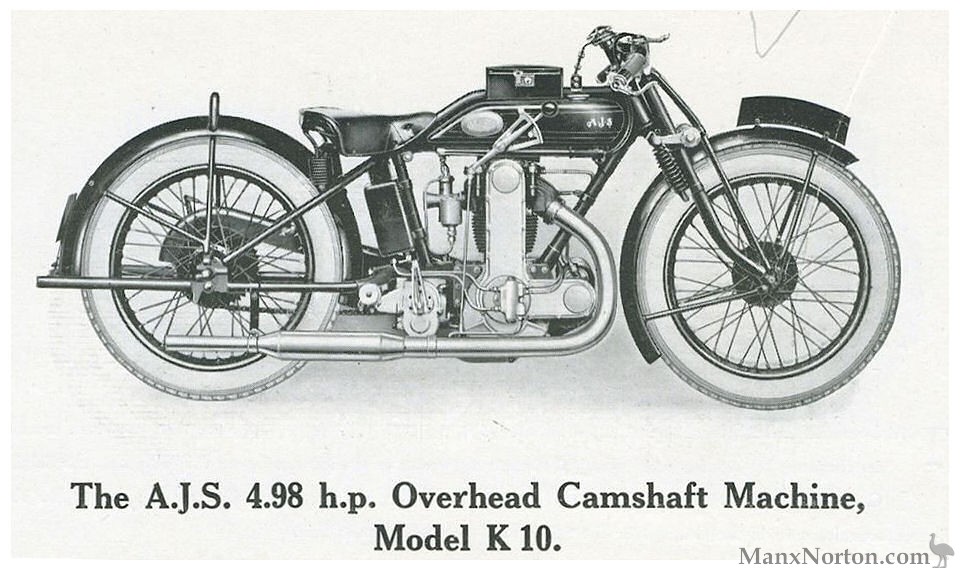
THE 4:98 H.P. OVERHEAD CAMSHAFT MACHINE MODEL K.10
The specification of this machine is as follows:
ENGINE. A.J.S. design and manufacture. 84 X 90 mm. bore and stroke. 498 c.c. capacity. Overhead valves operated by chain-drive camshaft with patent tensioning device and re-action damper. Detachable head. Aluminium piston. Roller bearings to big end, ball races to main shafts, ball-bearing timing shafts.
CARBURETTOR. Binks special two-jet racing type with twist grip control.
TANK. 2 gallons petrol.
TABLE OF GRADIENTS
IGNITION. Lucas magneto. Handlebar control.
LUBRICATION. Dry sump. Separate oil compartment holding gall., fitted to rear down-tube. A shock absorber is fitted to the engine shaft.
CHAIN GUARDS. Semi-enclosed type giving easy access transmission and clutch. to
GEAR-BOX. A.J.S. Counter-shaft three-speed gear fitted with ball-bearings throughout. Operated by an improved gate-change.
GEAR RATIOS. 4.65, 5.64 and 9.16 to 1.
CLUTCH. Multiple plate. Hand-controlled.
REAR WHEEL. Fitted with specially light hub and large diameter brake drum.
TYRES. Dunlop cord wired-on. 26 in. by 3.25 in.
MUDGUARDS. Narrow racing type.
BRAKES. Front and rear internal-expanding pattern. Extremely powerful and smooth acting. Rear operated by pedal on left-hand side footrest, and front by lever on left handlebar.
FORKS. A.J.S. design and make. Links adjustable for taking up side-play. Lower links fitted with shock absorbers.
TOOL CASE. Fitted on top of tank.
SADDLE. Terry spring-seat. No. 1 largest size.
HANDLEBARS. "T.T." type.
FOOTRESTS. Adjustable, allowing the rider to procure the most suitable riding position.
STAND. Fitted to rear wheel only.
MEASUREMENTS. Wheel base, 4 ft. 6 in. Height of saddle, 28 in
THE 3.49 H.P. OVERHEAD CAMSHAFT MACHINE. MODEL K.7
This model is a smaller replica of the 4.98 h.p. O.H.C. machine, and the general specification of this model as regards equipment is the same as Model K.10 other than the following –
ENGINE. 74 x 81 mm. bore and stroke. 349 c.c. capacity.
TANK. 1¾ gallons petrol.
CHAINS. ½ in. pitch x 5/16 in. wide. GEAR RATIOS. 5.52, 6.78, and 10.31 to 1.
TYRES. 26 in. by 3 in. Dunlop cord wired-on.
WHEEL BASE. 4 ft. 5 ¾ in.
Source: The Book of the AJS (1927-1928), by W.C. Haycraft. Pitmans.

J. Simpson, on a camshaft 350 A.J.S., treated the spectators at the Brooklands Grand Prix on October 8 to a delightful exhibition of dare-devil cornering. From lap two until the finish he led the field, and finished a winner at 55.56 m.p.h. In a novelty trial run by the Cork M.C.C. recently, E. Browne (A.J.S.) made the best performance. G. D. Watson (A.J.S) was awarded a silver cup in the Daw Cup Trial run by the Brixton and D. M.C. on October 1. A. Colcombe (A.J.S. s.c.) was the winner of a solo reliability trial for the President's Challenge Cup. run by the Prestigne A.C. on October 1.
Speculations as to whether the A.J.S. concern intended to market the overhead camshaft model, which has been raced successfully, have been set at rest by the inclusion of machines fitted with that type of engine in the 1928 range models. The side-valve and push-rod, overhead models have been redesigned fairly extensively, the detachable cylinder heads being fitted by means of studs instead of the bridge-piece hitherto used. The range for 1928 has been augmented by the addition of a 248 c.c. side-valve machine.
The Register (Adelaide, SA) Tue 29 Nov 1927