
The Ariel Cycle Co., Ltd.
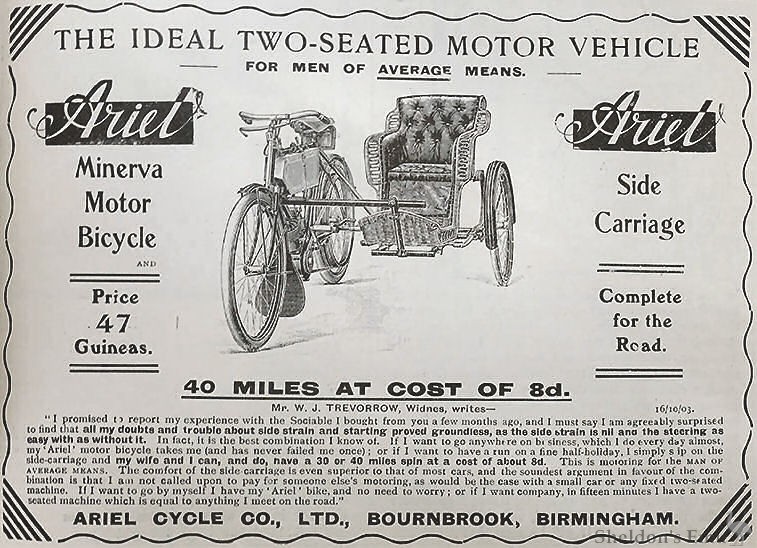
Motor bicycles will form the chief exhibit of the pioneer manufacturers of all-British motor cycles. Ten motor bicycles will be shown, with a variety of Ariel sidecarriages and forecarriages, prices varying from thirty-five guineas upwards. One of the special features of this exhibit will be the new 3½ h.p. Ariel engine, with the now popular mechanically operated valves. This model has been specially designed for use in conjunction with sidecarriage or forecarriage. The engine is up to the usual well-known Ariel standard, and bristles with good points, a few being: Extra large phosphor bronze bearings; fly-wheels of equal weight; new designed contact breaker with transparent celluloid face; two to one gear, rotated by a worm drive, entirely detachable i without disturbing the crank case. The 3½ h.p. Ariel motor bicycle will be fitted with Ariel duplex front forks, Longuemare spray carburetter, two accumulators with two-way switch, exhaust valve-lifter, and combined cut-out to operate from the handle-bar.
The Ariel 2¼ h.p. model will be on similar lines, but fitted with a surface carburetter, as this type has been found the most suitable for an engine of this power. Ariel-Minerva models are marvellous value, and the 2 h.p. Ariel-Minerva at thirty-five guineas will be very hard to beat; 2¾ and 3½ h.p. Ariel-Minervas will be offered at forty and forty- five guineas respectively, inclusive of Minerva- Longuemare spray carburetter. A very interesting link with the past will be found on. this stand in the shape of an Ariel motor tricycle and quad, in which class of machine the Ariel Company held practically a monopoly a few seasons ago; they are still open to supply in limited quantities. This firm will also show one of their new patent attachments for coupling an ordinary bicycle to a motor bicycle, which has been perfected in every way and fully protected.
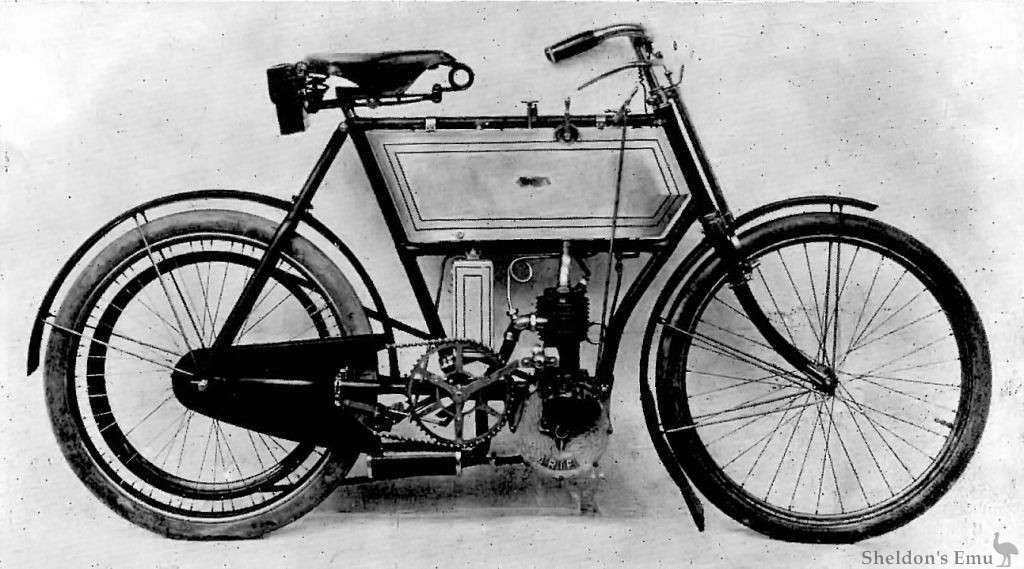
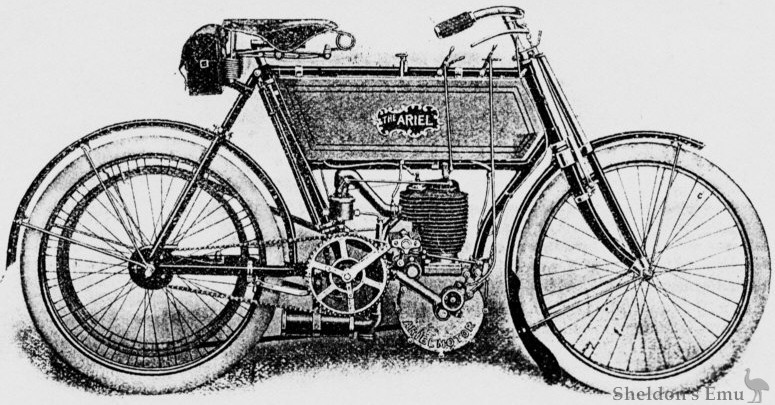
The above is the latest type of motor bicycle introduced by The Ariel Motor Co., Ltd. The whole machine, including the engine of 2¼ h.p., has been designed and manufactured at their factory in Birmingham. The carburetter, of the surface type, is the same design as used with great success on Ariel tricycles and quads, with a running capacity of 110 to 120 miles. The lubricating pump with glass barrel and oil compartment is let into the frame tank, the accumulators being carried in a separate case under frame tank. Ignition is by make and break on the timing shaft, a trembler being fitted on the induction coil. One lever controls the speed; this lever also opens the exhaust valve when placed in a vertical position. A useful refinement is the addition of a prolector over the chain and free-wheel clutch.
The Ariel Motor Co., with their unique experience of motor cycle manufacture, should secure conspicuous success with this machine. We understand Mr. E. Herington will ride an identical mount in the Glasgow-London non-stop run.
~The Motor Cycle
The Ariel Cycle Co., Ltd., Birmingham (Stand 143), have, as may be expected, a very handsome display of their motor bicycles and tricars. The workmanship is, as usual, superb, and the finish splendid. One of the attractions on this stand is a 3½ h.p. tricar specially built for the Kingston and Surbiton Motor Co. The engine is cooled by two large fans situated one on each side of the cylinder. The transmission is by a wide belt. Two legs are fitted by hinges to the stays and so form a stand when required. The firm are also showing 2½ and 2¾ h.p. Ariel No. 1 motor bicycles, and a 3½ h.p. of the same type. The 2½ h.p. is now fitted with m.o.v.
The inlet valve is worked by means of a cam actuating a rocking lever, to which a rod is attached which pulls the valve down against the tension of the spring. The Ariel No. 2's are also shown in sizes of 3½ h.p. and 2¾ and 2 h.p. The well known Ariel sidecar and push cycle attachments are exhibited. We would remind our readers that the Ariel No. 2 3½ h.p. has a distribution gear driven by the worm gearing which proved a great attraction at last years show.
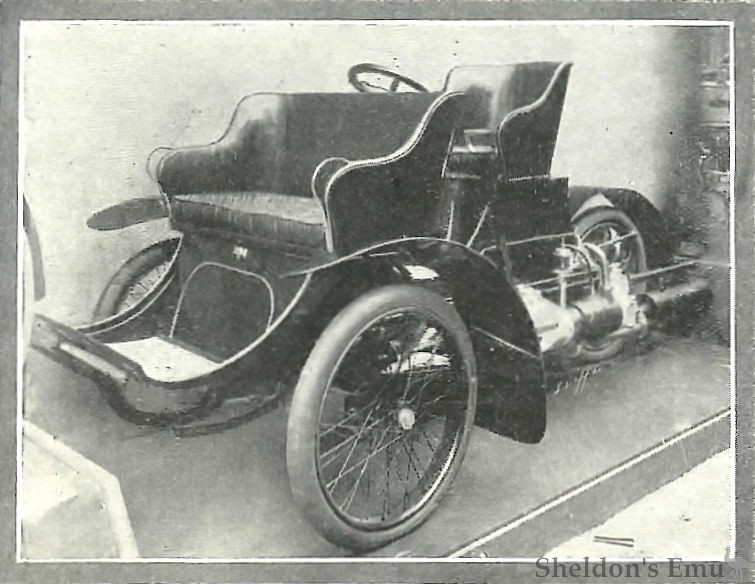
One of the most interesting machines on this stand is the Arielette, which may be briefly described as a modernized Bollee. We understand that the company have bought the Bollee patents and have applied the same in the form seen here. Among other improvements are the substitution of water cooling for the old air cooling, and electric ignition, and the Ariel contact breaker for the old tube ignition. The driver's seat is arranged higher and mounted on springs. This gives him a better view ahead, and also enables him to put both his feet on one footboard instead of straddling the gear box as before. The water tank and radiator are constructcd similarly to a cylindrical fire tube boiler, this being mounted on the right hand side of the back part of the frame. The steering centres are well inclined, and the steering wheel is mounted upon a central column. The motor is of 5 h.p. nominal, and, with three persons up (the front seat being adapted to carry two passengers), a speed of about thirty- five miles per hour can be readied on the level. The petrol tank is located under the driver's seat. The old features of a laterally arranged horizontal motor, three-speed sliding gear, belt drive, slung driving wheel, and so forth are all retained. The Bollée, which was the first tricar, promises to rise Phoenix-like from its ashes. It was certainly a delightful machine, and had it been as well built as the Arielette it would not have fallen out of use.
Report on the 1904 Stanley Show, The Motor Cycle, November 28th.