The Norton Engine.
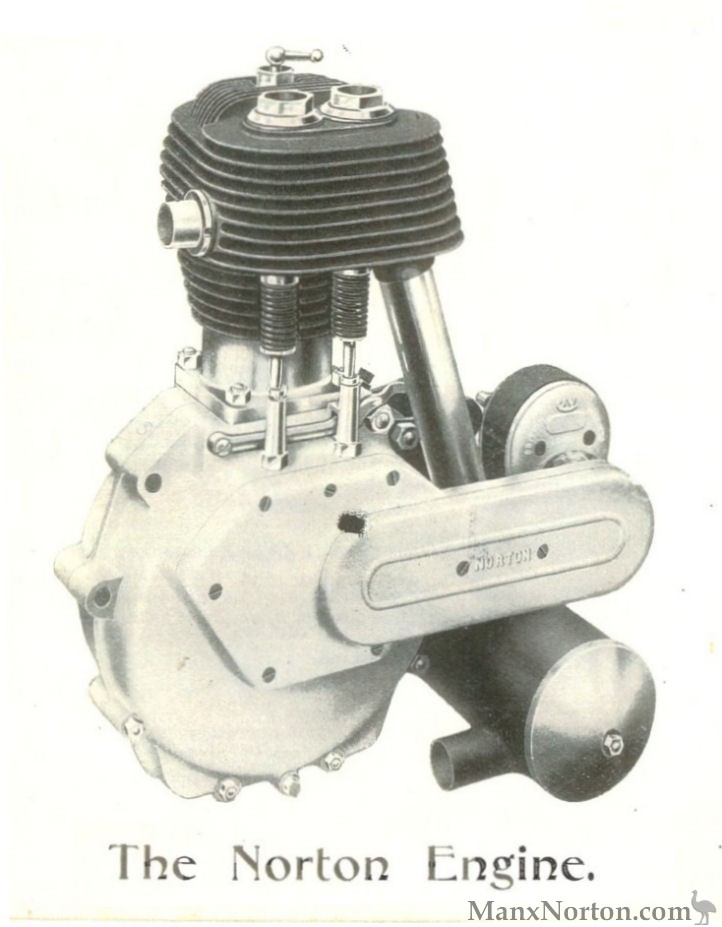
The appearance of the NORTON engine at once appeals to the engineer. Of clean, sound design, no unnecessary protuberances, scrolls, or advertisement appear upon it. There are no awkward interstices for the collection of dirt. All cover screws are sunk flush with the case, all corners are radiused and edges rounded. The special surface finish makes it VERY Easy TO KEEP CLEAN, and it is now generally recognized that for SMOOTH POWER production and efficiency there is no better engine than the long stroke NORTON.
THE CYLINDER—which may be removed from all models without disturbing the engine in its seating—is a splendid casting with very deep radiators of graduated section, and air ways between the valve chamber and barrel.
VALVES.
THE NORTON NEVER BREAKS VALVES.
This fact has often been commented upon, and is not due to anything mysterious in the material of the valves themselves (which are made from good quality nickel steel, lfin. diameter), but to sane and far-seeing design of the valve mechanism and combustion chamber, by means of which the valves, themselves never attain a high temperature. The exhaust gases make their exit by a tangential port, thus avoiding any retarding effect, and, the exhaust pipe being perfectly straight, they make a bee line into the expansion chamber, and thence by a pipe to the rear of the machine.
THE CONNECTING ROD is of high tension nickel steel of tapered H section, heat treated, with large bearing bushes of phosphor bronze, through which are cut spiral oil ways connected to ducts which pass through the rod to collectors in its outer surface. They are perfectly fitted to their respective pins of finely ground Ubas, the finished bearing surface being like polished glass, and giving many thousand miles service.
PISTON-—Is exceptionally light, and designed with a view to the proper transference of heat. It has the original oil and gas trapping channels—another early Norton introduction now being copied. The exceptional compression retaining qualities of the Norton engine, and the way it maintains its power on long hills or under heavy loads is largely accounted for by piston design. Two piston rings are fitted, and are concentric, so fitting more snugly into their grooves, and offering much less chance of blowing past than the more usual eccentric type.
The GUDGEON PIN is hollow and light, of parallel diameter, and a close fit in the piston bosses, being secured by a fixed key at one end and a removable pin at the other, so designed that whilst it is impossible for the pin to turn and come out, the natural expansion and contraction of the metal is not obstructed—a frequent cause of distortion, seizure, and breakage. The strength of the Norton piston is in design, and not mass of metal. The Sports model pistons have domed tops with well radiused bases.
FLYWHEELS are of extra large diameter and width of rim. An oil throwing ring effectively prevents leakage past the main shafts, which run in ball bearings on the timing side, and roller bearings on the driving side.
CRANK-CASE—An extremely clean and substantial job, giving the engine a very distingue appearance. A valuable feature is the oil sump at the base, designed to maintain a more uniform oil level than exists in the ordinary engine, and to supply an increased amount to the piston, etc., when hill-climbing. The timing gear case is carefully webbed in its interior, entirely preventing springing or drumming, and the TIMING GEAR - the nervous system of the engine—is particularly robust, the external cam faces being ½in. wide, as are also the rocker faces, which are direct acting, and not of the bell-crank type, efficiency and simplicity so being secured. The cam shaft bearings are abnormally large, being in fact equal to the gudgeon pin bearings on many engines. Oil is forced from the crank-case to the outer bearing through the hollow cam shafts at each down stroke of the piston, this ensures great durability, so maintaining constant tappet clearances, and minimizing the necessity for adjustment. TESTING.
The NORTON engine is built and then immediately run under its own power in a test frame. Should this preliminary test prove satisfactory, the engine is taken by an expert road tester who subjects it to a' most exhaustive test for power, flexibility hill-climbing, etc., etc., recording results on a test card.
After each item is entered as Al, the engine is taken to pieces again, each part is carefully examined, and, if satisfactory reassembled and sent to the finishing shop to be fitted to its machine. The completed motor cycle is then taken a further road test, and finally passed out of the works.
The Brooklands Test.
The Brooklands Special and the B.R.S. engines are, as the name implies, "special." From commencement to finish these super fine engines are built with one end in view—Power Development —without which speed is impossible. The methods employed to ensure this are of necessity somewhat costly, and, indeed, useless if applied to engines of inferior design. We are frequently asked the difference between the standard T.T. engine, which may develop Record speeds, and the B.S., which does and will attain record speeds. This is our secret; the difference is the reason for the speed, and we must ask our friends to accept the speed as the difference.
Upon completion in the works, these engines are sent in batches to Brooklands, where, after a few preliminary laps, they are officially timed over the kilo. or lap, and a certificate of the individual performance of each engine is issued by the authorities.
We illustrate one of these certificates. The speed —75 miles per hour—does not represent the limit, or even the speed attained b that particular unit, but merely the speed we guarantee all B. engines to have officially exceeded during test.
After this, the unit, exactly as when certified, is transferred to its frame, and, after passing a short road test, is ready for dispatch
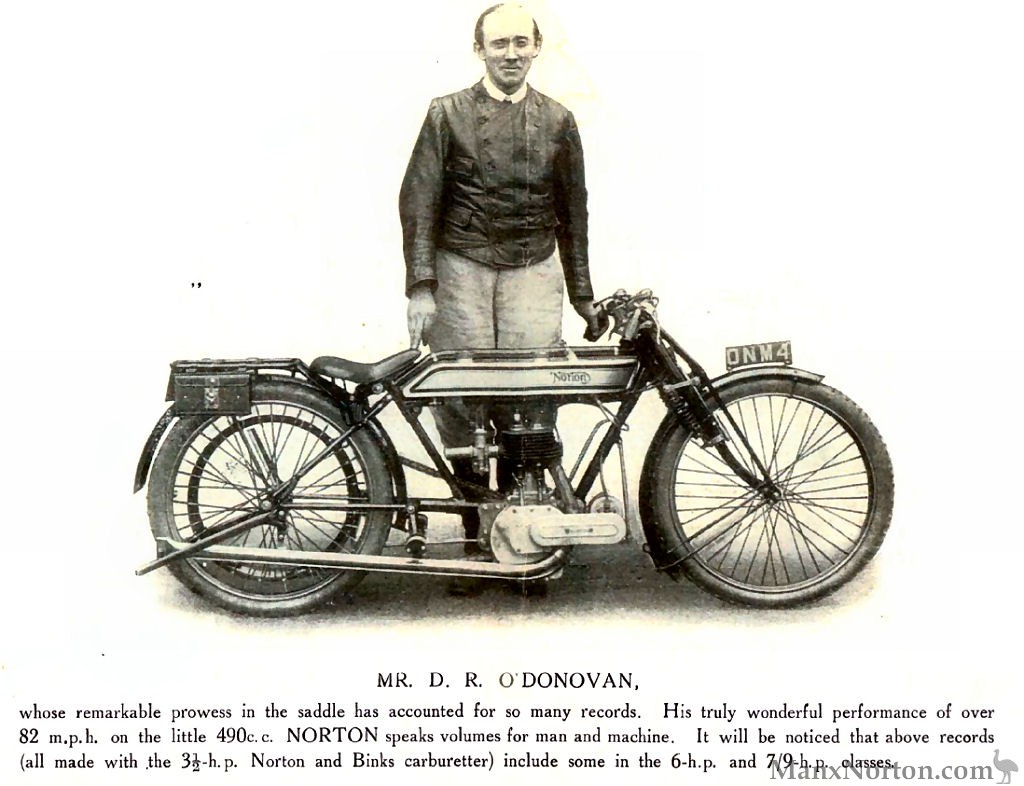
MR. D. R. O DONOVAN, whose remarkable prowess in the saddle has accounted for so many records. His truly wonderful performance of over 82 m.p.h, on the little 490c.c. NORTON speaks volumes for man and machine. It will be noticed that above records (all made with the 3½-h.p. Norton and Binks carburetter) include some in the 6-h.p. and 7/9-h. p. classes.
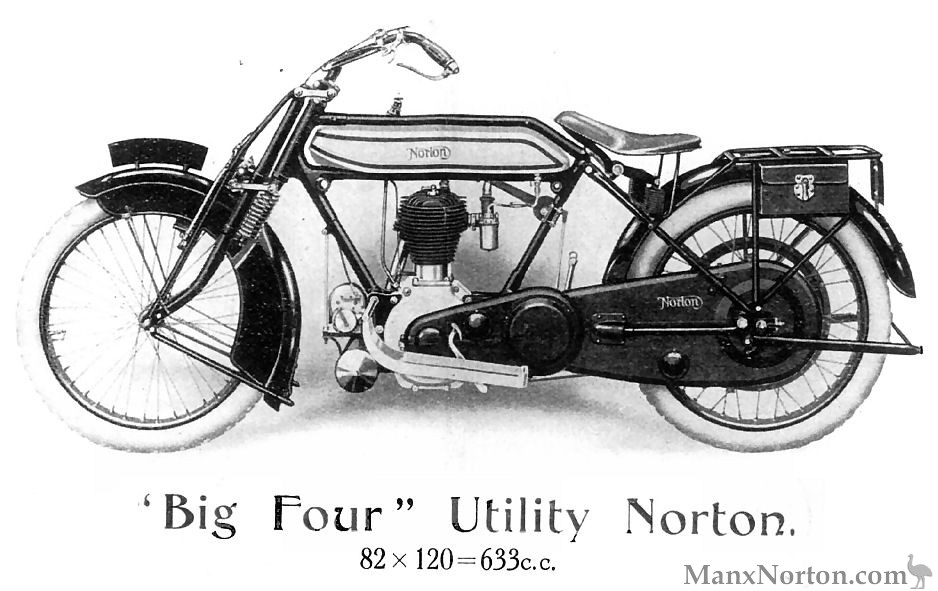
82 x 120 = 633c.c.
Norton One.
Code Word, Chafour.
The Norton, the machine which has made big singles popular for side-car work.— The Motor Cycle, Nov. 13th, 1919.
650x65 m/m. or 700 x 80 (extra) Dunlop Heavy Tyres. B. & B. Carburetter with Starting Pilot.
Approx. Solo Gears: Cog. 17 teeth—Top, 4½; Middle, 7¾; Low, 13¼.
Sidecar „, „ 15 „ „ 5¼ „ 9 „ 15½.
Weight complete, but without petrol. 285 lbs. Wheel base, 57½ in.
The top half of the gear-case is readily removed, exposing the whole of the transmission, or the rear separately detached to permit of wheel removal.
All adjustments may be made without disturbing the case. May be supplied with chain guard instead of cover if desired. Ground clearance, 6 in.
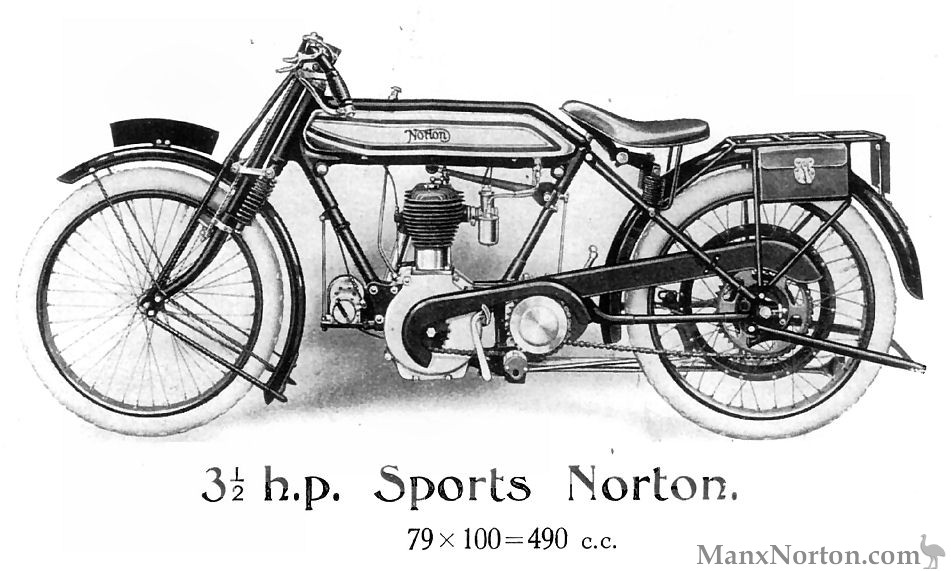
3½ h.p. Sports Norton.
79 x 100 = 490 c.c.
Norton Sixteen.
Code Word : "Tourist."
3-Speeds. Hand-controlled Clutch. Kick Start.
Gears: Cog. 17 teeth—for solo use: Top, 4½; Middle, 7¾; Low, 13¼.
650x65 Tyres. B. & B. Carburetter. Tank Capacity: Petrol, 2 gals. ; Oil, 3 pints.
Weight without petrol, 252 lbs. Wheel base, 57 in.
Ground clearance, 6 in.
This is without doubt the fastest geared 3½ h.p. T.T. made.
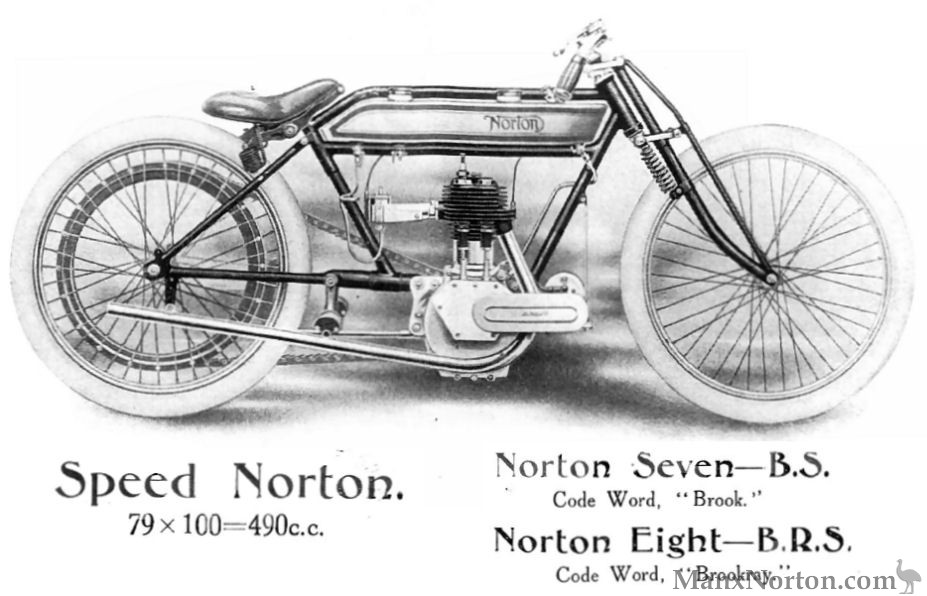
79 x 100 = 490c.c.
Norton Seven— B.S.
Code Word, "Brook."
Norton Eight—B.R.S.
Code Word, "Brookray."
26x2¼ Dunlop tyres. Direct Belt Drive. Adjustable Pulley, giving gears from 5½ to 3¾ to 1.
Wheel Base, 54 in. Weight, fully equipped for the road, 203 lbs.
An epicyclic two speed gear and clutch, or Philipson Governor Pulley may be fitted to the engine shaft at an extra cost. A speed mount with highly refined engine, each one tuned and tested at Brooklands and timed, the Timekeeper issuing a signed certificate with each engine to the effect that a speed of 70 m.p.h, for the lap, or 75 m.p.h, for the kilo, has been exceeded by the Brooklands Special Engines, and 65 for the lap, or 70 for the kilo, for the Brooklands Road Special. On the B.S. a Binks Rat-Trap Racing Carburetter is standard, and a B. & B. on the B.R.S. Both models are supplied fully equipped for the road, as is the T.T. It is recommended for those who wish to use the B.S. for the road that a standard touring carburetter be used. It is supplied in addition to the Rat-Trap at an extra cost, and the fastest single in the world becomes beautifully docile and tractable for riding to the venue of competition.
The speed of the 3½-h.p. long-stroke Norton is, indeed, one of the most remarkable features of modern motor cycle engine construction.—Motor Cycling, Feb. 8th. 1916.
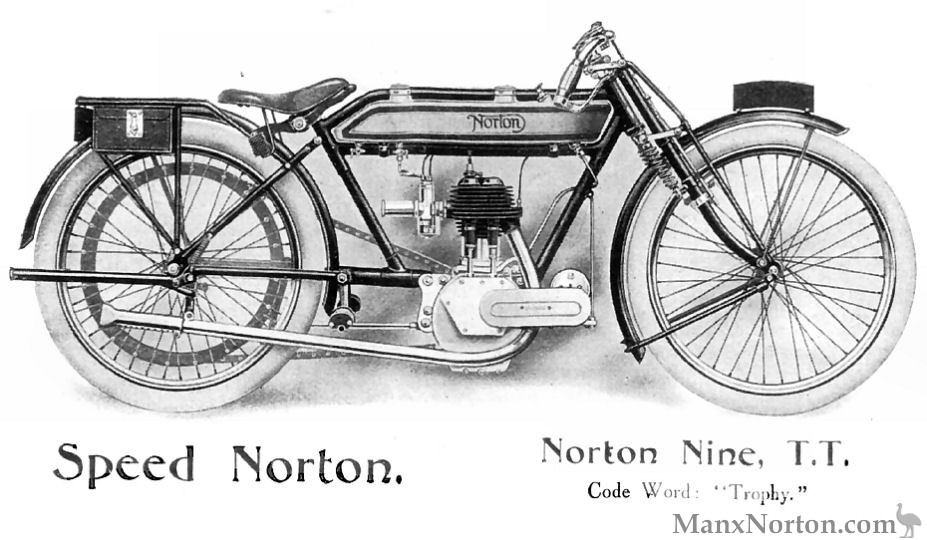
Speed Norton
Norton Nine, T.T.
Code Word: "Trophy."
2¼ in. Dunlop Tyres. Adjustable Pulley, giving gears from 6 to 4 to 1. B. & B. Carburetter.
Wheel base, 54 in. Weight, 203 lbs.
An epicyclic 2-speed gear and clutch or Philipson Governor Pulley may be fitted to the engine as an extra.
An all-round sporting model with high speed possibilities. It is fully equipped for the road ; the comfortable riding position and great ease of steering make it eminently suitable for long distance competition work or fast touring. It is considered the most efficient T.T. machine and hill climber made.
The SILENCER of this and other speed models is of unique design, being so arranged that any degree of either silence or freedom of exhaust may be obtained. This desirable feature enables one to ride with quietness and decorum to the venue of competition, and then adjust the muffler to give the maximum freedom of exhaust permitted by the judges.