
Matchless.
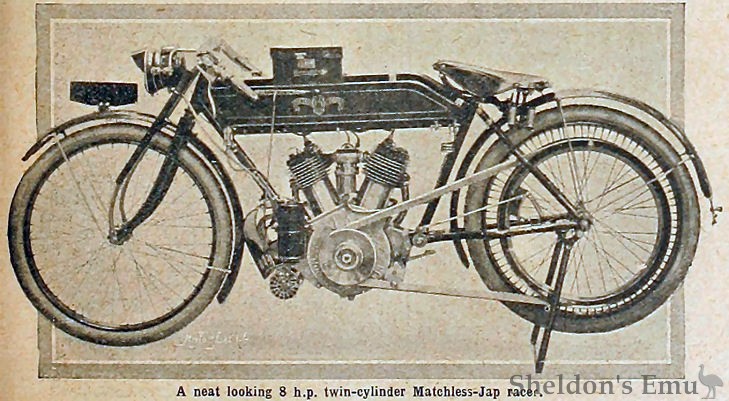
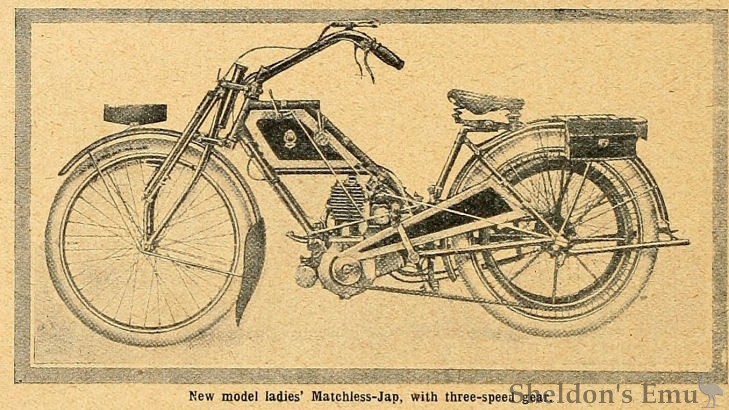
Messrs. Collier and Sons will exhibit ten Matchless motor bicycles and two sidecars, also C. R. Collier's famous red 7 h.p. racer, on which he has made world's records for the kilometre, mile, and live miles. The lady's 2½ h.p. m.o.i.v. is fitted with a three-speed gear, and the engine is vertically placed in a new open frame. The following men's machines will be on view : A 3 h.p. twin, m.o.i.v., 60 x 75 mm. engine; a 3½ h.p. single-cylinder, 85½ x 35 mm., m.o.i.v., free engine clutch; a similar machine with three-speed gear; a 5 h.p. twin, 85 x 55 mm., overhead valves, fitted with the Matchless six-speed gear, as used in the T.T. races; a 5 h.p. twin, 75 x 85 mm., m.o.i.v., with free engine clutch hub, and special touring equipment. In addition to the above there will be six standard models fitted with the latest ball bearing Bosch magnetos, spring front forks, adjustable pulleys, stands to both wheels, number plates, bags, and tools.
The principal improvements introduced by Messrs. Collier are the six-speed gear already referred to, stronger mudguards with metal side shields to front wheel, and back mudguard fixed without stays.
The Matchless engine will make its first appearance. Several notable improvements will be noticed in this engine especially the timing gear, valve lifting mechanism, and compression taps, whilst all running parts will be absolutely interchangeable with the J.A.P. engines, which Messrs. Collier have previously used so successfully. The adjustable pulley has a positive locking arrangement.
1911 Olympia Show - The Motor Cycle November 16th, 1911. Page 1220B
MATCHLESS, No. 35.
H. COLLIER AND SONS, LTD., Plumstead, S.W. – Messrs. Collier and Sons are exhibiting a very complete range of models. Two of the 3½ h.p. single-cylinder machines are shown with the new Matchless engine, one with a free engine clutch, and a similar machine with a three-speed gear. Their machines are on standard lines throughout, having a low saddle position and a very complete equipment of tools. All fittings, such as stand and carrier, are neatly fixed and carried out in a workmanlike manner. A feature which is bound to attract attention on this stand is C. R. Collier's 7 h.p. racer on which he has attained such marvellous speeds at Brooklands, incidentally capturing two world's records. This machine is the fastest motor bicycle in the world. A neat open-frame model is also shown with a 2½ h.p. engine placed vertically in the frame. This model is supplied with three-speed gear as a standard.
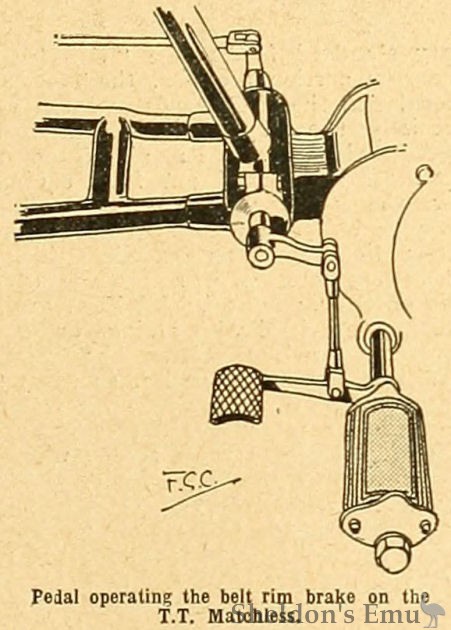
This model is similar to that used by the Collier brothers in the Tourist Trophy Race. The six-speed gear is well worth close inspection, and was described in our Tourist Trophy issues. It is sufficient, therefore, to say here that it consists of an expanding engine pulley, the belt slack being taken up by a simple movement of the back wheel. This movement is very substantially carried out, ensuring rigidity for the back wheel.
Another new model has a 3 h.p. J.A.P. twin-cylinder engine, 60 x 76 mm., with the valves disposed at the side. This is an extremely neat power unit, and should have a great future for those who require an efficient medium-weight twin. On all these models it should be noticed how carefully the mudguarding has been carried out, which is, of course, a very important feature from the rider's point of view. This is the first time the Matchless engine has been exhibited, and it is noticeable that the valve-lifting mechanism and tuning gear are particularly neatly constructed. All except the 2¼ h.p. ladies' model, illustrated last week, have toolbags on the top tube. Features common to all models are inverted handle-bar levers. a large magneto shield, carrier and stand acting as stays for the mudguard, screw-down filler caps of large size, adjustable drip-feed lubricator, and petrol gauge projecting from side of tank. A generator bracket is formed on the left hand fork link.
1911 Olympia Show - The Motor Cycle November 23rd, 1911. Page 1280