
Veloce.
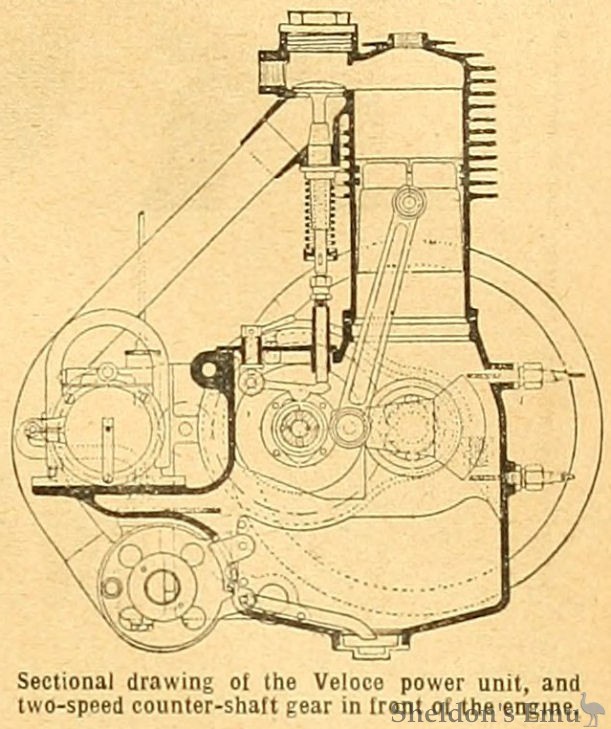
Last week we were shown a most ingenious motor cycle manufactured by the Veloce Co., of Birmingham. The frame is on standard lines, having a dropped top tube, Druid forks, and side flaps to front guard, but the engine and two-speed gear are distinctly novel. The engine has a solid crankshaft supported on one side only by two ball bearings; between these bearings lie two gear wheels, fixed to the crankshaft. In the front part of the crank case lies a counter-shaft carrying two special bronze gear wheels, formed to take a double conical clutch within. These gears are always in mesh, and one of them runs at half engine speed and acts as a timing wheel. The double-faced clutch is actuated by a quick thread screw, and locks either one or other of the special bronze wheels to the counter shaft, on the near side of which is fixed a 6½in. pulley.
The lubrication is most ingenious. In front of the counter-shaft and driven by an intermediate wheel lies the magneto and a small eccentric oil pump. This pump draws oil from a filter placed in a large sump below the crank case and delivers it, through a regulator with a sight indicator, through a pipe joined to the gear case into the hollow counter-shaft by means of a cap constantly filled with oil from the pump. From the counter-shaft oil holes are drilled to the gear bearings and cams, the holes in the cams being arranged so as to throw oil direct on to the big end bearing, it then returns to the crank case and sump.
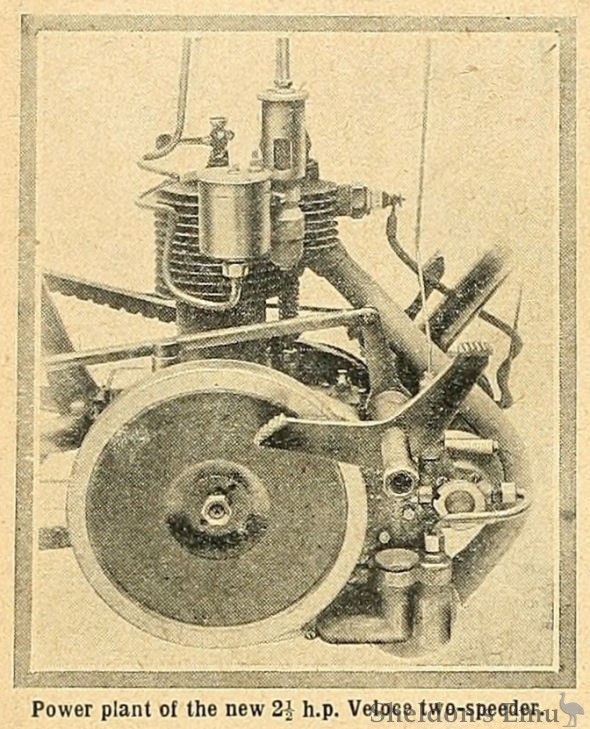
The engine has a bore and stroke of 68 x 76 mm., and is fitted with a 9¼in. outside flywheel. Both valves are mechanically operated and are situated in front of the cylinder, the inlet over the exhaust. No oil reservoir is fitted to the tank, as the sump holds two pints and is fitted with a large filler cap from which the level can be seen. The gears are operated by a double pedal on the right side of the machine, and from a short run we found the machine and gears very silent and easy to work. The engine is rated at 2½ h.p., and is fitted with Bosch magneto and B. and B. carburetter. The large pulley in front of the engine should make for immunity from belt slip. The option is given of three gear ratios - 5 to 1 and 8 to 1, 5½ to 1 and 9.35 to 1, and 6 to 1 and 10.2 to 1. A point we raised in connection with the lubrication system as to whether the crank case could be kept oiltight with the considerable amount of oil used was answered in the affirmative, and certainly the engine we tried was almost spotless.
1911 Olympia Show - The Motor Cycle November 9th, 1911. Page 1176
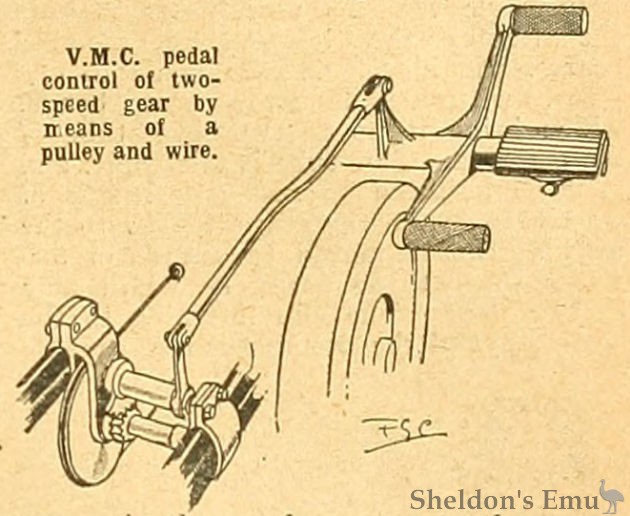
V.M.C., No. 58.
Veloce, Ltd., Fleet Street, Birmingham. – This is one of the most up-to-date bicycles in the exhibition. The two-speed gear and clutch are incorporated in the engine, forming one unit. The clutch of the double cone type is capable of being moved to either side, so that either one or other of the gears is put into action. Only six gear wheels are required, including the magneto and gear pump drive. The gears are operated by means of a pedal. Lubrication is arranged on thoroughly up-to-date lines – a rotary oil pump, driven from the end of the magneto-shaft, draws oil from the sump and the crank case to a large filter inside the crank case, which on its way passes through an indicator, raising a light rod passing through the tank, showing the rider that the lubricant is flowing properly. In case of an excess of pressure, a plunger is forced upwards, uncovering an extra hole, so that the excess flows back to the reservoir. The oil is then passed through a passage in the crank case on to the gear-shaft, the gear wheels, and clutch operating mechanism. A hole in the cam is so arranged that it allows oil to be sprayed in the cups on the connecting rod, whence it passes into the cylinder and to the gudgeon pin. The gear wheels always run in an oil bath, the level of which is kept constant by the oil pump. Care has been taken to avoid leakage of oil in the joints and bearings. Sufficient oil is carried in the crank case for over 200 miles. The diameter of the driving pulley is 6in., so that an efficient belt drive is provided. The whole of the tank is devoted to the carrying of petrol, and there is room tor l½ gallons. The frame is dropped at the rear, and follows standard lines. The magneto is carried forward, and is well protected by means of a shield.
1911 Olympia Show - The Motor Cycle November 23rd, 1911. Page 1251.
...cyclists to learn that the well-known English firm, Veloce Limited, Fleet-street, Birmingham, have accomplished something in motor cycle construction that has never been hitherto attempted, and the success this firm has met with placing upon the market a reliable machine which overcomes the defects mentioned above promises to revolutionise motor cycling. For, in designing the V.M.C. engine and motor cycle, Veloce Limited have attained their object, namely, to provide a machine which can ridden and controlled in the thickest traffic without fear of damaging the gears when changing, or ruining the engine for want of lubrication. The makers have also guarded against excessive wear of belt due to small pulleys and short drive.
NZ Motor and Cycle Journal, 25th April 1912.

L. 2½ h.p. Veloce engine, showing mechanical lubricator and oil pump under crank case, also outside flywheel and overhead inlet valve arrangement.
R. The complete machine. The large diameter geared down engine pulley will be noticed.
A RUN ON THE VELOCE.
ON a recent visit to Birmingham we accepted an invitation of the Veloce Co. to sample the running of one of their 2½ h.p. machines. The day was not auspicious, for" all the morning it poured with, rain, and in the afternoon dried up just enough to give the tramlines and setts [1] a treacherous coating of grease. However, the low build and light weight of the machine emboldened us to make a start, so the low gear was engaged and the machine given a push, whereupon the engine started to fire slowly , so slowly, in fact, that we were able to depress the gear pedal to the free engine position with great ease and then mount the machine in comfort and tuck in coat tails, etc., before engaging the clutch. The gears are operated by a rocking pedal with the left foot, pressure backwards engaging the low ratio, and forwards the high.
The Low Gear Seldom Needed.
On letting in the low gear the machine slid gently away, and after slight acceleration in went the high without a suspicion of jerk. As far as power was concerned the low gear need never have been used, but we found it a great, blessing in the thick traffic and on the greasy roads. A slight sing in the gears was noticeable but not unpleasant, whilst the exhaust and the valve timing gear are beautifully quiet.
Through seas of mud we churned our way all morning, and though the particular machine lent us was fitted up in T.T. style with only regulation width guards they were so well arranged that the mud thrown up was not excessive. In the afternoon we had a practical demonstration of the advantages of forced lubrication, for on slippery roads in thick traffic one is relieved of all trouble in this direction by an occasional glance at the indicator, we noticed two points in particular, one was that the outside flywheel permitted the engine to run very slowly, and although it revolves in a contrary direction to the road wheels the effect is not noticeable; in fact, the machine is very steady in grease. Secondly, that throughout the heavy rain there was no suspicion of belt slip, which may be accounted for by the large geared-down engine pulley. The gear ratios used were 5½ to 1 and 9½ to 1 approximately.
The Works Organisation.
On returning to the works Mr. Taylor showed us round, and we were delighted with the jigs and tools in use and the careful way in which the parts are turned out. For the present year the 70 x 76 mm. engine only, will be manufactured, but it is possible that a larger model also will be marketed in 1913. Before leaving the works in Clissold Place we were introduced to Mr. Nat Woods, of Christchurch, New Zealand, who had just placed a considerable order for motor cycles with Veloce, Ltd.
The Motor Cycle May 23rd, 1912. Page 557
The Veloce London Agency.
The Wilton Cycle Co., Wilton Road, S.W, have secured the sole London agency for the Veloce motor bicycle, the excellent running of which was lately referred to in these pages.
The Motor Cycle OCTOBER 24th, 1912
Olympia Show
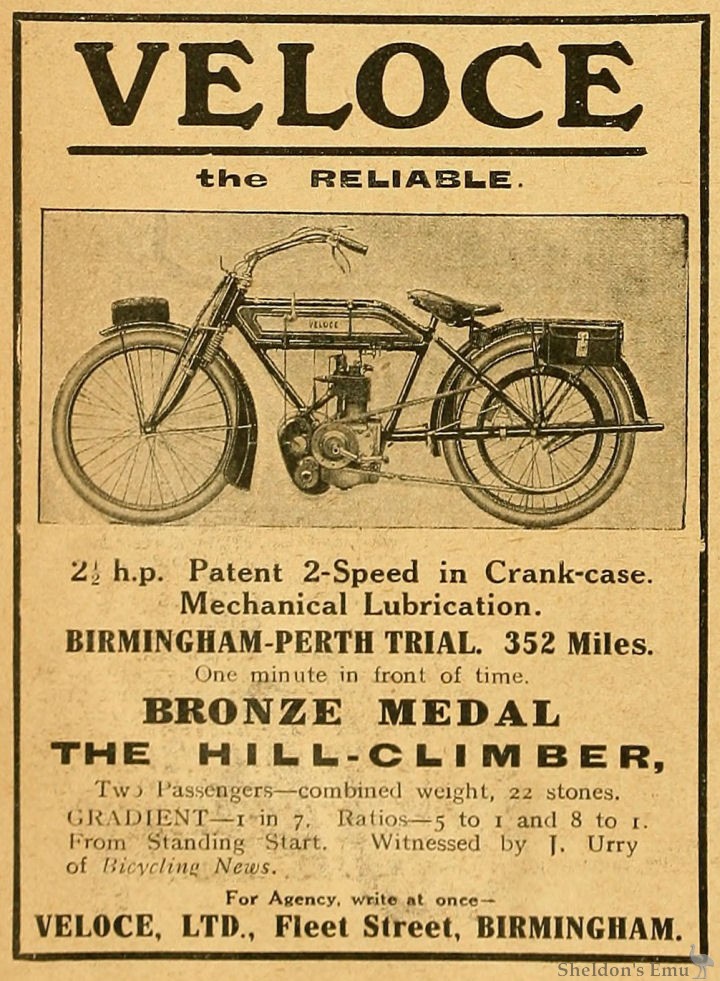
A very interesting and handy-looking machine is the Veloce, which made its debut at the Show. This model also is fitted with a 2½ h.p. engine, and has a two-speed gear in the crank case, as well as a free-engine arrangement and forced lubrication. Its method of oiling is quite unique and gives no trouble. An indicator rod passing up the side of the petrol tank keeps the rider informed as to the proper flow of oil. It will be interesting to know how this little machine performs on the road. We welcome it as a very promising looking mount, and congratulate the makers on their enterprise.
The Motor Cycle DECEMBER 5th, 1912
Notes. 1. cobbled stone setts