


CHAPTER II
VARIOUS PRELIMINARIES
IN this chapter we assume that the reader has selected and ordered his new mount, and desires to get it on the road as soon as the various legal formalities and requirements have been satisfied.
The absolute novice is strongly advised not to attempt to ride the machine away from the works. This is courting disaster if the route involves driving through much traffic. Often an expert driver, who has been accustomed for years to driving a machine with throttle control action working in the reverse direction to that of the new machine, finds that he is not quite happy on this mount for several days. As we all know, the subconscious mind plays a great part in driving, and especially in a sudden emergency. The strong probability is that, when confronted with sudden danger and an instantaneous and unpremeditated decision has to be made, the wrong action would instinctively be taken, that is to say, the throttle would be opened wide instead of being shut, or vice versa, with appalling results. This has actually happened in quite a number of instances. The wisest course is to make arrangements with the nearest agent to have the motorcycle delivered for a nominal charge by one of his employees. A.J.S. dealers are scattered widely throughout the United Kingdom, and no difficulty should be experienced in this connection. First supply the dealer with the registration licence before the machine can be delivered. One of the largest and most conveniently situated spares stockists in the Metropolitan area is H. Taylor & Co., Ltd., of 135 London Road, Kingston-on-Thames (Branch: 2 Tichbourne Court, W.C.l). Buyers resident in London would do well to purchase their spares direct from the manufacturers at Plumstead. It is also well to remember that at Plumstead A.J.S. owners have at their disposal a comprehensive A.J.S. Service Department capable of dealing with any repairs and overhauls.
Registration and Tax. All motor-cycles are subject to registration and taxation, and a machine cannot be used on the highway until a registration number has been allotted to it and a licence obtained from the local borough or county council office. This registration or index number belongs to a machine until such machine is no longer used on the highway. If, after expiry of a licence, no renewal is made for a prolonged period, the authorities must be informed of the reason in advance. In the case of motorcycles the tax is to be on cubic capacity, not a weight basis.
There has been persistent urging by many people for the reintroduction of a petrol tax, but so far no change has been made. On and after 1st January, 1933, 150 c.c. machines will be taxed at 15s. per annum, 150-250 c.c. at 30s. per annum, and 250-1000 c.c. at £3 per annum.
A licence application form (R.F. 1/2) is obtainable from any head post office, and must be very carefully filled in and posted to the licences dept, of the county council in whose area the machine is usually kept. Certain data, e.g. engine No. and frame No., will have to be first obtained from the dealer, if the machine is not delivered by rail. On page 31 a portion of an application form is reproduced. It will be observed that quarterly licences as well as annual licences may be taken out at the rider's discretion. Common sense dictates what licence should be taken out under the prevailing circumstances. A point to be noted, however, is that a post office can only issue renewals of the same type as already existing, that is to say, that a quarterly licence can only be renewed as a quarterly licence, and an annual one as an annual one. Application for annual licence renewal must be made between the 1st and 15th of January each year. In calculating the weight unladen, the weight of all parts normally used must be included, exception being given only in the case of fuel, water, oil, accumulators, and loose equipment.* The registration authorities, if they doubted the accuracy of a weight declaration, might call upon the owner to have the machine weighed on an approved weighbridge in the presence of authorized officials. When selling a machine, the licence, if unexpired, may be handed over to the new owner, and the registration book must be handed over to the new owner, who is required to pass it on to the registration authority after entering particulars of ownership. Both vendor and purchaser must notify the authorities of the transaction. It should be thoroughly understood that every taxation licence is issued for use with one machine, and one only. It is kept for use with that machine, whatever changes of ownership may occur. In the registration book all changes of ownership are recorded, as well as full particulars of licences issued. The book thus forms a complete record of the machine's history, and, incidentally, is of no little interest to the purchaser of a second-hand machine.
If a motor-cycle is registered as a solo machine, and the motorist decides to attach a sidecar, he must take out a fresh licence, and return the existing one, plus the balance due on a sidecar, i.e. 20s. All 1932 solo A.J.S. machines, except models T5 and TB6, are taxed at the rate of £3 per annum. These two lightweight models, weighing under 224 lb., are subject to the 30s. per annum tax provided their registration is effected before 1st January, 1933, and they will thereafter continue to be taxed at this rate.
* In the event of the authorities requiring a TB6 to be weighed the tools must be removed or it will be taxed at £3.
When the machine is on the road it must carry the licence - which is in the form of a disc - in a conspicuous position, visible always by daylight from the near side of the machine. The licence should be carried in a weatherproof holder, and may be mounted (1) on the front number plate, (2) on the handlebars, (3) at the side of the tank, (4) in the case of sidecar machines on the side panel of the sidecar body. The licence is of a distinctive colour, which is changed annually, and therefore a police officer can tell at a glance when an annual licence is out of date. Fourteen days' grace, however, is allowed from the expiry to the renewal of an annual licence.
Driving Licence. It is unlawful to drive any motor vehicle on the road without a driving licence bearing the rider's signature, which may at any time be demanded by a police officer together with a "certificate of insurance." Five days' grace is now allowed, however, for the licence to be produced in person at a police station specified. The fee for a licence is 5s., and it is valid for one year from the day it is issued. Applications should be made to the licences department of the county council in whose area the motor-cyclist normally resides. If the applicant is 16 years of age, he can, subject to a certain standard of physical fitness, obtain a licence to drive a motor-cycle only; but if he be 17 or over, a licence enabling him to drive a car or motor-cycle is, subject to the same condition, obtainable. For forging or altering a licence, the offender makes himself liable to two years imprisonment.
With regard to physical fitness, no test is compulsory, but a driver is required to make a declaration on Form DF1 that he suffers from 'no such physical infirmity' as to render him a source of danger to the public. A 'source of danger' includes a man having abnormal eyesight to the extent that he cannot read a car number plate at a distance of 25 yd., has lost a limb, has muscular paralysis, is liable to fainting or giddiness, or suffers from any form of epilepsy. It should be stated, however, that if after the licence application form has been filled up, the licensing authorities are doubtful as to the driver's fitness, they may decline to issue a licence, but the would-be motor-cyclist can demand an official test for driving fitness, the fee for which is 10s. Defective eyesight, epilepsy, or giddiness definitely bar a man from obtaining a licence. The penalty for making a false declaration is a fine not exceeding £50, and if done deliberately may incur imprisonment. The driving licence is strictly non-transferable, and is liable to be endorsed or even suspended at the jurisdiction of any magistrate, under the Motor Car Act of 1903. No police officer may lawfully peruse the endorsements at the back of a licence. This eliminates prejudice that the officer might have against the offending motorist before deciding to report him for contravening the law. It is not, however, wise to roundly abuse an officer for this, or for any other reason. Remember that the British policeman, in spite of all the intolerance often unjustly attributed to him, is a very fair, reasonable, and just man, when treated with due respect. When treated otherwise, however, he is a decidedly stiff proposition to deal with.
Third-party Insurance. It is now compulsory for every motorcyclist to insure himself against third-party risks. Failure to do- so involves severe penalties. The law now requires that every person knocked down by reason of careless or negligent driving shall be able to recover from the motorist or motor-cyclist, through the insurance company, damages up to '25 for every accident he may be involved in. The premium for third-party cover is very reasonable, being about 30s. per annum unless pillion riding is indulged in or the policy covers the driving of more than one machine, in which case a higher rate is charged. If a pillion passenger is carried the insurance policy must cover him, and likewise any sidecar passengers. On paying the insurance premium and supplying all necessary information to the company, they will issue to the applicant the all-important 'Certificate of Insurance,' which must be sent with the driving licence application form and afterwards produced on demand. Riders already insured thereafter receive reminders from their insurance companies before the policy expires, and on renewing them automatically receive their new 'certificates.' Altering or forging a "certificate " is a criminal offence. If a certificate cannot be produced on demand a summons will follow unless the rider can produce the certificate at a police station specified within five days.
In the case of a new machine it is, of course, desirable to take out an insurance policy covering besides third-party risks damage to the machine. If the machine is bought on the hire-purchase system this will be insisted on.
It is best to take out a comprehensive policy with a reputable company. Most insurance companies give no-claim bonuses. It therefore does not pay to worry a company over trifling and inexpensive details. All risks can be covered for a medium power machine for about £6 per annum. The insured should guard against any conduct likely to invalidate his policy. All clauses should be very carefully studied and complied with ; otherwise in the hour of need the insurance company will remain neutral and repudiate liability, citing as its reason the violation of some clause of its policy by the insured person, and the rider may have to foot the bill himself.
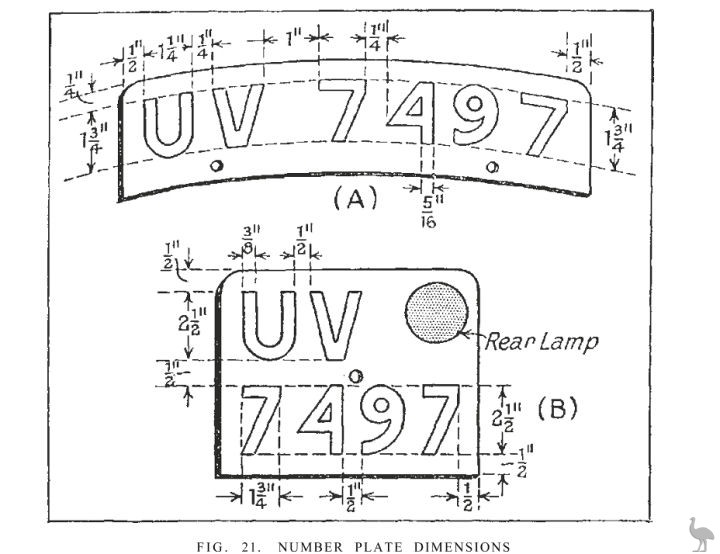
At A are shown the old dimensions still used for a front plate and at B the new dimensions required for rear plates
Number Plates. It is not sufficient merely to have a number plate on the machine. The number plate must be in accordance with a definite scheme and definite dimensions laid down. Up till 6th October, 1930, both number plates were permitted to be in accordance with the dimensions given at A (Fig. 21). This still holds good in respect to the front number plate, but as regards the rear plate new dimensions are now specified. They must be as shown at B (Fig. 21). All letters and figures must be 2½ in. high, with a total width for each letter or number of 1¾in., except in the case of the figure 1. Every part of every letter and figure must be 3/8 in. broad. The space between adjoining letters and between adjoining figures must be ½ in., and there must be a margin between the nearest part of any letter or figure, and the top, bottom, and sides of the black background of at least ½ in. The lettering if placed above the numbers need not be centralized, but the letters themselves cannot be separated more than the prescribed ½ in., and there must be ½ in. space between the bottom of the lettering and the top of the numbers. The rear plate must be illuminated after dark by a suitable tail light.
Audible Warning of Approach. The exhaust noise does not come within this category ; the law stipulates that an independent warning mechanism must be provided on the machine. This may be in the form of a mechanical, electric, or bulb type horn. They all have their merits. For touring purposes a bulb type is suitable, but for the sports rider, mounted on a fast and perhaps slightly noisy machine, a mechanical horn, mounted on the handlebars, or an H.F. electric horn, is invaluable. The ideal is to have two, but do not buy one of those cheap horns which begin by sliding down the handlebar towards the steering head, and end by dissolving into their component parts.
Never use a horn unnecessarily - particularly the mechanical type - for it is apt to offend people when thus used, and remember the sounding of the horn with the machine stationary is technically an offence!
Lamps. During the period between one hour after sunset and one hour before dawn (summer time) it is compulsory to show a white light facing to the front and a red one to the rear in the case of both solo and sidecar machines. The sidecar lamps must be fitted on the offside so as to indicate the entire width of the vehicle. At present it is compulsory to fit a rear lamp, not just a reflector. Recent legislation now makes it a punishable offence to take any mechanically driven vehicle on the highway at night without a red rear lamp fitted. Reflectors are allowed only on pedal cycles.
Lighting sets are either of the acetylene or electric type. Electric lighting is now becoming almost universal, and has revolutionized night riding; for there can be no possible doubt that it is far and away the best of the two types. It is, of course, purely a matter of expense. (See pages 2, 25.)
Other legal aspects affecting, chiefly, the conduct of the driver, will be considered in Chapter III. We may assume that the makers have complied with the law in the fitting of brakes and sidecar. The former, however, must be kept in proper order, otherwise a breach of the law is incurred.
Speedometer. Many people are apt to regard this instrument as a pure luxury. This view is wrong ; it is practically a necessity. By its agency both your tyre mileage and your fuel consumption can be accurately estimated ; it is of vast service in watching the tune of your engine by informing you when the machine is losing speed, or climbing a hill slower than it used to do, and by indicating whether any mechanical adjustments that you may have made result in an increase of engine revolutions. Watching the fluctuations of a speedometer needle is at all times fascinating, and in long distance tours the instrument is of great assistance. Tank- fitted or tank panel-fitted 'Smith' speedometers driven from the gear-box are not standardized on any model, but can be had as an extra. The 'Smith' can be fitted on all 1929-33 models.
All speedometers work on one of two principles - the centrifugal or the magnetic - and the average cost of an instrument is £2 to £2 10s. Most popular among the centrifugal type are the 'Cowey,' the 'Smith,' and the 'Watford.' The 'Stewart' works on the magnetic principle, however. All these instruments are wonderfully accurate, arid require little attention. An ultra-modern instrument is the 'Bonniksen' time speedometer, which registers both time and distance, thereby elucidating the average speed. Those owners of early A.J.S. motor-cycles are strongly advised, also to fit one of the above mentioned instruments to their machines; a front wheel drive is easily arranged.
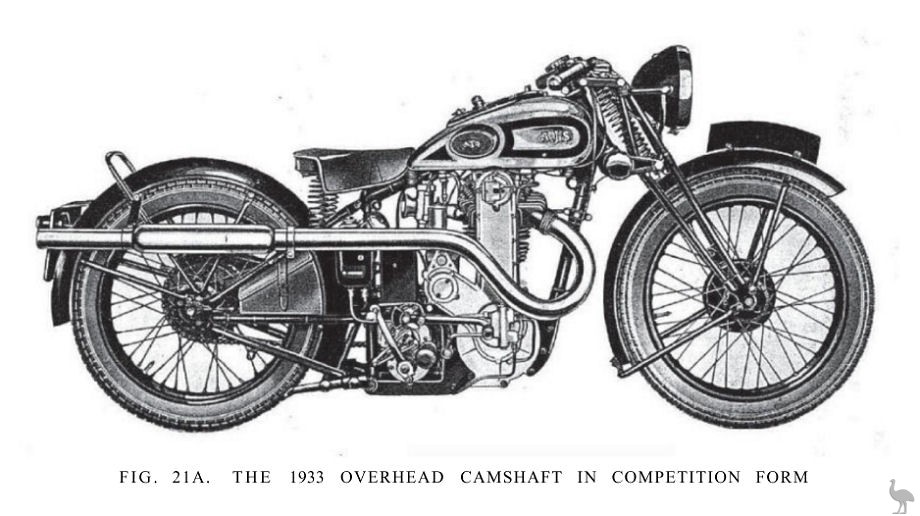
Joining a Club. At the present time there are numerous clubs throughout the country that are willing to accept members for a small fee. These clubs frequently hold meetings, including hill climbs, reliability trials, and social events. There is no doubt that one derives many advantages from joining a local club. But if you value your machine do not enter for one of those freak scrambles which occasionally take place, which assume the form of paper chases, in which paper is substituted by fragments of the leading pack in the form of fish tails, silencers, and sundry loose equipment. Enter for the more sober reliability trials and hill climbs. For competition and track racing the new overhead camshaft A.J.S. shown in Fig. 21A is an ideal mount.
This machine is available with a 3-46 h.p. or a 4-95 h.p. engine, and a racing edition is available as an alternative to the competition type shown (see p. 27)
Besides these smaller clubs there are three great road organizations, one of which it is advisable to join. Innumerable benefits are obtainable on payment of a nominal annual subscription. They comprise, among other things, free legal advice, 'get-you-home' schemes, general road assistance, and use of road telephones.
In some cases the smaller clubs are affiliated to one of these bodies. The addresses of these clubs are as follows -
Royal Automobile Club, Pall Mall, London, S.W.l.
Automobile Association and Motor Union, Fanum House, New Coventry Street, W.1.