
CHAPTER IV
IN this chapter we will consider briefly the expenses connected with motor-cycling, and thereafter we will discuss some matters relating to touring. Most motor-cyclists, sooner or later, have a desire to extend their field of activities. They become tired of constantly wandering over their old routes, which are usually confined to a radius of about 50 miles from their homes, and they wish to set out on a long distance tour, either in this country or abroad. For the present let us deal with running costs.
RUNNING COSTS
Cost of the Machine. This is the principal cost of motor-cycling, representing as it does an initial outlay of some £50 or more, according to the type of machine purchased. But remember this is really an investment, and the expended capital can be recovered minus a certain sum representing depreciation on selling the machine. Any A.J.S. model can also be bought on the hire- purchase system.
Depreciation. This ugly item is an added reason for purchasing a reputable machine in the first place, for such machines always command a fair market price. It is a hideous fact, but nevertheless true, that the purchaser loses at least £5 in removing the machine from the shop window. From that time onwards the machine can no longer be regarded as new. It stands to reason that depreciation* depends mainly on the way the machine is kept, but it also depends largely upon the age of the machine. Many people will not buy a machine that is more than three or four years old (old in the sense of date of design). Therefore, unless the rider intends to stick to the machine until it is thoroughly worn out, it usually pays to sell after a couple of years' riding. The vendor may then reasonably hope to recover at least 50 per cent of his capital expenditure. If the machine is in sound condition, and the appearance is still good, he may get back as much as 70 per cent. In reckoning the cost of motorcycling, this factor must be taken into consideration. Reckless or careless driving and general neglect of the machine cause depreciation to be very rapid, and motor-cycling becomes a costly affair.
Cost of Licences. This has been already dealt with in Chapter Depreciation is usually reckoned at 33/- per cent per annum.
II. It represents a very fair outlay to the motor-cyclist, and is rather disproportionate to the damage done to the highways. However, under the present system of taxation, it must be faced cheerfully.
Garaging. Keeping a solo motor-cycle at a public garage costs about 2s. 6d. a week on the average, or £6 a year, and a combination an extra shilling a week. If circumstances permit, it is well worth while erecting a cheap shed or buying a portable and collapsible shed ready-made. Overhauls can then be carried out in perfect seclusion and, moreover, no objection can be made to coming in at " unearthly hours." Such a shed should not cost more than '4 or '5, and, of course, it will last indefinitely. Due regard must be paid to fire regulations (see page 60), and before erection, plans of the structure must be submitted to the local surveyor for approval.
Petrol Consumption. Petrol consumption depends on many factors. Fast driving or driving on low gears results in a high consumption. Also a badly tuned carburettor will not contribute to fuel economy. Speaking generally, however, the average 3-49 h.p. machine should have a fuel consumption of at least 80 m.p.g., and when specially tuned should do about 90 to 95 miles on a gallon of spirit. A 4-98 h.p. machine should do at least 70 m.p.g. solo, and at least 50 m.p.g. with sidecar.
Oil Consumption. One quart of oil should suffice for a mileage of at least 500, with considerate driving of a 3 -49 h.p. solo machine and at least 350 for a 4-98 h.p. model.
Tyres. Tyres, when well inflated, should have a useful life of from 10,000-12,000 miles. A certain amount of luck enters into the question, for a severe gash due to a piece of broken glass may practically ruin a new tyre, but this rarely happens. Some words on tyre maintenance are given in Chapter III (see page 46). When buying new tyres it always pays to get the best, and nothing but the best. Firestone tyres are standard on all A.J.S. machines.
Sparking Plugs. Quality here again is important. Cheap plugs give poor service, and soon want renewal. Buy plugs as recommended by the makers (see page 47). These should only need annual renewal. Unsatisfactory plugs often cause mysterious loss of power.
TOURING
Dress. Long distance touring requires careful preliminary consideration regarding dress if any enjoyment is to be derived from the tour - or rather if acute discomfort is to be avoided. The all-weather motor-cyclist has to cope with every variety of heat and cold, wind and wet. For short distance runs dress does not matter much. All that is required is protection of the clothes and eyes from dirt. Clothing for this work is left to the rider's fancy. Some go about clad in flying suits, helmet, and so on. Others go about dressed in riding breeches, leggings, and a bright coloured beret. All this is a question of individual taste, but where touring is concerned, the rider must have plenty of warm waterproof clothing and goggles should be worn. Constant and prolonged exposure of the eyes to cold and dust produces chronic inflammation, and is thoroughly bad for the eyes.
All-Weather Riding. Whilst it cannot be denied that riding in spring and summer weather is very pleasant, winter riding has its charms. Many riders openly avow that they do not care what the weather is like. They get plenty of satisfaction under all conditions. This is, perhaps, true in the case of a certain class of rider, but not for the majority. This type of motor-cyclist keeps himself warm through sheer excitement, not woolly underclothing ! However, we will deal with the average rider, who places bodily warmth foremost.
The commonest type of winter dress consists of the ordinary buff waterproof coat and leggings, the latter either buttoning up the sides, or lacing. Most accessory dealers sell this type of apparel. They are, however, rather clumsy, and apt to get torn and become generally dilapidated looking. A far more satisfactory garment is one of the surplus R.A.F. Sidcot flying suits with fur collar, that can be obtained for the modest sum of about three guineas. Better still, get a leather coat and trousers to match. No definite instructions regarding apparel can be given. It is all a question of taste and money available.
Headgear. A tight-fitting cap is the most suitable headgear for normal motor-cycling purposes. If predisposed to blow off, it may be reversed, that is, placed peak to the rear. Many riders are inclined to dispense with headgear altogether. This is all right provided that the hair is not liberally swamped with hair grease. In this case dust and grit accumulate horribly. For long distance touring, in cold weather, the helmet is unchallenged ; it keeps the ears and face warm and free from road dust. For competition riding (reliability trials excluded!) the crash helmet is essential. In all track racing it is compulsory to wear such a helmet.
Gloves. The problem of keeping the hands warm and at the same time enabling them to finger the controls sensitively is a difficult one. Many fast riders prefer to do without gloves, saying that they would rather have the finger tips cold than run the risk of being cold all over. Woollen gloves are dangerous, as they may open the throttle by catching on the lever when removing the hand to change gear. Gauntlets keep out the cold, but spoil the sensitiveness of control. An attempt to solve the glove difficulty has been made by several firms who market a rubber muff which fits over the handlebar grip and controls. This idea is very sound, and should the rider experience great discomfort through cold hands he cannot do better than obtain a pair of these muffs.
Preparing for a Tour. If the reader is contemplating an extensive tour, and is a member of one of the Associations mentioned in Chapter II, he should write to the secretary of the Association concerned and apprise him of the intended route. A detailed itinerary will then be supplied, and useful information concerning state of roads, etc., given. When undertaking a Continental tour, the society, if requested to do so, will obtain the member's passports, carnets, or triptiques, and thereby eliminate the necessity for leaving deposits when visiting a foreign country.
Maps and Guides. These are very necessary adjuncts to touring, and indeed the fascination of planning a tour is part of its pleasure. The route should be traced out in red ink on the map to facilitate reading. Large scale Ordnance Survey maps are the best, as they show all contours, and the route may be chosen so as to avoid all the worst gradients, unless the tourist wishes to include all the fine view points, and then, of course, he will select the hilly roads. The tourist, if his time is limited, should split up the route into sections, allotting so much time for each section. He can then run to a definite time schedule. For long distance touring in the United Kingdom, the Michelin guide is of great value, giving as it does all particulars regarding hotels- repairers, and other useful information.
Spares. There is little need to carry more than a repair outfit, pump, complete tool kit, spare plugs, spare tubes, spare chains and links, one spare valve complete with spring, washer, and cotter, and a complete repair outfit for tyres, as before mentioned. Pack the tools tightly with rags. Also take some spare bulbs.
Luggage. For touring purposes, it is obviously senseless to burden up the machine with luggage. Carry on the machine the absolute minimum amount necessary. Send the rest by rail. We will not defile these pages with a description of all the gear and tackle necessary to keep man in a civilized and respectable condition. We will leave that to the reader's common sense.
Taking the Machine Abroad. The triptiques, referred to previously, enables the owner to travel in Finland, France, Italy, Holland, Belgium, Romania, Spain, Portugal, Russia, Norway, and Sweden, or as an alternative a member may get an International Customs Pass, issued by the A.C.U. and A.A. to members and non-members, whereby the highest continental duty payable suffices for all the countries forming part of the convention.
International Travelling Passes (duration, 12 months) are also issued, enabling the holder to travel in all countries which are parties to the agreement, without obtaining the special licences
or carrying special numbers in each country as hitherto. The Customs Pass concerns the customs duty payable ; the Travelling Pass is exclusively a licence for the machine and driver abroad.
It is no longer necessary for the tourist to be examined by a foreign official, to obtain foreign licences, or to undergo any other formalities. It is only necessary to obtain the International Pass and fix an oval plate to the machine with the letter G.B. painted in white on a black background. This plate must be illuminated by night.
Continental Rule of the Road, etc. As a general rule Keep to the Left and Pass on the Bight in Austria, Hungary, Portugal, and Sweden.
As a general rule Keep to the Right and Pass on the Left in Belgium, France, Germany, Holland, Italy, Russia, Spain. Switzerland, and the following provinces of Austria and Hungary, viz., Carniola, Dalmatia, Tyrol, Istria, Carinthia.
The speed limit in Belgium is 40 kilom. an hour in the country and 15 in town. Special regulations apply to Brussels. Most Belgian roads are very bad.
Lighting-up time in Prance is 15 minutes after sunset. Hear number plates must be illuminated. French roads are, on the whole, good. Cars and motor-cycles entering Paris are stopped, the petrol in tanks measured, and octroi duty charged.
The roads in Holland are generally good, but narrow and winding. No special limit is fixed on country roads, but motorists can be prosecuted for driving to the common danger. Some roads are closed to motor traffic.
The general rule of the road in Italy is to keep to the right, but it is frequently reversed in many districts and towns.
In Northern Italy and parts of Central Italy the roads are good and often excellent. In the Southern Provinces the roads are bad.
The speed limit in Spain is under 20 m.p.h, in parts.
GENERAL HINTS ON TOURING
A few general hints on the subject of touring may well conclude this chapter and, if acted upon, will contribute to the pleasure derived by the tourist -
1. Before setting out on a long distance tour satisfy yourself that the machine is in sound mechanical condition and that the tyres, which can mar or make a tour, are likewise in good condition.
2. See that you have aboard a complete tool kit and repair outfit and a few vital spare parts.
3. If you are driving a combination, put a passenger in the 'chair.'
4. When touring abroad remember that you are the foreigner, not those with whom you come in contact.
5. Never drive further in a day than you feel fit for, and keep the speed for the greater part at 25-35 m.p.h. Such a speed is not conducive to physical fatigue and enables you to see the country through which you are passing.
6. Avoid the big towns and cities as much as possible.
7. Plan the whole tour carefully before setting out.
8. See that you are fully insured against accident, and against third party risks and have the necessary "certificate."
9. Smear potato juice on goggles in wet weather to prevent blurring.
 |
|
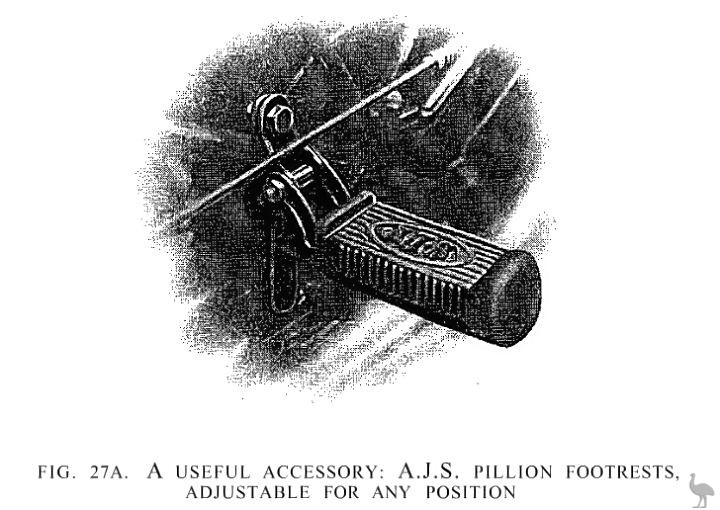
FIG. 27A. A USEFUL ACCESSORY: A.J.S. PILLION FOOTRESTS, ADJUSTABLE FOR ANY POSITION |
|
INTERNATIONAL MARKS An oval plate is used, the distinguishing marks of the country of origin, consisting of one or two letters, painted in black upon a white ground. | ||||||||||||||||||||||||||||||||||||
|