

CHAPTER VI
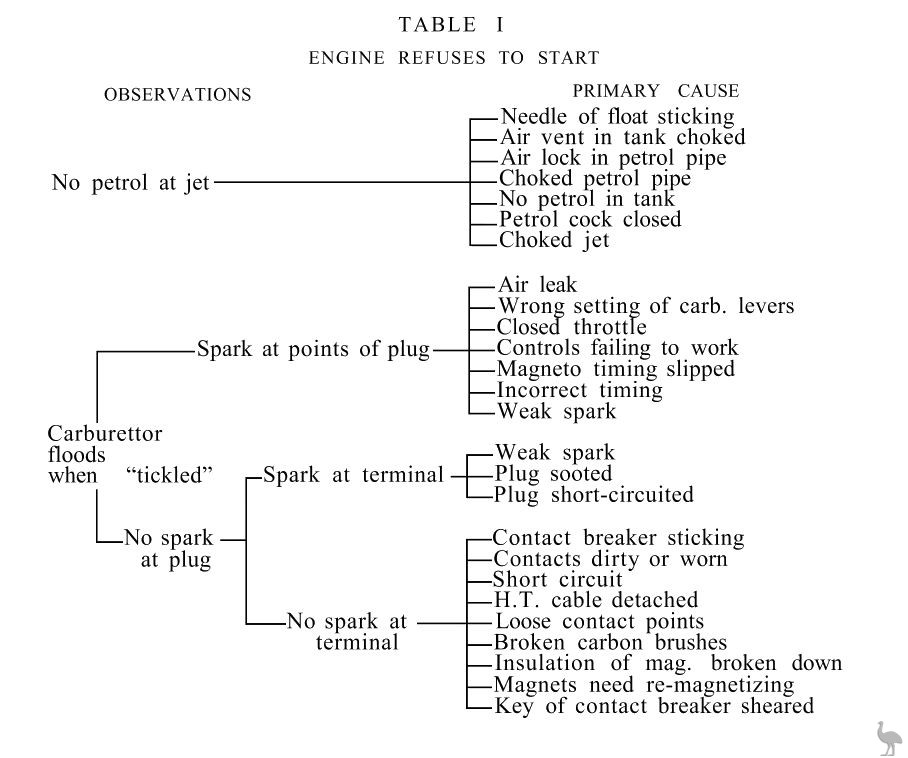
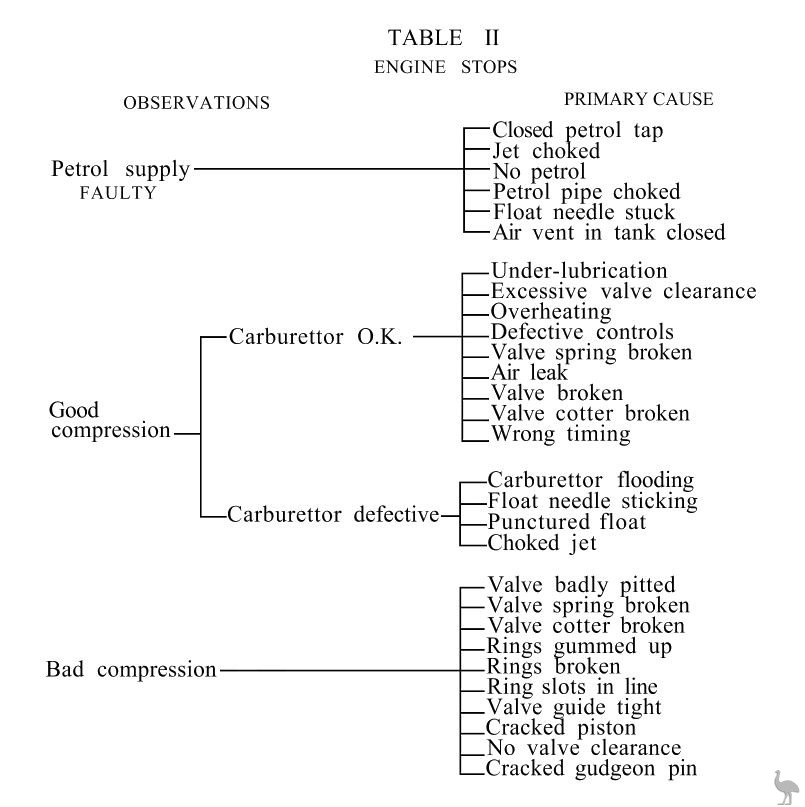
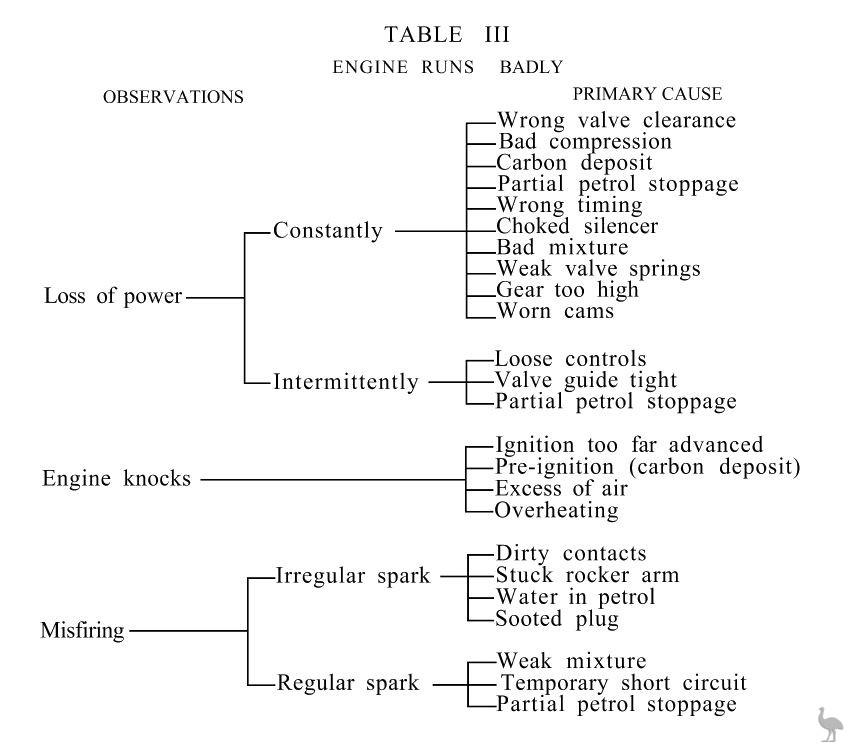
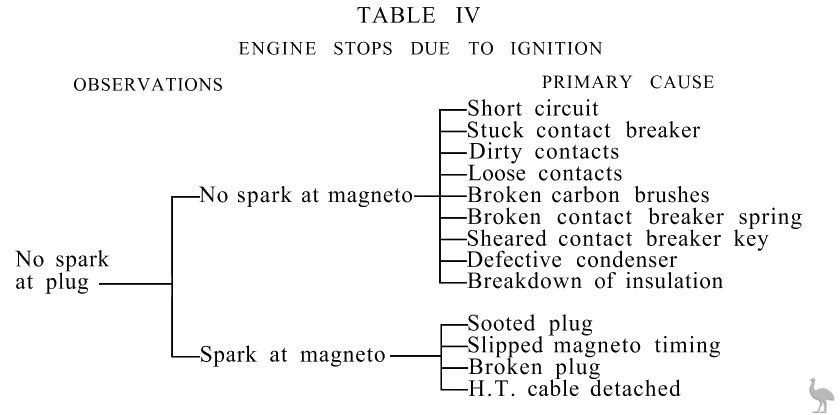
THE four tables given on succeeding pages enable: faults to be located readily by means of a system of elimination. The experienced driver can narrow the possible causes of trouble to a very small field almost immediately. Trouble's, however, are now so rare that little heed is paid to them until they actually arise. But it is advisable to be prepared for all contingencies. The chapter dealing with the engine should have given the reader a general idea of what troubles to expect. Remember that IF A CHARGE OF PROPERLY PROPORTIONED GAS IS COMPRESSED INTO THE CYLINDER, AND A SPARK OCCURS AT THE RIGHT TIME, THE ENGINE MUST FIRE. It cannot do otherwise. Troubles are
usually due to faults either in (1) the ignition system, (2) the carburettor, (3) the engine mechanism itself. In tracking down the origin of engine trouble, it is highly important to make a mental note of the symptoms displayed immediately before the engine 'gives up the ghost.' This should greatly assist quick and accurate diagnosis. Do not get 'hot and bothered' over an engine, and start vigorously pulling things to pieces - they have all to be replaced, by the way, but calmly reflect upon the probable cause of trouble and act accordingly. It may be mentioned that a complete engine stoppage is usually more easy to rectify than a partial one. We will now deal with some of the principal troubles and their remedies, starting with ignition troubles first, as they are by far the most frequent. The symptoms of any particular trouble may, of course, apply to other troubles, but a particular trouble always produces definite symptoms.
IGNITION TROUBLES
Pre-ignition
Symptoms. Sudden stoppage during hard work, either with a very dirty engine or a new sparking plug. Probably knocking occurs. Slight bouts of pre-ignition are often confined to hill work ; the engine starts knocking and ceases work at once. In some cases it is due to overheating alone, and the engine will restart immediately after cooling. In others it is due to running with spark too far advanced.
Remedy. This varies with the cause. If due to carbon deposits, decarbonize ; otherwise clean or renew sparking plug. If due to overheating alone, allow to cool and give more oil. Verify magneto timing.
Wet Plugs
Symptoms. Misfiring or stoppage of cylinder concerned due to shorting through water particles.
Remedy. Dry plugs and wrap terminals with insulating tape, if necessary, or fit waterproof terminals.
Oily or Sooted Plug
Symptoms. Same as for wet plug.
Remedy. Clean or renew plug, and cut down oil supply.
Plug Points Too Far Apart
Symptoms. Great difficulty in starting but no trouble once started.
Remedy. Reset points with gauge to -02 in.
Bad Condition of Contact-Breaker Points
Symptoms. Misfiring or cessation of work.
Remedy. Adjust 'break' and clean contacts. Make certain that contacts close properly.
Rocker Arm Sticking
Symptoms. Irregular firing of engine due to rocker arm of contact breaker sticking. This arm has a small fibre bush bearing, and in damp weather this occasionally swells and causes the rocker to stick intermittently,
Remedy. Remove bush and carefully ease it with emery cloth or a file. Do not oil it. This will produce further swelling.
Broken Contact Spring.
Symptoms. Sudden and complete stoppage.
Remedy. Replace spring, or effect temporary repair with a small elastic band.
Insulated Contact Points
Symptoms. Engine cannot be started. Insulation is caused by dirt or oil. It is a common practical joke to place a slip of paper between the points ; this insulates them also.
Remedy. Clean and reset points, or remove paper slip with as mild language as possible.
Loose Contact Points
Symptoms. Intermittent misfiring. Looseness discernible to eye on scrutiny.
Remedy. If the platinum itself is loose in screw, get the rivet soldered tightly in place by a jeweler. If screw is loose, tighten up lock-nut.
Weak Contact-Breaker Spring
Symptoms. Missing at high speed after big mileage.
Remedy. Renew offending article.
Magneto, Loss of Magnetism
Symptoms. Great difficulty in starting unrectified by all ordinary adjustments. Engine runs fairly well at speed, but poorly at low speed. This trouble, however, is rare.
Remedy. Send to makers for re-magnetizing.
Condenser Broken Down
Symptoms. Misfiring or stoppage with heavy sparking across the contact-breaker points which are rapidly pitted and blackened. If a magneto suddenly starts eating up the platinum contacts, suspect a faulty condenser immediately.
Remedy. Return to factory.
Magneto Insulation Broken Down
Symptoms. No " juice " anywhere.
Remedy. Send back to makers.
Defective High Tension Cable
Symptoms. Occasional misfiring due to rubber on cable becoming burnt by contact with hot cylinder, or rotted, thereby causing defective insulation.
Remedy. Replace. Temporary repair made by binding faulty cable with insulating tape.
Crossed Wires
Symptoms. Usually a Big Twin fails to start though inspection reveals a spark at each plug. Explosions may occur in the silencer, or the engine may backfire.
Remedy. Connect up the high tension cables to their respective plug terminals (front Magdyno pick-up goes to rear cylinder).
Slipped Magneto Timing
Symptoms. Very sudden stoppage after running perfectly. If the sleeve lock-nut on the armature shaft (of an early engine with the sleeve not keyed), or the lock-nut on the camshaft of a 1933 twin works loose, the timing may slip.
Remedy. Re-time and do up nut securely.
Defective Carbon Brush
Symptoms. Bad misfiring or stoppage due to beads of water or grit between the contacts.
Remedy. Clean slip-ring and see that the carbon is not broken or cracked. Also see that brush is held down by the spring properly.
Incorrect Magneto Timing
Symptoms. If too far advanced, very difficult starting and pronounced tendency to knock at the least provocation. If over retarded, great loss of power with explosions in exhaust.
Remedy. Re-time magneto accurately.
Broken Ignition Cable
Symptoms. Those of incorrect timing in the direction of lateness, producing loss of power and, perhaps, red-hot exhaust pipe.
Remedy. Obvious. Temporary repair may be effected by securing cam-ring on three-quarter advance position, and running on fixed ignition.
CARBURETTOR TROUBLES Punctured Carburettor Float
Symptoms. The effects vary from complete flooding (when petrol is visibly dripping from carburettor) to choking and starting difficulties. An engine normally started easily with slight 'tickling' will now be difficult to start, while an engine normally only started with liberal 'tickling' will start readily. If the trouble is mild there may be merely slight overheating and excessive petrol consumption. When the float is removed and shaken, petrol may be heard splashing about inside.
Remedy. Immerse the float in boiling water, thereby volatilizing and expelling all petrol. Mark the puncture indicated by air bubbles, and send the float to a jeweler to get the hole sealed with a small blob of solder. When repaired, place the float in water and see whether it swims on an even keel. If not, correct balance by adding another spot of solder in an appropriate position ; otherwise the float will tend to bind on its spindle in the carburettor.
Water in Petrol
Symptoms. Intermittent misfiring occasionally bad enough to cause a stoppage, and 'popping back.'
Remedy. If trouble does not rectify itself, drain tank, clean gauzes, and refill tank.
Choked Jet
Symptoms. Misfiring or stoppage.
Remedy. If a choked jet is suspected, take out the clutch and open the throttle wide for a few seconds. The extra suction concentrated on the jet by this violent acceleration will often clear the jet. Failing this, remove and clean, or insert a spare. A jet should be cleaned very carefully indeed. Blow through orifice hard and see whether this removes obstruction. If it does, leave the jet alone afterwards.
Jets Wrong Size
Symptoms. Indifferent general performance of engine.
Remedy. Tune the carburettor (see page 129).
Incorrect Petrol Level
Symptoms. If too high, petrol will slowly drip from jet. orifice and issue from bottom of spray chamber, and overheating and high petrol consumption will ensue. If too low, the engine will be difficult to start, and will run best at high speed, but never develop full power. Interference, however, seldom advisable.
Remedy. Readjust by moving the float slightly upwards on its needle. First see that the carburettor is 'square' with the engine. If tilted, the petrol level will be altered accordingly.
Float-chamber Needle not Seating Properly
Symptoms. They vary from mild to profuse flooding of the carburettor.
Remedy. Clean valve seat and valve itself and grind-in with the fingers until a ring contact is evident. Be careful to hold needle quite vertically when doing this. See whether needle is bent, and renew if it is so. Verify float action.
Choked Petrol Pipe
Symptoms. Engine runs well at small throttle openings but weakly at speed and when hill climbing. Moreover, the carburettor cannot be flooded instantly.
Remedy. Remove and clean.
Sticking Carburettor Slides (Amal)
Symptoms. Erratic behavior of engine and uncertain response to control movements.
Remedy. Dismantle, clean, and adjust until they work up and down freely.
Choked Air Vent in Petrol Tank
Symptoms. This can easily be mistaken for a choked petrol pipe, there being, of course, insufficient fuel supplied to the carburettor owing to a partial vacuum caused by petrol displacement. Remedy. Obvious.
Defective Control Cables
Symptoms. Control cables may be slack, broken, or stiff. In any case the engine will not respond correctly to the control lever movements, and erratic running will result.
Remedy. If slack, take up the slack with adjusting screws: if broken, renew or repair; if stiff, remove frayed portions and grease, or if necessary, renew.
Petrol Spraying from Air Intake
Symptoms. Self explanatory. Wet petrol is blown against the hand held to the air intake. It is occasionally accompanied by loss of power, overheating, and heavy fuel consumption.
Remedy. If engine runs well do not pay much heed to this trouble. It occurs to a certain degree with 90 per cent of the petrol engines on the road. If the phenomenon is so marked as to impair running, renew the inlet valve spring.
Air Leaks at Induction Pipe (with Clip Carburettor Fixing)
Symptoms. Difficulty in starting, slow acceleration, inability of engine to take full air.
Remedy. Bind with insulating tape, or better, use a jointing compound.
Carburettor Ablaze
Symptoms. Horribly obvious.
Remedy. Instantly switch off petrol and open throttle. The petrol in carburettor will be then used up rapidly. Also try and smother the seat of the fire with a rag or cap if available. No disastrous effects should then accrue. If, however, any delay is made before taking action, the flames will spread to the petrol tank, and if that ignites it will be fatal for the machine. When the fire is quenched the rider should ascertain the cause, and take such action as will prevent a recurrence. Common causes are petrol dripping on part of hot exhaust system, an electrical short circuit, and sticking inlet valve causing a blow-back of burning gas into the carburettor.
ENGINE TROUBLES
Gummed-up Piston
Symptoms. Impossibility of turning cold engine over fast enough to fire.
Remedy. Prime.
Seized Piston
Symptoms. If, when travelling on the road, the machine pulls up suddenly for no apparent reason, piston seizure can be suspected. If the rider is travelling fast when this occurs, a violent skid will ensue, which should be corrected by instantly declutching and turning into the skid.
Remedy. After the cylinder has cooled down pump sufficient oil into the engine to produce a smoky exhaust, get the engine re-started and proceed quietly until the machine can be examined by a competent mechanic.
Sticking Inlet Valve
Symptoms. If stuck permanently open, there is no compression and violent puff-backs can be heard emerging from the carburettor, sometimes accompanied by smoke or flame, or the carburettor may be even set on fire. If occasional sticking occurs there is loss of power and the foregoing symptoms disappear and reappear. Remedy. Clean valve stem and examine spring. If weak, renew.
Wrong Valve Clearances
Symptoms. Loss of power, noise.
Remedy. Reset (as described in following chapter) with gauge.
Piston Rings Stuck in Grooves
Symptoms, Loss of compression, hot crankcase, hissing heard in crankcase.
Remedy. Remove and clean grooves. If piston rings are discoloured, renew.
Exhaust Valve Stuck Open
Symptoms. If partial, loss of power, explosions in silencer ; if jammed completely, no compression and cylinder ceases firing.
Remedy. Remove valve and examine seat for particle of grit that might prevent valve seating properly. Also inspect for dirt in guide, binding valve stem, no valve clearance, broken spring, wrong valve lifter adjustment, and anything likely to prevent the valve seating itself.
Insufficient Lubrication
Symptoms. If slight, weak running, especially on gradients, with tendency for pre-ignition. If gross, dreadful knocking, marked overheating, terminating in a partial or complete seizure. Remedy. Turn on more oil.
Loose Gudgeon-Pin Bearing
Symptoms. A slight metallic click, accelerating into a jingle at speed.
Remedy. Fit a new bush (see page 134).
Leaky Valves
Symptoms. Poor compression, power unsatisfactory. Inspection reveals pitted faces and seats.
Remedy. Grind-in.
Loose Bearings
Symptoms. Gradual power decline and development of rattly noises. A tight engine (not an engine full of alcohol) should emit the following noises only, viz., click of the valves, suck of air intake, and puff of the exhaust. If in addition to these noises a rattling looseness becomes audible, the bearings are in a bad state.
Remedy. Give the machine a complete overhaul.