

CHAPTER III
DRIVING HINTS AND TIPS
Preliminary Instruction. At this point in the proceedings we take it that the reader's mount has been fully equipped for taking the public highway, and is now garaged awaiting its first run on the road. This first trip is always regarded by the 'tyro' with something approaching awe. Any preliminary nervousness, however, disappears almost instantly on taking the road, and confidence is gradually, and then rapidly, acquired. Thereafter progress is very rapid indeed, and after about a dozen runs or so the rider usually feels capable of undertaking his first long cross-country trip, and begins to thoroughly enjoy the sport; for motor-cycling is undoubtedly one of the finest tonics in the world for the average man, distracting, as it does, the mind from all business and domestic worries. But the rider should guard against becoming prematurely over-confident of his own abilities, and keep his speed down to reasonable proportions for some considerable time. Failure to do this usually results in his having some hairbreadth escapes, which quickly remind him that he is yet a beginner, and that, if he pursues his suicidal tendencies, he will be a beginner somewhere else. Indeed, very high speed should not be indulged in until the subconscious mind can be trusted completely to carry out the various muscular control movements automatically in the lightning emergencies which all road users are bound to be confronted with, sooner or later.
We will now turn to the question of actually preparing for the first run, which should be taken over a road well known to, the rider and comparatively deserted. Firstly, it is advisable to read carefully through the maker's instruction handbook, carefully noting and, if possible, memorizing the more important details, especially those regarding gear changing; for the gear-box, remember, is a very expensive item of the equipment, and is subject to much damage if carelessly handled. Then place the machine on its stand by releasing the latter and dragging the machine upwards and backwards upon it. Pump up the tyres if they need it (for correct inflation pressures see page 46), and replenish the tanks. When filling the petrol tank, which holds about 2 gallons, take care to use a good size funnel with gauze filter when filling from a can; otherwise you may allow dirt or grit to find its way into the petrol system, and, perhaps, choke a carburettor jet, though this is unlikely, since there are filters in the system itself. As regards
fuel, the author would mention that No. 1 petrol is suitable for all models except TB6 and TB8, where No. 1 petrol and benzol (equal proportions) gives the best results. For racing, alcohol fuels are desirable, but these require special compression ratios, and are really beyond the scope of this handbook. Always replenish the oil tank with the same lubricant. The A.J.S. Co. advise the use of none but the finest brand of oil for lubrication. Any reputable oil firm will give the reader advice on the particular grade to use.
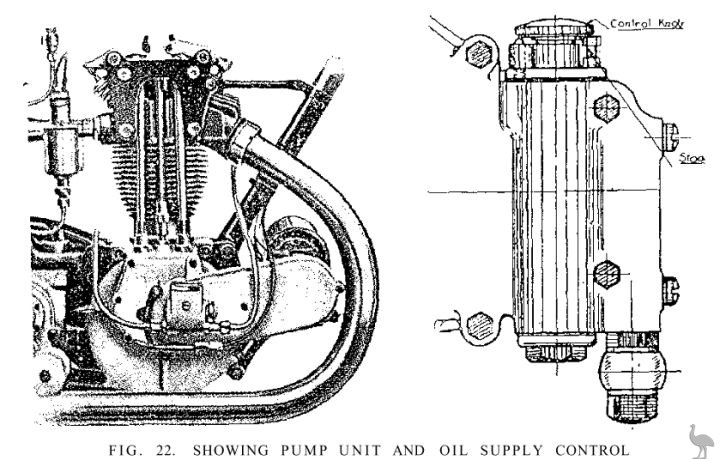
1926-28 A.J.S. machines had a sight-feed Pilgrim pump (left) driven by a dog coupling off the inlet camshaft. To increase the oil supply rotate the milled adjuster anti-clockwise. 1929-30 machines had dry sump lubrication without a main supply adjustment. 1931-33 singles have a duplex pump (right) with regulator
The gear-box oil level should be roughly ascertained by removing the lubricator at the side of the gear-box (see Fig. 57). Wakefield 'Castrolease' is recommended (for instructions see page 134). Open the petrol cock by pushing the press button forward.
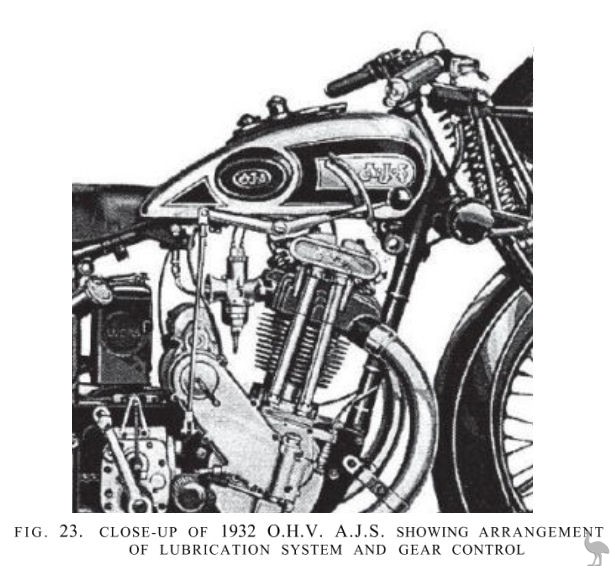
Engine Lubrication. All A.J.S. machines, except Big Twins and O.H.C.'s, now have adjustable mechanical lubrication, so that no attention whatsoever is required other than seeing that the oil level in the tank is kept at the correct level and occasionally draining the crankcase (see page 123). The amount of oil pumped to the engine can be varied by altering the setting of the control knob on the pump unit (Fig. 22). Screwing this knob down, i.e. in a clockwise direction, cuts down the supply of oil, while turning: it the reverse way increases the supply. As may be seen in Fig. 22, a stop below the control knob prevents the oil supply being cut right off When the engine leaves the factory the oil supply is set on the generous side, and after the engine has been well run-in, say after a mileage of 500 to 600, or if the engine smokes excessively, the control knob should be screwed, down about one-eighth of a turn and then re-tested for about 50 miles. If the oil supply is excessive, continue to cut it down by turning the control knob a further eighth of a turn, and so on, until the correct degree of lubrication is obtained. An approximately correct setting is arrived at by screwing the control knob lightly down to the stop and then unscrewing half a turn. If the lubrication system is functioning correctly, oil should be observed flowing from the small pipe inside the oil tank immediately below the filler cap.
On. 1929-30 machines the main oil supply was not adjustable, but an auxiliary oil feed to the piston had a needle valve control. When using these machines for racing, the needle valve, seen in Fig. 41 should be unscrewed one or two turns. This feeds oil direct to the piston. On A.J.S. motor-cycles designed 1926 to 1929, Pilgrim sight feed mechanical pumps were fitted, supplemented by an auxiliary hand pump. One increases the supply by rotating the regulating disc on the side of the pump in an anticlockwise direction 1/16 in. at a time, or giving a separate charge of oil from the auxiliary hand pump. AN ENGINE SHOULD BE LUBRICATED SO THAT ON ACCELERATING IN LOW GEAR A PUFF OF BLUE SMOKE ISSUES FROM THE EXHAUST. Once this ideal is obtained, leave the setting alone. While learning to drive, the lower gears are used very much, and consequently lack of good air cooling makes the engine rather hot. Therefore, before setting out on the first run, it is advisable to give more oil than would normally be given. To operate the hand-pump fitted prior to 1929, depress the plunger to its full extent. This fills the barrel with oil, and the plunger, being spring loaded, will automatically ascend, and, while doing so, injects the oil directly into the crankcase. The lubricator can be put out of action by depressing the plunger, and fixing it in its fully depressed position by means of the small catch provided for that purpose. In the case of an early machine equipped with hand-pump only, a full charge should be given every six or seven miles, and, when the engine is being unduly worked, small injections should be frequently made.
Before actually starting up the engine, it is best to take a good look over the machine and get thoroughly conversant with the positions and actions of the various controls. Experiments may afterwards be made with them with the engine running on the stand.
The A.J.S. Controls. The reader should not merely content himself with knowing how the various controls work, but he should understand their exact functions. He should also understand the four-stroke principle which is described in chapter V. He will then not drive the machine like a Robot, but like an intelligent being. It is a popular idea that motor-cycling requires little intelligence. This is not so; skillful driving requires deep concentration and thought. In fact, nearly all the faculties are brought into active play while driving a motor-cycle, and hence the satisfaction and pleasure that the motor-cyclist derives.
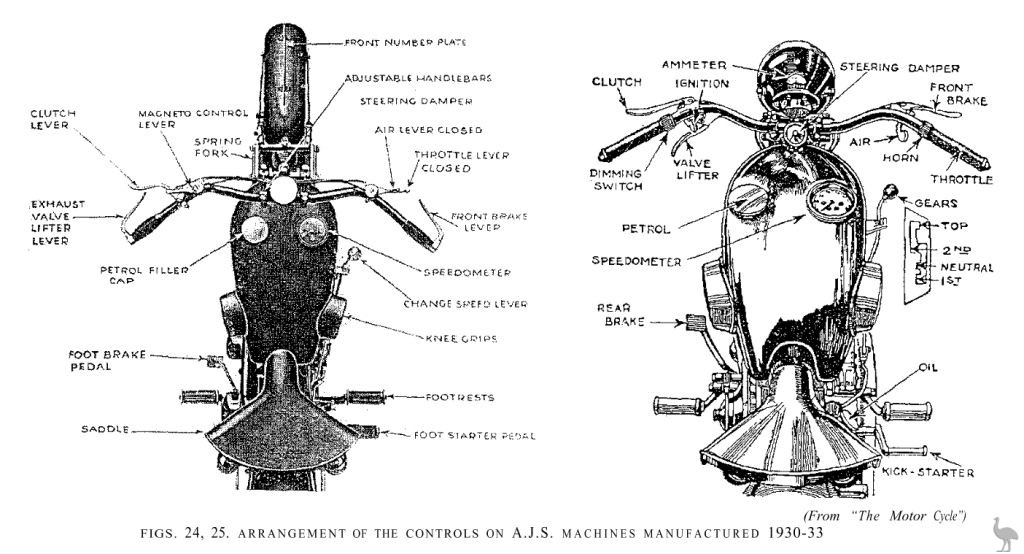
Motor-cycle controls are of two types: (1) engine controls, (2) cycle controls. The former are the most sensitive and important ; they are analogous to delicate nerves which convey impulses from the driver's hands to the interior of the engine. If the reader has ridden a three-speed pedal cycle, he will understand the purposes of the gear-box. It is to be hoped, anyway, that he has ridden a " push-bike," for he will then have no difficulty in balancing the motor-cycle straight away. Moreover, he will have acquired some road sense which only experience can give. A sketch of the 1931, 1932, A.J.S. controls is shown in Fig. 25. The engine controls are all mounted on the handlebars and comprise four: (1) throttle twist-grip; (2) air lever, which on the Bowden carburettor (page 82) is substituted by a mixture control for starting and normal running; (3) lever for advancing and retarding spark, (4) exhaust valve lifter. The two carburettor lever controls arc mounted on the right-hand side of the handlebars. A twist-grip {opening inwards) constitutes the throttle which regulates the supply of gas to the engine, and a short trigger below the inside of it the air lever, which likewise controls the air supply. The air trigger is opened by pushing to the right. Their functions will be explained in that section of Chapter V dealing with the carburettor. The exhaust valve lifter, which may be seen on the left-hand side, is primarily intended as a decompressor for facilitating starting. The magneto trigger advances the spark by being pushed towards the right, except in the case of some 1931 and earlier models where it is pushed to the left. For all normal purposes it may be left on three-quarters advance, except for starting, when it should be a quarter to half retarded to prevent the engine back-firing, and thereby delivering a nasty blow to the foot operating the kick-starter. The novice may disregard this lever, leaving it on half advance.
The cycle controls consist of the clutch, the gear-change lever, and the two brakes. The front brake for the present may also be disregarded. Later on use both brakes simultaneously. The clutch is for coupling up the engine to the gear-box. The general principle of the latter should be thoroughly grasped.
Function of the Gear-box. This is made clear if the simple principles involved are understood. The reader will agree that work done is proportional to horse-power developed (neglecting transmission losses). An engine may be called upon to do the same amount of work climbing a gradient a quarter of a mile long as it does on a level mile. The essential difference is that the rate of work is much greater in the former case; that is to say, the work is distributed over a shorter distance. Assuming the speed of the motor-cycle to be kept constant in both cases, four times as much work will have to be done in the same time. The number of firing strokes in the case of a direct driven machine is, of course, the same in both cases, and therefore the power of each stroke will have to be increased by enriching the explosive mixture, i.e. by opening the throttle. But suppose that the throttle is wide open, and the output of work docs not exceed the load imposed by gravity when climbing ; then, naturally, the machine will slow up and probably stop. There is only one way out of the problem, and that is to increase the number of power strokes until the power output is quadrupled in the given time. This means, incidentally, quadrupling the engine revolutions. This can be done by incorporating a gear-box whereby the ratio of engine speed to rear wheel speed can be varied at the will of the driver. The principle on which all gear-box designs are based is the fact that the larger the circumference of a rotating wheel is, the greater is the speed of any point on that circumference relative to the axial speed. Thus a combination of wheels or pinions can be arranged on a countershaft (i.e. a shaft between engine and rear wheel) such that, by the engagement of different pinions of varying sixes, variations of the relative speeds of engine and rear wheel can be obtained.
On the left is shown the control layout on 1930 series 'M' machines of which a great number are in use to-day. On the right is the arrangement on the 1931 series 'S* machines and the 1932-33 'T' machines. The machine illustrated is a model TB8 without instrument panel, but the controls are the same for all models except that on 4-speed models top gear position is at the rear and bottom gear position at the front of the gate ; also no air trigger is provided on machines with the Bowden carburettor
That destructive weapon of war - the tank - is a, good example of how huge driving force can be obtained from a comparatively small motor by the employment of a sufficiently low gear. Up to a point the brake horse-power developed is proportional to the engine revolutions, or (to use an apparently contradictory statement) the power curve is a straight line. The reason for this is apparent if a moment's thought is given to the subject.
The novice is recommended to experiment with gear changes on the stand with the engine shut off. This may be done by moving the rear wheel and coaxing the gears and dogs into engagement. But never force a gear into engagement. The gear-box is not designed for such treatment, and will not stand it for long.
Starting the Engine. We presume that petrol and oil cocks are left open. For easy starting the throttle setting is important. To find the correct setting, first shut the throttle and air controls right back. On machines with the Bowden carburettor there is no air lever, but set the mixture control lever to the closed or starting position. This mixture control lever corresponds to the corrector or choke generally used on car carburettors. Now on machines with lever control open the throttle about one-quarter of its travel or less. In the case of twist-grip control the air control is a separate trigger. The twist-grip is operated by turning inwards to open and outwards to shut. Shut the twist-grip right back, and then turn the twist-grip inwards very slightly so that there is about 1/8 in. pull on the wire after you have felt the resistance of the throttle spring. On models having the Bowden carburettor, 1/16 in. throttle opening is sufficient. For these settings to be correct there must be no slack in the controls ; that is to say, when the lever or twist-grip is shut right back, a slight movement should begin to move the throttle; if it does not do so, the slack should be taken up by means of the adjusting screw on the top of the carburettor. Do not forget the throttle stop. Leave the air level or trigger slightly open, unless the engine is stone cold, when it is advisable to close it completely. The ignition lever or trigger should be retarded about one-quarter or one-half its travel. Before getting astride the saddle satisfy yourself that the gear lever is locked in 'neutral' position and flood the carburettor by 'tickling' the needle for a second (if is unnecessary to flood in the case of the Bowden carburettor). Now raise the exhaust lifter and engage the starter with the right foot. Turn the engine over several times with the aid of exhaust lifter, thereby sucking the mixture in. If is best to use the lifter merely for overcoming compression. If this is done, full suction will occur on each inlet stroke.
Should an early pattern A.J.S. engine with cast-iron piston be very stiff, if may be necessary to prime it by opening the cock on top of the cylinder, and allowing a few drops of petrol to enter by means of the small priming pipe provided. This should free the 'gummed' up piston. But do not prime unless absolutely necessary. Then give one vigorous kick, dropping the exhaust lifter just before the foot reaches the bottom. The engine should now fire. Take the foot off the starter instantly it does so, but do not allow it to spring back with a 'bang' after starting the engine. Bring the foot back with the pedal and thereby prevent a heavy blow being given to the stop. If only a few muffled explosions occur, open the air lever slightly and also give more gas. The engine should then fire instantly. No Carburation difficulty should be experienced once the engine warms up. As soon as the engine starts push open the air lever or mixture control. When the engine has just started from cold with the air or mixture control fully closed it will be found that the mixture is very rich, so steadily open the control until the engine runs smoothly. After the engine has warmed up full air may be given. Never leave the engine running by itself. As soon as the oil circulates properly, and the engine gets into its stride, the revolutions will increase greatly, and the throttle must be closed accordingly.
In regard to easy starting (as may be understood by referring to the context and diagram of the Amal carburettor on pages 79-82) it is essential to keep the throttle nearly closed, so as to induce a high velocity air current over the smaller, or pilot, jet. Under such circumstances it is worse than useless to attempt to start up with the throttle wide open. Refusal to start is always due to some definite cause, and repeated operation of the kick-starter under the same conditions is futile, besides being very exhausting and exasperating. If the engine does not start easily after the first attempt, the rider is usually inclined to flood the carburettor excessively, and so cause the mixture to become much too rich. In this case open the throttle and air lever fully, raise the exhaust valve lifter, and kick the engine over several times. This will result in the excess petrol being cleared out. When starting with the engine warm keep the air lever or mixture control fully open. Most modern machines, however, are not addicted to starting trouble, except on rare occasions. We will deal with these and their remedies later.
THE FIRST RUN
A tip worth noting is, 'Don't go out for a ten minute spin : stop on the road until you get the 'feel' and handling of the machine thoroughly - even if you do keep your lunch waiting.' You will then reduce to the minimum the time during which you are a potential source of danger to yourself and all other road users. Now for the first run. Don't forget the driving licence and the insurance 'certificate.'
Standing on the left-hand side of the machine, push it gently off the stand with the engine still revving and the gear in neutral. The machine will undoubtedly, to the new rider, appear at first rather unwieldy. Therefore, stand close up to your mount when wheeling it about, otherwise you may find yourself underneath the machine. Take things coolly, as though you had driven all your life, and, sitting on the saddle, raise the clutch and push the gear lever into first gear position. Then speed up the engine slightly by opening the throttle and engage the clutch by gently and slowly releasing the lever. You will then move off It is best not to place the feet on the rests just at first, but to let them dangle on the road ready to support the machine if you find balance difficult. But place them there as soon as you feel able to do so. Bear in mind that you can stop the machine instantly you are in difficulties by raising the exhaust lifter or declutching, and applying the brakes. Never attempt to use any of the gears without first declutching. The novice always gets the impression that he is travelling very fast on first gear, and does not at first feel equal to changing into 'second.' Moreover, when changing, he feels it imperative to look down at the gear quadrant to verify the gear lever position. If the gears are fumbled, instantly whip out the clutch and start afresh. It is advisable, therefore, to travel some considerable distance on bottom gear, and practice going back into 'neutral' without stopping the engine. After getting accustomed to driving on first gear, a change should be made into 'second' on a piece of road with no cross-roads. Speed up the machine, and then throttle down, lift the clutch, and push gear lever into position, afterwards letting in clutch again. It is worth while, now you are getting 'warmed up,' to go a step further, and get into top gear by repeating the former operations. Be careful not to allow the engine to 'knock,' which it will do if driven too slowly under load. 'Knocking' is intensely injurious to an engine, and is usually due to pre-ignition.
Therefore, open the throttle to speed the engine up, and slightly retard the ignition temporarily. It is always advisable to ease the clutch a little until the engine impulses become uniform and smooth. Once in top gear, if will be found that riding is much easier, and you will now begin to acquire considerable confidence. The pleasant 'zoom' of the exhaust seems very stimulating after the comparative clatter and 'fuss' that is noticeable when driving on low gear. You will probably be tempted almost immediately to open up a bit - even have a burst of speed. There is no harm in this if the road is clear and straight ; but for heaven's sake don't do it if there is a suspicion of an obstruction ahead. Also remember that you are driving a new engine (see page 46). When slowing up, leave a good margin of safety. On changing down, the machine should be slowed up until it is travelling at a speed at which it normally does on the gear that is about to be engaged, and the engine must be revved up slightly. The two engaging pinions will then be running at the same speed. No changes down should ever be made while travelling over 15 m.p.h.
This is about all that need be said regarding the first run. We will conclude this chapter with some general hints on driving, and a survey of the chief dangers of motor-cycling and legal matters.
HINTS ON DRIVING
Use of Gear-box and Clutch. This has been dealt with to some extent in the foregoing paragraphs, and the remarks there should be carefully borne in mind, and if carefully observed should enable perfect gear changes to be made. A few additional remarks regarding possible abuses of the gear-box and clutch that may unknowingly be committed are added herewith -
Never employ a low gear for braking purposes; that is to say, never engage a low gear when travelling fast in order to pull up, and do not use a low gear when descending hills, unless they are quite out of the ordinary, for the internal expanding type brakes should be capable of fulfilling all requirements in this direction.
The machine should also never be run unnecessarily on first gear. This gear is only provided for ease of starting and climbing steep gradients, or when negotiating very heavy traffic demanding a very slow rate of progress. Using the first gear unnecessarily simply means extra wear and tear, high petrol consumption, and shortens the life of the engine and transmission.
Never slip the clutch as an alternative to gear changing. Prolonged slipping under load will burn out the cork inserts. Moderate slipping on the level at low speed does no harm.
Take care never to allow oil to find its way on to the clutch plates.
Tyre Inflation. Tyres should always be pumped up to a definite pressure by consulting a pressure gauge. On the Firestone tyres, used on. all A.J.S. machines, Schrader valves are fitted, and a Schrader pressure gauge is obtainable. The tyres must not be soft or rolling will occur on corners and the covers will wear badly. Soft tyres are also liable to creep and thereby cause damage to the inner tubes. If, on the other hand, tyres are over-inflated, excessive vibration will result, with horrible discomfort to the driver. Needless to say, the rear tyre usually requires more inflation than the front one. Well inflated tyres have least skidding tendency, and produce the minimum amount of wheel slip at speed. In the case of the two lightweight models (T5, TB6) the 25 in x 3 in. tyres should be inflated to the following pressures: front tyre, 15-16 lb.; rear tyre, 22-24 lb.
With the heavyweight machines (T6, T8, TB8, T9) shod with 26 in. x 3-25 in. tyres, recommended pressures are: front tyre, solo, 15-16 lb ; single S.C., 15-16 lb. ; double S.C., 17-18 lb. Rear tyre: solo, 18-20 lb.; single S.G., 20-22 lb.; double S.C., 24-26 lb. Sidecar tyre: single S.C., 15-16 lb.; double S.C., 20-22 lb. The above recommendations apply to average weight drivers. For abnormal weight or carrying pillion passenger add 2 lb. to rear tyre pressure only.
'Running-in' a New Engine. When an engine is assembled the bearings are made as tight a fit as is reasonably possible. Owing to the crystalline nature of metal, an extensive and prolonged smooth rubbing will compress the bearing surfaces of the metal together until they attain a glass-like uniformity and hardness. During the process, of course, a certain amount of play arises in the bearings - just sufficient for good running fits. Thereafter wear is very slow. But imagine what will happen if the bearings are straight away subjected to violent friction and heat. Instead of the surfaces acquiring a glassy surface, they will rapidly wear down and become scored or abraded, and continue to be rather soft. Another important point to consider is the fact that until there are good running fits throughout the engine, oil will be unable to find its way about in any quantity over the bearing surfaces, which in consequence will remain partially dry if the engine is unduly worked, with the attendant danger of seizure. Distortion through overheating is also liable to arise. Distortion is of two kinds - temporary and permanent. If permanent distortion of the valve seatings takes place, an engine will never be fully efficient afterwards. All A.J.S. machines are tested on the road at Plumstead before leaving the manufacturers; but as the mileage they do is not great, the rider should therefore restrain his desire to drive the engine hard until at least 500 to 600 miles on the road have been covered.
Sparking Plugs. Always run with a decent plug in the 'pot.' There are many good plugs now available, such as the Lodge H.l. A cheap plug causes loss of power and pre-ignition.
Keeping an Engine Cool. If an engine's tune is to be maintained, it is essential not to overheat it. In spite of plenty of cylinder finning, all air cooled engines are liable to become overheated. To prevent this the controls should be handled carefully.
Always drive with the air lever of the carburettor open as far as possible, consistent with even running, and the spark lever well advanced.
After climbing a stiff gradient, never open out on the other side ; allow the engine to cool either by raising the exhaust lifter, or by nearly closing the throttle and opening the air lever. The throttle must not be completely closed, otherwise no cooling air enters the cylinder and the oil is liable to be sucked into the combustion chamber by the vacuum thereby created which, of course, accelerates carbonization. Some of the bad effects of overheating have already been mentioned.
Methods of Controlling Speed. Speed may normally be controlled in two ways - (1) driving on the throttle, (2) using the exhaust lifter. The latter method is bad practice, and on the O.H.V, models may cause bent exhaust valves, for if the exhaust valve is held up while the throttle is left open enough to produce a combustible mixture, it will be continually swept by a high temperature flame. That this does happen is indicated by the banging that usually occurs along the exhaust pipe and silencer when this practice is adopted. Moreover, the use of the exhaust valve lifter necessitates complete removal of fingers from the throttle, which is in itself dangerous. Driving on the throttle has many points in its favour. Closing the throttle exerts a powerful braking effect, which can be used to advantage both when driving on the level and descending hills. Indeed, the really good driver seldom uses his brakes. He cultivates such good judgment of speed and distance that he does not often require them. An occasional jab of a brake is all that he needs. A front brake must never be used suddenly ; a skid will probably ensue. The rear brake should always be applied first.
Cruising Speed. Every machine has what, for want of a better name, may be called its cruising speed. By this we mean the speed at which the engine runs most sweetly. It usually lies somewhere between 25 and 35 miles an hour. The rider should find out what this speed is in the case of his own mount, and drive most frequently at that speed. If a long life is desired of an engine it should always be driven well within its maximum capacity, that is to say, on about % throttle. In the case of most riders there is not much danger of doing this owing to the winding nature of the roads in this country. At 65 m.p.h, what appears normally to be a straight road often becomes suddenly full of nasty bends which have to be negotiated carefully. Nevertheless it is easy to over-drive an engine in hilly districts. While on the subject of speed we will deal with that so hotly-discussed problem,
'What is a safe speed ?' The answer to this question is, 'A. speed at which the driver has complete mastery over his mount in the given circumstances.' In many cases the man with leather helmet and. goggles hurtling along at 60 m.p.h, is far less dangerous than the sublime idiot who leisurely careers over minor cross-roads at speeds varying from 15 to 20 miles an hour. When somebody on the main road nearly dispatches him and himself to eternity (the best place for him), he miserably complains that he was only doing 20 m.p.h. - 20 m.p.h, across a main road I Such people ought not to be charged with exceeding the speed limit, but with attempted murder and suicide! The author has had the misfortune to run up against one of these maniacs, and realizes the nasty sensations that surge up when crashing broadside-on into a vehicle, as well as the nasty repair bill that must inevitably follow. A theory has actually been advanced by some motor-cyclists that it is safer to take cross-roads at high speed because there is less time during which you may hit anything coming across. This line of thought is analogous to that of the Irishman who, when stopped for speeding, said that he was racing to get home as quickly as possible because his brakes had failed, and he was afraid of smashing into anything! Comment on this illogical and suicidal reasoning is needless.
Cornering. The art of cornering takes some time to master. We all know that for a bicycle or motor-cycle to get round a bend fast without skidding it is necessary that the machine should be banked, i.e. the rider must lean the machine inwards towards the centre of the circle. The reason for this is as follows - every moving body possesses momentum, and that momentum at any given time acts in the direction that the body is moving at that time. In the instance of a body describing a circle it is evident that the body is continually changing its direction (a circle theoretically consists of an infinite number of straight lines), and consequently the momentum acts tangentially. Thus there are resultant forces continually urging the centre of gravity of the motor-cycle outwards from the centre, when rounding a bend. But this can be counteracted by inclining the body and machine inwards. A better method, used by some fast drivers, is to incline the machine inwards and the body outwards. Using this method, one may corner almost on the exhaust pipe. Make a habit of always cornering close in at the blindest part, and indicate your intentions well before actually turning off at a sharp bend. It is no consolation to be able to say that you gave a hand signal, after a high-powered car has buckled up your rear wheel. Never omit to sound the horn at all corners. Sometimes it pays to swerve slightly to the offside before approaching a moderate bend at high speed, throttle down, and bank inwards, thereby cutting the corner somewhat and at the same time keeping close in. The throttle may be opened up again half way round the bend. This kind of cornering, however, comes under the heading of 'stunt' driving, which is not recommended to any but the experienced driver.
When cornering with a pillion passenger for the first time, reduce speed well below that at which you generally take a corner solo. Failure to do this will probably cause you to drift well away from your proper side of the road - a most risky procedure - because you are afraid of banking too steeply. It is, undoubtedly, unpleasant to bank steeply with a passenger riding pillion. We will deal with pillion riding again later,
Left-hand corners demand special caution on the part of the driver of a sidecar outfit, according to the speed at which corners are taken. He should throw the weight of his body towards the left. A passenger may assist the driver by leaning in towards the centre of the bend; but he should not adopt 'T.T.' acrobatic methods. Your passenger might easily break his neck against a lamp-post, to say nothing of the indignation and terror that would be caused to any witnesses of the occurrence. The proper manner to navigate a sidecar round a left-hand corner is as follows: approach the corner at a pace well below that which safety requires, and open the throttle gradually and cautiously on the bend ; the outfit will then pivot on the sidecar wheel, which is precisely what is required. Conversely, on a right-hand corner either close the throttle or apply the brake a little as the outfit is actually swinging round the bend ; it will then pivot on the rear wheel of the motor-cycle. Always endeavor to take corners with a sidecar at a reasonable speed, especially when turning to the left, as centrifugal force puts a great lateral strain on the machine. When turning to the right the lateral strain is reversed in direction and has a crushing effect on the sidecar axle via the torque arms. At high speed the strain is terrific, and a sidecar axle may break. Result, an inquest. Difficulty is often experienced in the management of an empty sidecar while cornering. Ballast substituted for the passenger is of great assistance in this connection.
Sidecar Alinement. If a sidecar outfit has a tendency to steer to the right or left due to reasons other than road camber, the motor-cycle is probably not upright or else the sidecar itself is out of alinement (see page 151). After a new A.J.S. sidecar has done a considerable mileage it occasionally happens that the sidecar fittings take a permanent 'set,' causing the machine to lean slightly towards the sidecar. This trouble can be easily cured by means of the adjustable arms.
Hill Climbing. There are few hills likely to be encountered by A.J.S. riders which present any serious difficulties. It is purely a question of making the best job of it, or in other words, a climb that will not bring the blush of shame if there should happen to be critical motor-cyclists watching hill ascents, as is often the case, by the side of the road. It is advisable, before an ascent is made, to allow the engine to cool down very thoroughly first. Unless the road is notoriously bad, take a fast determined rush at the hill, and get up as far as possible on top gear. But never allow the engine to labour. As the machine slows up it will be necessary to give less air and retard the ignition gradually. Change to a lower gear instantly the revolutions fall seriously, and there is danger of overstraining the engine. Do not race the engine on low gear, for racing an engine takes more wear out of it than hundreds of miles of normal usage. If a bad patch of road looms ahead which will necessitate changing down again, change down before you reach it. Choose your path carefully, and swing wide round all corners that are not blind. It is preferable to drive at a good speed on some bad surfaces. This also applies to driving on 'wavy' level roads. It will be found that periodic 'plunging' does not then occur. Sometimes speed variations will also produce the desired effect. Having made a hill ascent, allow the engine to cool either by stopping it or by using the exhaust lifter while descending the next hill.
When climbing a steep hill with a sidecar it is not necessary on taking a left-hand bend to lean over in that direction, as the natural sidecar side-drag tends to turn the machine to the left. This does not apply with a right-hand bend.
When climbing a very steep gradient the passenger can assist the driver by placing as much weight as possible over the rear wheel. Similarly, on descending an unusually steep gradient, he should try and put as much weight as possible on the driving wheel so as to assist the steering.
Coasting. Running declutched down hill with engine stopped is very popular among riders. It cannot be denied that the smoothness and noiselessness of it is altogether a delightful sensation. This procedure, however, unless the hill be very long, does not lend itself to cooling the engine very well, and we must assume that the driver has been climbing - unless, of course, his garage is situated on the top of a hill. It is far better to use the exhaust lifter or, if the hill is steep, to open the air lever and partially close the throttle. When letting in the clutch again, it is desirable that it should not be let in under full compression with the machine travelling fast; such action may result in a bad skid, and damage the rear tyre. Wait until your mount has slowed up to about 20 m.p.h. ; then raise the exhaust valve and let the clutch in gently ; when the click and whirr of the valves indicate that the engine is coupled up again, drop the exhaust valve. The throttle being only slightly open, the power strokes will be resumed gradually.
Engine Sprockets for Hill Climbs. For 3-49 h.p. models it is useful to have spares with from 1.8 to 22 teeth. For 4-98 h.p. machines suitable sprockets have 18 to 20 teeth. A. 19-tooth sprocket suits the average hill, but 18 teeth gives more speed for steepish gradients. As a rule, in a hill-climb it is better to gear too low rather than too high. Experience is the best guide.
Pillion Riding. We will not enter into the question whether pillion riding is dangerous or not. Undoubtedly much depends upon the qualities of the driver and the circumstances under which it is undertaken. The fact remains that, as the law stands at present, the only legal requirements are that the pillion passenger shall sit astride a suitable pillion seat fixed to the machine and shall be covered by insurance. We will, therefore, give a few hints which, if observed, will contribute to safety.
1. The pillion rider should sit astride as close to the driver as possible, so as to put the minimum weight on the tail of the machine. Preferably he, or she, should hold the driver lightly by the waist, and sit on the machine as limply as possible.
2. Footrests should always be provided for the passenger. The feet cannot then foul any of the mechanism, or interfere with the stability of the machine (see Fig. 27A).
3. The driver should not engage in protracted conversation with his passenger while driving.
4. If the roads are greasy do not take a passenger on the back. Crossing and recrossing greasy tramlines on top gear with a passenger is a risky business. It is safer to engage a low gear, and place the feet on the road.
5. Never swerve or bank violently, two-up. The passenger may get terrified, and cause a disaster by leaning one way or the other.
6. Never take a pillion passenger on a long distance night run.
GENERAL HINTS
1. Use the hooter as sparingly as possible. When essential, deliver two or three quick imperious blasts, and be always prepared to stop abruptly. Sometimes it may be found essential to yell out to somebody rather than use the horn. The language is usually highly coloured, but under such circumstances politeness is criminal. Always use the horn at crossroads and corners.
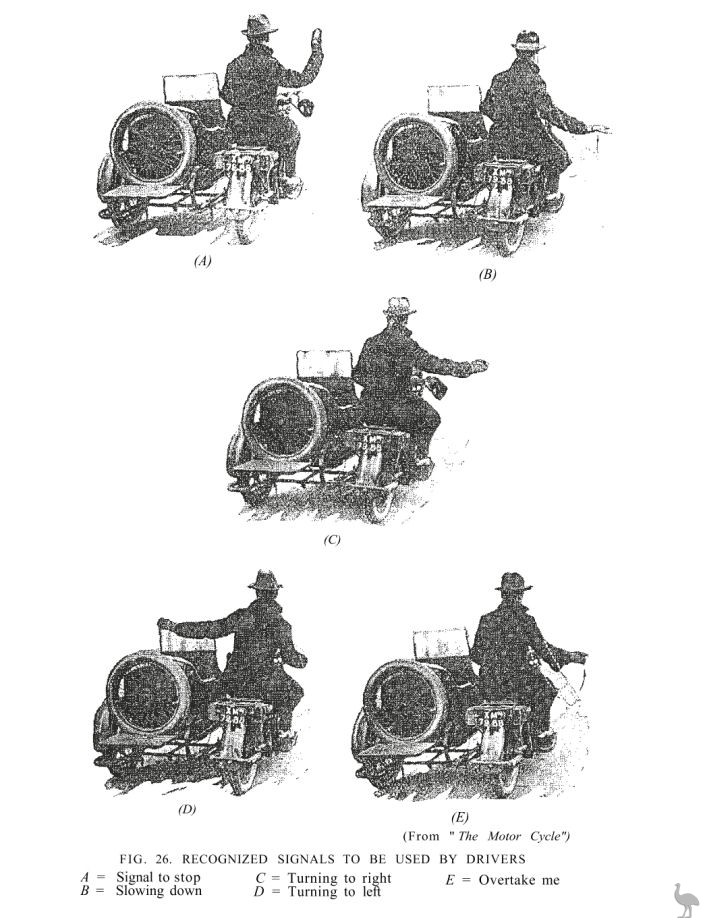
2. Always give hand signals, even if you think you are alone on the earth. If a habit is made of it, you will give them instinctively. Remember, however, to give signals in ample time. When stopping, either put your right hand up, as shown in Fig. 26, or move the left hand up and down vertically, as many people do. In any case make your intentions clear. A signal that is rarely used, but which is sometimes invaluable, is the signal indicating that you intend to proceed straight ahead. This should be given when you are confronted with oncoming traffic which doubts your intentions at a cross-road. In any doubtful situation, instantly whip out your hand to show what you are going to do, and do it. Everybody knows the utter folly of two people dodging each other. On the pavement two pedestrians doing this invariably fail to clear each other, unless one stops or gives way.
3. Never hesitate. Do the wrong thing rather than run amok. You will then retain your nerve and keep your wits about you.
4. If you should have to choose between killing someone or risking death yourself, do not be a coward, but take the risk. It is usually possible to slip backwards over the carrier at the last moment.
5. Approach cross-roads dead slow.
6. Keep the eyes well ahead. By doing this it is often possible to see over hedges traffic that is rapidly approaching. The habit of taking a sweeping survey of the view ahead is invaluable, and after a time becomes second nature.
7. Always remember that cows and sheep believe strongly in obstruction.
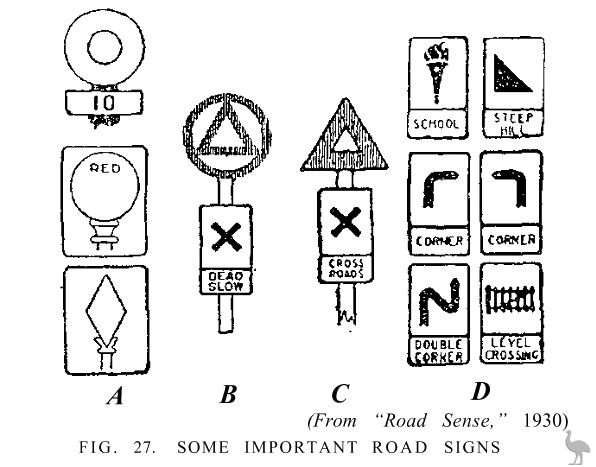
8. Obey all special speed limits and notices (see Fig. 27) and respect the white lines and automatic traffic signals.
By disregard of these you bring contempt upon motor-cyclists as a body.
9. Never take things too fine. In ninety-nine cases out of a hundred you will escape, but on the hundredth you may crash. This particularly applies to 'cutting in.'
10. When streets are greasy, give and take as much room as possible. A side slip on the open road, at reasonable speed, seldom does much harm; but a skid in front of a lorry means either the hospital or the cemetery. Therefore, never behave rashly in front of heavy vehicles.
11. Always have a finger close to the throttle and a foot ready for the brake.
12. Always ensure that the oil tank and gear-box contain sufficient lubricating oil.
13. Keep the 'certificate' in a safe place with the driving licence on your person.
14. The speed limit has gone, but don't demonstrate the fact too often in the wrong place.
15. If you have an electric lighting set look after the battery and charge during the day.
ROAD DANGERS AND THEIR PREVENTION
Nowadays road dangers constitute a very real menace to life and limb, but most of them can be effectively counteracted. Some are unavoidable. Others are caused by the selfishness or inexperience of the drivers themselves. The golden rule is this : 'Cultivate sufficient imagination to ride in a state of constantly expecting the unexpected, especially over unfamiliar roads, and always assume the other fellow may do the wrong thing.' Remember that bad accidents always arise from, some unexpected or sudden incident, e.g. -
A child suddenly darting across the highway.
Vehicles in front stopping suddenly (beware four-wheeled brakes).
Cars you are overtaking drawing out.
A steam roller round the corner.
Cyclists riding abreast the other side of a canal bridge.
Faulty hand signals.
Sudden brake failure.
Snap of a throttle cable.
Attempted suicide by dogs, poultry, drunken men, old ladies.
Skid of a vehicle in front.
Passengers dismounting from tramcars.
Pedestrian stepping off the kerb with eyes skywards.
Person emerging from behind stationary vehicle.
There are a thousand and one other contingencies that the mind can conjure up, any or all of which may arise in lightning fashion. It therefore behoves the motor-cyclist to concentrate on his job, and never to allow either his mind or his eyes to wander. When driving in traffic, a glance to ascertain whether any blue smoke is issuing from the exhaust may easily cost a man his life. Absent-mindedness in the professor's study is said to be a sign of genius, but on the road it is a sure passport to eternity.
'Dangerous' and 'Careless' Driving. Although the general 20 m.p.h, speed limit, honoured more in the breach than the observance, has now disappeared, a vigilant police watch on driving is kept by the new mobile police force, and woe to the motor-cyclist or motorist caught driving to the public danger. 'Dangerous driving,' now heavily punished, means driving at a speed or manner dangerous having regard to all the circumstances actual or hypothetical, i.e. having regard to other traffic or pedestrians that are in the vicinity or might reasonably be expected to be there.
In order to meet cases of negligent driving of an unpremeditated nature, such as failure to give hand signals, 'careless driving' is made an offence with which a motorist may be charged, and the penalties for this are not quite so severe as for "dangerous driving." Passing on corners and cutting-in would come under the first heading, however. 'Drunk in charge' usually means imprisonment and automatic suspension of the driving licence. A summons must be served within fourteen days of an alleged offence, and the driver must be notified at the time of committing it that prosecution will be considered.
Danger Signs. There are various types of signs scattered about the country, and they should be implicitly obeyed. Fig. 27 shows the principal types. Those shown at A from top to bottom are respectively the local speed-limit sign, one indicating that road traffic is prohibited, and a general motor notice. At C and D are a group of self-explanatory signs. In spite of the abolition of the general speed limit, some local limits still exist and must be strictly observed. A special sign designed to show when a driver is approaching a main road from a subsidiary road is now in common use. This sign is shown at B (Fig. 27).
Skidding. Nerve is the best antidote to skidding. A bold rider seldom skids, and when he does he usually corrects it, Skids seldom occur on dry roads. Too violent braking or crossing tramlines in a timid fashion is usually the cause. Brakes should be very gingerly applied on wet roads, and tramlines should be negotiated fearlessly at a good speed and at a sharp angle. A rear tyre with worn tread usually facilitates skidding. Therefore, during the winter months, if the rear tyre is worn badly, change it over to the front. This procedure is recommended, anyway; for it enables the best tyre mileage to be obtained. If a skid does occur, instantly declutch and turn the machine in the direction of the skid, braking at the same time. If you do not go over, carry straight on without stopping.
Animals on the Road. Animals that the motor-cyclist encounters on the road vary from small Pekingese dogs, complete with pink ribbons, to vicious-looking bulls. The former may be completely ignored, but the latter must be treated very cautiously.
If a fierce terrier, or an Alsatian wolfhound, leaps at you, it is safer to deal severely with it, rather than say, 'Good dog,' or something to that effect. By this we mean throttle up and either kick out or land out with a clenched fist. This action is unlikely to harm the dog, but the suddenness of it will momentarily deter it from its canine instincts and will enable you to accelerate clear. A dog jumping about under the front wheel is decidedly dangerous and do not be afraid of accelerating. A dog can always get clear of a single track motor-cycle, but not a car. A car driver should always slow down. Straying cattle are sometimes encountered on country roads at night, and the rider should be prepared to meet with unlighted objects accordingly.
Always throttle right down when passing horses. If you are signaled to stop and fail to do it you are violating the law. Apart from this, a horse is a very faithful and intelligent animal, and you have no right to frighten it by roaring past. Such action is contemptible.
Dazzle. When driving by night, cars with glaring headlights are frequently met. If the eyes are allowed to face such lights, the pupils contract to such an extent that temporary blindness ensues immediately after the lights have passed. This is very dangerous if there is any traffic immediately ahead of you. Make it a rule to keep the eyes focused on the ground in front, and 'concentrate' them at the moment of passing. This should entirely eliminate what is usually called 'dazzle.' It is purely a question of using a certain amount of will power and common sense. On a model provided with Lucas
electric lighting always dim the headlamp when approaching a brightly illuminated vehicle. Its driver, if he is a gentleman, will then cut out the glare from his lamp or lamps.
When a fog is coming on before dark, it is imperative not to waste a second during daylight if bound on a long run with little prospect of 'getting there' by any other means. There are three reasons for this - (1) As soon as the ground temperature falls on the approach of night, the fog will rapidly thicken, (2) lights in fog are worse than useless for picking out one's way, (3) the fog will drive most road users off the road, and there will be little likelihood of any assistance forthcoming, should you have any trouble. If engine trouble should develop just before dusk, you will have to do one of two things - either work like a Trojan and get the engine running again, or abandon all attempts to proceed farther. Driving long distances in thick fog requires all the courage and nerve that you can summon up. If a vehicle ahead is making good progress, follow its tail light. It is astonishing how a man can steer his machine dead straight, so long as he has a sense of direction, even though he may be unable to see the road at all. In some cases frost-covered telegraph wires show up above a low lying fog and give considerable assistance. Similarly tramlines are very useful. A dense fog is often accompanied by icebound roads. Driving on an icebound and fogbound road by night is not one of the best forms of amusement. Skilful use of the throttle has to be made to eliminate wheel spin, and brakes have to be used super-cautiously. Driving in fog, in spite of its dangers, has attractions to some people. It undoubtedly tests to the utmost the driver's abilities and endurance.
GENERAL REMARKS
Obey the law not only in letter but in spirit, and be courteous to all other road users. Never pass by a stranded motor-cyclist without asking whether you cannot assist. Nothing fills a rider with such disgust as for men to roar past when it is obvious that the driver requires help. It may be only a special size spanner that he requires, but stop to inquire. Remember, the modern motor-cycle is a ghastly thing to push up hills. Troubles that may beset the rider are many, but, actually, troubles are few and far between. All possible troubles are fully dealt with in Chapter VI. After considerable experience on the road the driver can tell by the sound and behavior of his engine whether it is running as it should, and can diagnose trouble instantly it occurs. In fact, the machine becomes an open book to him, and he never lets the idea of getting stranded enter his head ; also he feels confident of rectifying any trouble that may occur. Every engine has a personality of its own which only the driver who has studied if understands, and it will only give of its best to this driver.
Road Accidents. To conclude these hints, the author feels he must emphasize the very real need for the cultivation of driving skill and road sense among all motor-cyclists. Statistics of road accidents for the past year, recently issued by the Ministry of Transport, and which the author has before him as he writes these words, make appalling reading. No less than 6,500 people met their deaths on the road in 1931 - an average of eighteen per day. Altogether there were about 200,000 accidents known to the police as compared with 40,000 in 1918. Thus in thirteen years road accidents have become five times as frequent. The proportion of motor-cycle accidents does, however, show in a favourable light. Something must be done to stop this wanton destruction and maiming of human beings ! It is your bounden duty as an A.J.S. motor-cyclist to see that you do not contribute to the list of killed and injured on the roads of Great Britain during the forthcoming years, when motorists and motor-cyclists will become more and more numerous.
SOME POINTS ABOUT THE LAW
The legal matters regarding licensing and registration having been disposed of it remains to deal with questions concerning breakage of the law. It is wise to remember that in all cases of accidents or of legal trouble the legal departments of the Automobile Association and other road organizations are always ready to assist members on receipt of an S.O.S., and to give free legal defence in the case of certain offences. The following information is given because in law 'ignorance is no defence.'
What to do in Case of Accident. The first thing to do in case of accident is to obtain the names and addresses of at least two independent witnesses who are likely to assist your case. Carefully jot down on paper all particulars of road width, place of accident, your speed at time of accident, whether horn was sounded, and all other particulars relating to the accident. Remember that insurance companies rely mainly upon the police reports. Therefore, it is essential to summon a police officer so that he can take down signed statements from both parties, both for perusal by police headquarters and for the benefit of the insurance companies concerned. A full truthful statement must be made. Anything withheld will react unfavourably against the driver later on. If an injured person is likely to make a claim, an independent medical man should be called to examine him and make a report. Do not engage in any correspondence without legal advice, or if this is not taken, make clear that all your statements in the letter are made without prejudice to your case; and refrain from making statements either at the time of accident or afterwards, which might be construed as admission of liability. Never offer money to the injured person, for motives of sympathy arc often construed into admissions of legal liability.
Name and Address. To anyone who complains that the motorist has committed an offence of driving to the common danger, the driver must give his name and address. The maximum penalty for refusing, or for giving a false name and address, is £20, with heavier penalties for subsequent offences.
The Order to Stop. A person in charge of a horse may order a motor-cyclist to stop, and so may a constable in uniform, or a man injured by your machine. To fail to do so is an offence. In any case an order to stop should never be ignored. The signal to stop should be made as already noted on page 50.
Endorsement of Licence. Convictions under the Road Traffic Act, 1930, may be endorsed on the back of the licence, except a conviction for obstruction. In the case of 'dangerous driving' (page 55) an endorsement automatically follows. It is not widely known that a driver who has had his licence endorsed can obtain a clean licence at any time for the fee of 5s., provided that he has not, during a continuous period of not less than three years, had any conviction endorsed.
Drunkenness. A person found in charge of a motor-cycle while under the influence of drink is liable to imprisonment without the option of a fine, and on conviction his licence is automatically suspended.
Warning of Approach. It is compulsory to give audible warning of approach whenever it is necessary. Failure to do so renders the driver liable to conviction for 'dangerous driving,' and to an action for negligence if anybody is injured as a result.
Exhaust Cut-out. It is illegal to use an exhaust cut-out, or any contrivance enabling the exhaust gases to escape into the atmosphere without first passing through an effective silencer.
Arrest. The driver is liable to arrest by a police constable (whether in uniform or not) if he refuses to give his name and address, refuses to produce his licence on demand, or if his machine does not bear the identification (registration) marks.
Rules Regarding Number Plates. The driver of a motor-cycle is guilty of an offence if the number plates are not properly fixed, or if they are in any way obscured or rendered illegible or not properly illuminated, unless he can prove that he has taken reasonable steps to prevent this, and if the driver is not the owner the latter may be charged with aiding and abetting.
Illumination (see also Chapter II). The driver must always comply with the existing lighting regulations; otherwise he may be summoned. One number plate must be properly illuminated
Regarding the Registration Book. When a licence is issued a registration book is issued to the owner, and this must be sent to the Council with whom the vehicle is registered as follows -
1. When any alteration is made to the vehicle.
2. On sale or change of ownership.
3. On change of address.
4. When vehicle is broken up, destroyed, or permanently sent out of the United Kingdom.
Obstruction. The machine must not be left for an unreasonable or unnecessary time on the highway in such a position that it constitutes an obstruction to other traffic or pedestrians.
Time Limit for Summons. Unless previously warned at the time the offence is committed, notice of an intending prosecution for committing any motor-cycling offence must be given to the driver or the registered owner of the motor-cycle within 21 days of the alleged offence.
Right of Appeal. A person convicted of an offence under the Road Traffic Act, 1930, has the right to appeal to next Court of General Quarter Sessions. A right of appeal lies against an order disqualifying any person from obtaining a driver's licence.
Speed Limit. Although general speed limit has been abolished, special limits of 8 or 10 miles per hour are fixed in certain towns and villages. These must still be strictly observed.
Leaving the Machine. A motor-cycle may not be left with the engine running while the owner is absent, however short the period.
Police Warnings. A new system of dealing with first offences of a minor nature has recently been introduced. Under this system it is customary, unless the offence be serious, to give the offender an official warning instead of bringing a prosecution. Whether or not the offender be prosecuted is left to the discretion of the Commissioner of Police. This system is a step in the right direction and does much to avoid frivolous prosecutions.
Petrol Storage. Those who desire to possess a petrol 'dump' on their own property should remember that a maximum of 60 gallons in 2-gallon tins is permissible, and it must be located at least 20 ft. from an occupied building. Also the store must be arranged such that, in the event of fire and leakage from the tins, the inflammable liquid will not escape. Suitable ventilation must be provided, and when any petrol is kept other than in the fuel tank, a fire extinguisher or sand must be kept on the premises.