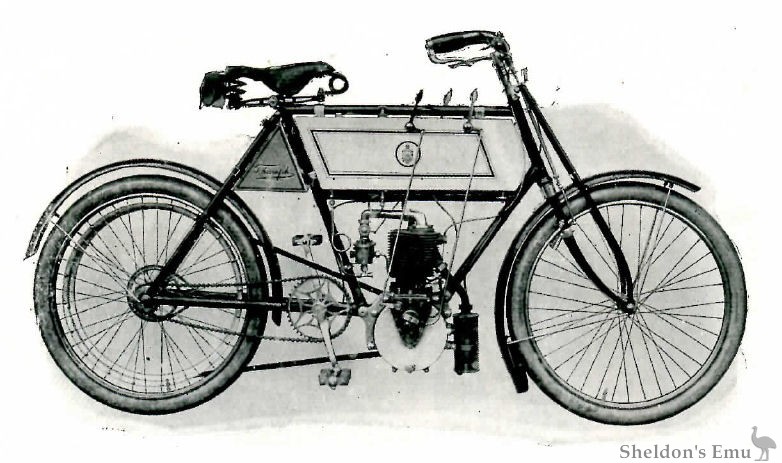

Triumph Cycle Co., Ltd.
The principal exhibit of this company, so far at least as motor cycles are concerned, will be a 3 h.p. motor bicycle, specially designed and recommended for the use of heavy riders or in hilly country, the chief consideration in constructing which has been great strength in every detail, so as to ensure durability and reliability. The engine being very powerful, enables the machine to be used also in conjunction with a forecarriage or trailer. The engine on this machine is placed in a vertical position in the frame, has a bore and stroke of 75 mm. x 80 mm., and gives off 3 b.h.p. at 1,800 revolutions.
In addition to the above, a 2½ h.p. motor bicycle will also be exhibited, which is practically a smaller edition of the 3 h.p., and which we can say from personal experience is a machine with exceptional powers as regards speed and hill climbing. This engine has a bore and stroke of 70 mm. x 76 mm., and is provided with extra large cooling surface and valves. A forecarriage with a 3 h.p water-cooled engine will also be exhibited.
The Motor Cycle, November 1903
Stanley Show 1903
Stanley Show, The Motor Cycle, Nov 25th 1903
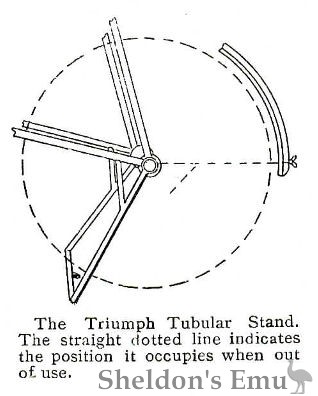
The straight dotted line indicates the position it occupies when out of use.
The Triumph Cycle Co., Ltd., Coventry
(Stand 162).–
Great improvements on last year's pattern are shown in the Triumph machines, and visitors to the show should make a point of seeing this exhibit. The 1905 machine is fitted with a 3 h.p. engine, placed in a vertical position, and, as is now so usual, the crank chamber is made to form part of the frame. The crankshaft, it may now be noted, is mounted on ball bearings. As to the down tubes from the head to the bottom bracket, these are made in duplicate, and give a very strong frame and good support of the engine. The motor is beautifully made in every respect, and is fitted with mechanically operated valves. The control is by means of a. valve lifter, which is also fitted with an automatic cut-out– a particularly neat arrangement fitted to the down tube, forward of the petrol tank. This is actuated by Bowden wire mechanism, and is so arranges that the exhaust valve is dropped to its seat before contact is made. A Brown and Barlow carburetter is fitted, and we are told that very excellent results are obtained. The accumulator is carried in the forward part of the petrol tank case, and beneath is carried a Fuller coil in close proximity to the sparking plug, so that the shortest possible lengths of wires are fitted.
At the junction of the down tube with the crank chamber are fitted very convenient footrests, and on the left-hand side is placed a pedal, which applies a powerful brake to the interior surface of the belt rim. A neatly-designed tubular stand, which can be quickly put in and out of action, is fitted to the rear axle, and is illustrated herewith. The machine is built low, is fitted with 26in. wheels, and is very carefully thought out and beautifully finished in every respect. The weight, less toolbag and rests, is 125 lbs.
Report on the 1904 Stanley Show, The Motor Cycle, November 28th, page 1168.