
Page 21
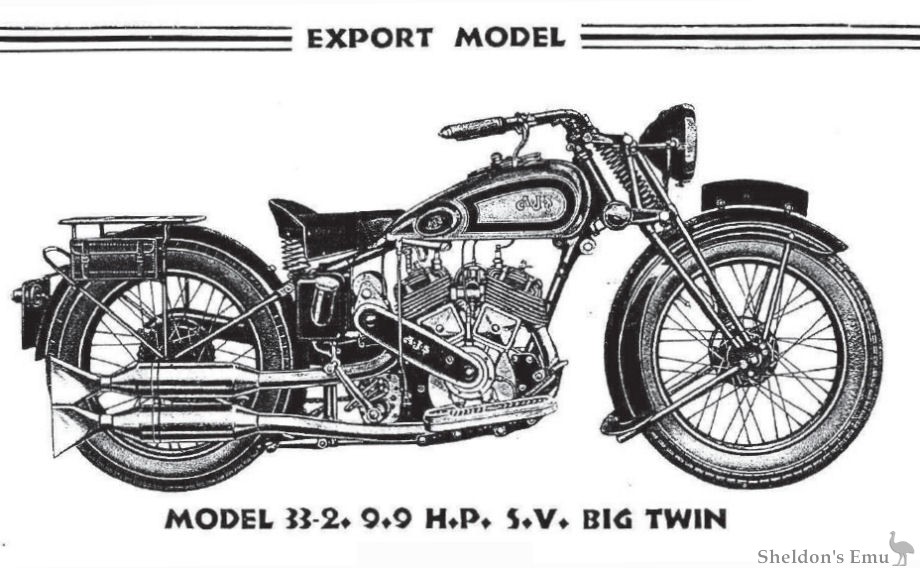
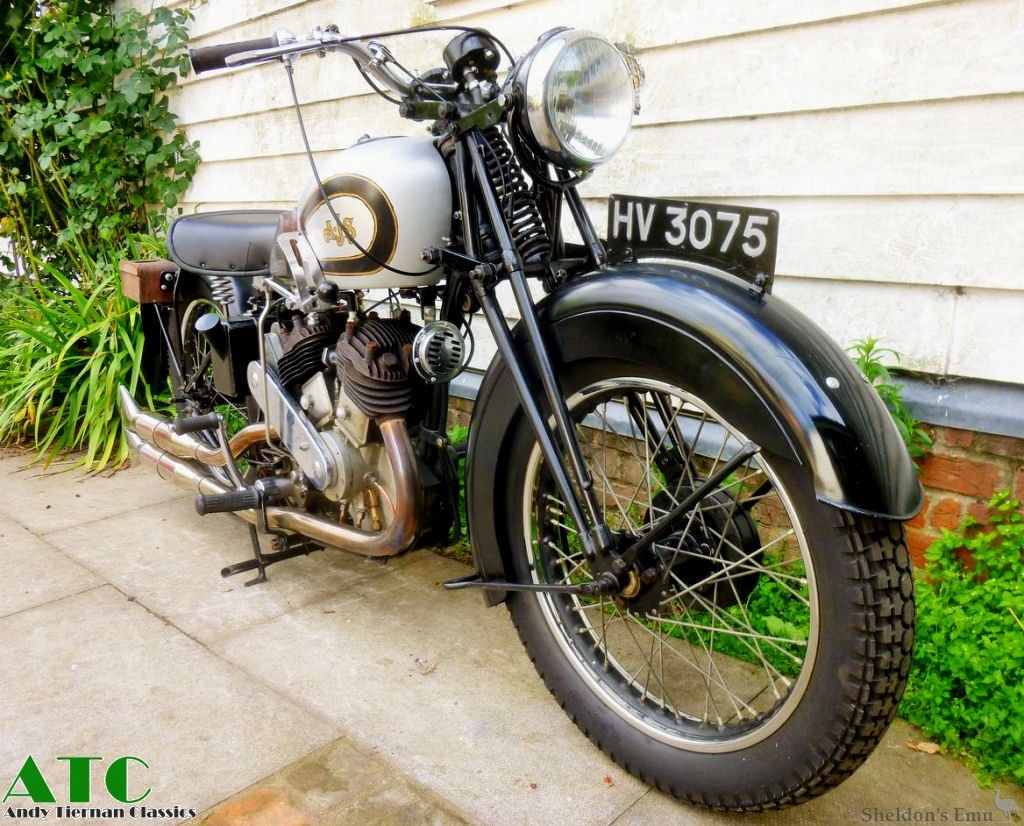
THE 9.90 H.P. STANDARD S.V. (1933) BIG TWIN
On going to press the author finds that the reintroduction of the famous Big Twin, referred to in the Preface of this handbook, has become a fait accompli. On 7th July, 1932, details of the two Big Twins, which are really advance 1935 models, were announced. They bear a close resemblance to earlier A.J.S. machines of this type, although greatly improved and of thoroughly up-to-date design. Two models are available, the Standard model and the 'Export' model, and their prices are, without Lucas electric lighting, £65 in each case. The Standard model has the following specification -
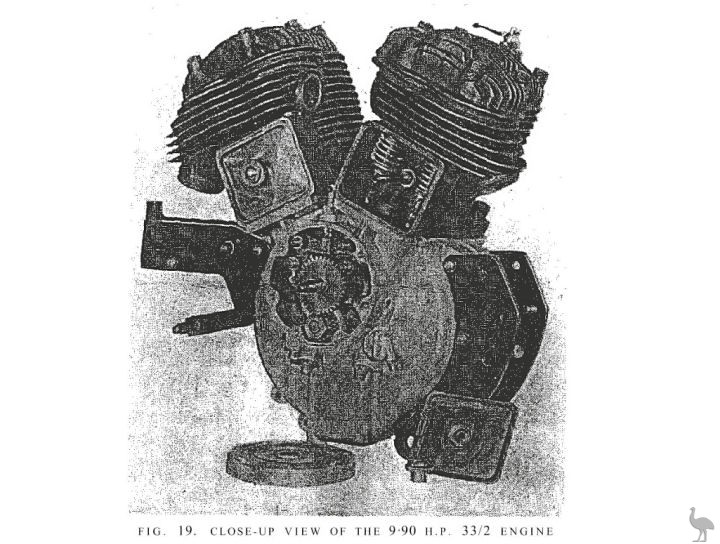
Engine. This engine has a bore and stroke of 85.5 mm. x 85.5 mm., giving a cubic capacity of 990 c.c. The two cylinders are set at 50 degrees to each other, and the bores, being 'square' with the cylinder castings, the firing angle is also 50 degrees. Fig. 19 shows the general design and construction of the power unit.
Page 21
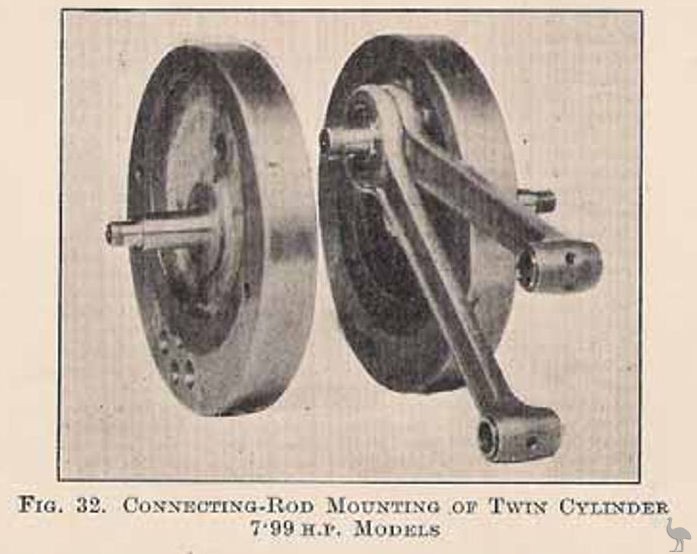
Left is shown a 1930 assembly. The crankpin on the new 33/2 engine has parallel location in the flywheel. It is flanged on either end of the 'run,' ¼ in. x ¼ in. rollers are used, and these run in a small metal cage.
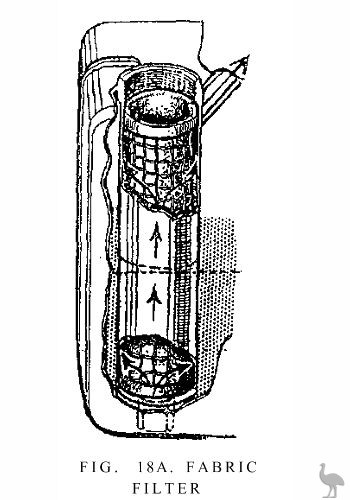
No separate big-end liner is used in the connecting rod and the diameter of the gudgeon pins are now much larger. Where the connecting rods were offset on the small end of the earlier engine, they are now square with the connecting-rod, and the small-end bush stands out farther on one side than the other. On the right is shown the detachable fabric filter in the oil tank
Page 22
The crankcase itself is a very neat aluminium casting split longitudinally in the usual manner. An extension immediately below the annular timing case, which has a readily detachable cover, houses the dry sump plunger, and if separation of. the crankcase halves is contemplated care is necessary in respect of this unit. A disc breather maintains atmospheric pressure in the crankcase. An oil bath (Fig. 7) lubricates the primary chain. The crankshaft assembly is an ordinary single-throw type built up of two flywheels, to which are keyed the friction fitting mainshafts, and a flanged crankpin upon which, with two sets of caged rollers interposed, but no bushes, are mounted a pair of 'H' section connecting rods having 7/8in. (I-D) phosphor-bronze small end bearings. With regard to the crankshaft bearings, that on the driving side has a heavy double-row caged roller bearing, while the other one is of the plain bush type. The pistons themselves are of aluminium alloy and have four rings each, the lower acting as a scraper ring. They are split diagonally across the skirts to allow for expansion, and they have fully floating gudgeon pins secured by small spring circlips to prevent scoring. With a cold engine the correct gap at the piston ring slots is .005 in. to .010 in. Permissible crankshaft end play is .025 in.
Page 23
The timing case cover and one valve cover plate have been removed to show the valves and timing gear. The induction manifold and carburettor are also removed. It is of interest to note that this engine is identical to that installed in the Matchless Big Twins
The cylinders, which have a compression ratio of 4-8 to 1, have cast-iron detachable heads, and the cylinder barrels are cast integral with two very neat valve chests which entirely enclose and protect the valves and their springs, two pressed steel cover plates held firm by centrally placed knurled nuts giving instant access to the valves. The. barrels are deeply spigoted at their bases and paper washers are used; C. and A. gaskets are fitted between the barrels and heads, which are of semi-turbulent design. The sparking plugs are not centrally located over the cylinder heads, but are placed in an offset position over the inlet valves. The two cylinders are interconnected by a horizontal induction manifold with screw-on unions.
Page 24
The valves themselves are of large diameter and of the mushroom type with single springs and slotted valve stems for the flat cotters used for anchorage. They reciprocate in chilled cast-iron guides which are readily detached for renewal. Round section tappets are used, and the adjustable heads screw into the tappet bodies and are secured by lock-nuts. The timing gear is extremely simple. It comprises a single cam wheel having three cams, one each for the exhaust and one for the inlet valves, driven off the engine pinion, and four toggles mounted on pivot pins and separated from the back of the timing case by 29/64 in. distance collars. The arrangement of these toggles is shown by Fig. 19, and the neat exhaust valve lifter mechanism in the centre is also clearly illustrated ; the timing pinions are marked for mesh. The products of combustion are swept out from the exhaust ports into an imposing and exceedingly quiet exhaust system comprising two 1¾ in. diameter chromium plated pipes, each terminating on the off side in a standard A.J.S. silencer and fish-tail.
The magneto, or "Magdyno," as the case may be, which is mounted on a platform above the gearbox, is driven by chain and sprockets direct off the camshaft. The camshaft sprocket fits on a slight taper, is not keyed, but held firmly by a nut screwed to the threaded end of the shaft. Chain tension is adjusted by tilting the special magneto platform (Fig. 8). A chromium plated and enameled pressed steel chain case protects the chain.
The lubrication of the engine is carried out by a D.S. system similar to that described on page 88. The double-acting oil pump forces oil under pressure to the big ends of the connecting rods, the mainshaft bearings and the camshaft bearings, while the whole of the timing gear runs submerged in oil, the surplus being returned to the crankcase through a small oil level hole.
With this lubrication system there is no means of adjustment provided as on the other models.
Tappet clearances 004 in. inlet and 006 exhaust (warm)
Magneto advance 7/16 in. before T.D.C. on full advance
CARBURETTOR. This is a No. 6/012 Amal. Particulars: main jet, 140; needle valve, 6/5, in position 2.
ignition. Lucas magneto behind the engine without Vernier timing adjustment. The magneto sprocket is not keyed to the armature shaft, but is a tapered friction fit. Lodge H.L. sparking plugs.
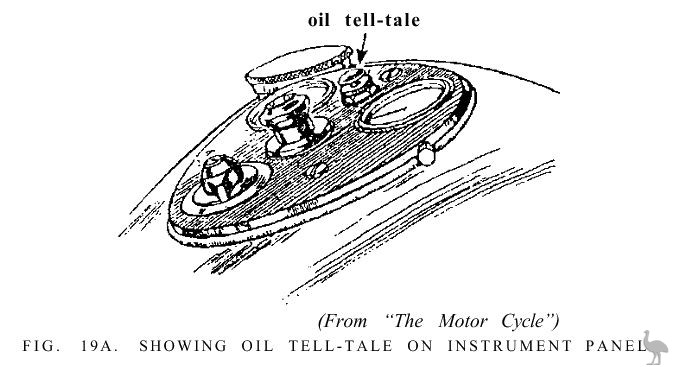
lubrication. On the Big Twin the lubrication system is of the dry-sump type, different from that used on the 1933 'camshafts.' It differs absolutely from the improved mechanical lubrication system fitted to the 1932 range of six machines. A half-gallon oil tank with fabric-type oil filter is mounted on the seat tube. On the instrument panel (Fig. 19A) is an oil tell-tale. This should indicate pressure when the engine is running.
Page 25
FRAME. This is a semi-cradle design with a very robust scat post, twin tubes running from the front of the power plant and swept to the rear wheel spindle, and a very large-diameter top tube. Standard A.J.S. forks are used except that the shock absorbers are adjustable by a hand-wheel on the off-side. There is also a steering damper.
TRANSMISSION. 5/8 in. pitch by 3/8in. wide, Coventry rear chain, totally-enclosed ½ in. by .305 in. Front chain with oil bath and shock absorber on engine mainshaft.
CLUTCH AND GEAR-BOX. The clutch is of the multiple plate and cork insert type, hand controlled. Gear-box is a four-speed, pivot mounted, Sturmey-Archer, with ratios of 4-5, 5-5, 7-3, and 13-5 to 1 solo.
WHEELS, TYRES, AND BRAKES. Both of the wheels quickly detachable and interchangeable, with 27 in. by 4 in. wired on, heavy type, non-skid Firestone tyres. Brakes of internal expanding type with 7 in. front and 7¾ in. rear diameter drums and dust and water-excluding flanges. The front and rear brakes are operated by a lever and foot pedal situated on the right and left-hand sides respectively, quick finger adjustment being afforded.
TANKS. The petrol tank has capacity for 3½ gallons of petrol, which is sufficient for 150-200 miles. On the top of the tank is a flush-fitting instrument panel with the oil tell-tale. The oil tank holds four pints. Standard A.J.S. finish.
MUDGUARDS. Well valanced, and fitted with drip channels. Rear : 6½ in. wide, with detachable portion for wheel removal.
MISCELLANEOUS. Included in specification are - Lycett saddle, semi-sports handlebars, rubber footrests, stands to front wheel and central spring-up stand, a complete set of tools. Lucas electric lighting costs £5 17s 6d. There are also various extras obtainable, such as an 8-day clock, electric horn, gearbox-driven speedometer, etc.
Page 26
THE 9.90 H.P. S.V. 'EXPORT' MODEL
The specification of this machine differs from the standard model in regard to a few points only. The main differences are as follows - Long touring handlebars are provided. A left-hand gear change is used. There is a ratchet control for the foot brake.
The clutch has foot control. Rubber footboards are specified instead of footrests. An air cleaner is fitted.
See also: AJS 1934 Model 2 990cc SV Twin