
Page 16
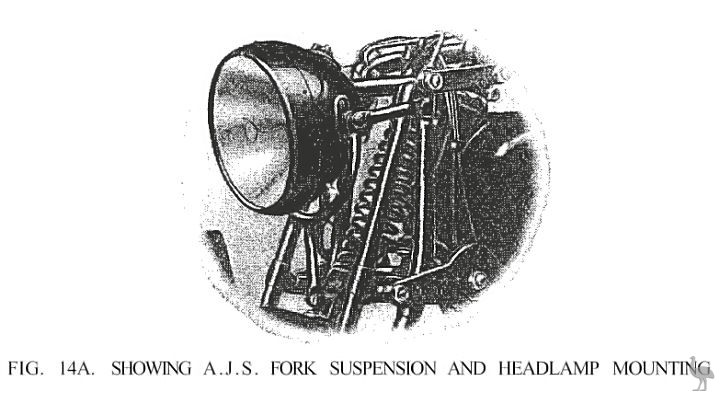
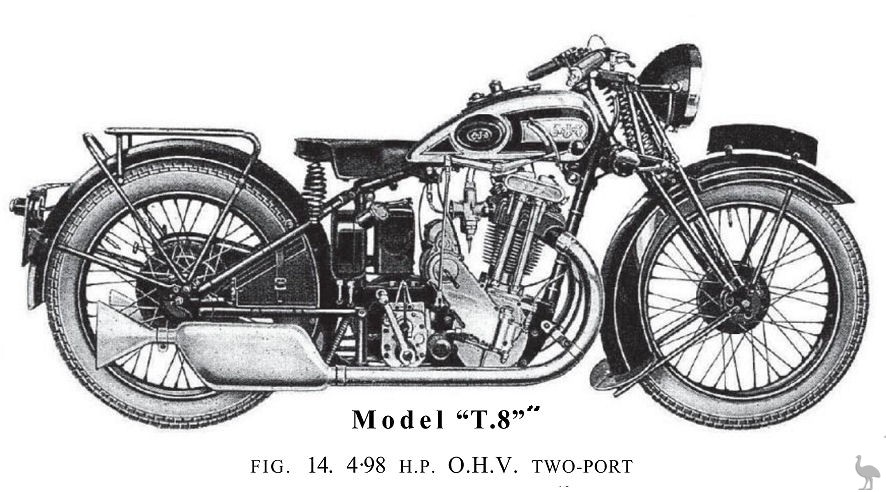
This machine has an appearance absolutely identical to that of Model T6, and as a matter of fact it is a more powerful version of this machine. The main differences in specification are as follows - ENGINE. The general layout of this engine, whose predecessors have performed so creditably in the Tourist Trophy Races, is similar to that of the 3 49 h.p. O.H.V, engine; some parts are actually interchangeable. The machine illustrated has, it will be noticed, a Bowden carburettor, but an Amal is now standard. It is of 84 by 90 mm. bore and stroke, giving 498 c.c. capacity. Like Model T6 engine, it is fitted with a detachable cylinder head, enclosed valve lifter mechanism, an aluminium alloy piston with non-segmented crown, and compound type valve springs. The correct valve clearance is 006 in. for the inlet and -008 in. for the exhaust valve, and the ignition advance, 7/16 in. before T.D.C.
Model T8 is undoubtedly very fast indeed. Its full throttle speed, as given by the manufacturers, is 78 miles per hour. It should attain this speed after careful running-in. The utmost care is taken in the erection, tuning, and testing of every machine. There is no doubt, however, that the crack rider who has the time, skill, and patience available can still further improve upon this very excellent performance and, given a certain amount of luck, could 'boost' the machine up to a speed of 85 m.p.h. To attain such a speed it is not necessary to run on anything except petrol-benzole, using a high-compression piston and well-tuned carburettor.
Page 17
As a matter of fact, two aluminium pistons are available for this machine. One is a low-compression member for use with ordinary petrol or petrol-benzol mixtures, and gives a compression ratio of 5-7 to 1. The other is a high-compression piston which provides a ratio of 7-5 to 1. This is a comparatively high ratio, and permits of every available ounce of fuel energy being utilized in the production of power with the rapidity of combustion at its highest value. Only by exceptionally rapid and complete gas combustion can mean piston speeds of approximately 30 m.p.h. be obtained (and this is the piston speed corresponding roughly to a road speed of 90 m.p.h, with a gear ratio of 5 to 1). It needs little imagination to realize what large inertia forces the connecting rod and bearings are called upon to resist in view of the fact that at 90 m.p.h, the piston is undergoing alternately positive and negative accelerations of a very high order nearly 200 times every second! The connecting rod and double row 'A in. roller bearings fitted to the big end are thus of very robust construction to stand up to the grueling ordeal to which, on occasions, they are submitted. The engine mainshafts rotate on ball bearings.
An Amal type 29/004 carburettor is fitted and the setting is: jet 180, valve 29/4, needle position 2. It is semi-automatic, and has twist-grip control. The ratios of the four-speed gear-box are: 1st, 4-81; 2nd, 5 8; 3rd, 10*4; 4th, 14-4 to 1. Various parts of the engine and machine have been slightly stiffened to withstand the very high speed which this model is capable of attaining. Recommended sidecar gear ratios are 5 53, 6 7, 12 0,
16*5 to 1. A carrier is fitted. Fuel consumption is 70-75 m.p.g., and oil consumption about 1,200 m.p.g.
Page 18
This, the largest "big port" machine, has the same specification as Model T8, except that the twin exhaust system has been scrapped in favour of the single port, a three-ring piston is used, and the equipment does not include a carrier. The compression ratio is 6.1 to 1, and the magneto advance 9/16 in. before T.D.C.
Racing type mudguards are used, and the three-speed ratios are: 4-8, 7-0, 12-85, solo, and 5-53, 8-12, 14-7, S/C.
Page 19: S.V. Lightweight Model T5