
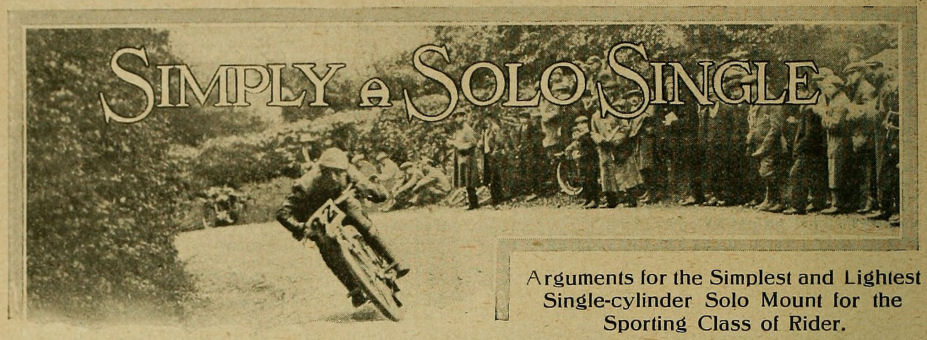
Arguments for the Simplest and Lightest Single-cylinder Solo Mount for the Sporting Class of Rider.
MY Army experience did it! During detention my point of view in regard to motor cycles veered round several points. Mixed up as I have been with motor cycles of all kinds, and having perforce to see them handled by riders, both male and female, of all degrees of skill, naturally I have, as a keen rider and a student of design, seen much to provide food for thought. My outstanding impression is that for solo work manufacturers are piling on too much weight. " Nothing new in that," the reader will retort, " since for years past we have had constant pleas for serviceable lightweights." But I am not thinking of weight reduction obtained by reducing the size of the engine. Often as I have watched riders operate their kick-starters, engage the low gear, and glide away on the clutch, a sense of admiration for the various progressive designers who had rendered that sort of thing possible has come over me, but, notwithstanding, I would continually reflect upon the happy and sporting days spent in 1908 to 1910, when " nippy " single-geared 3 ½, h.p. solo mounts were the rule. Why, the very uncertainty of a successful climb up a single-figure gradient on that type of machine thrilled one. The personal factor in handling the machine came largely into play. As one was dependent entirely upon the tune and handling of the engine, there was a sense of satisfaction in conquering a steep hill that no climb on a variably-geared mount can convey.
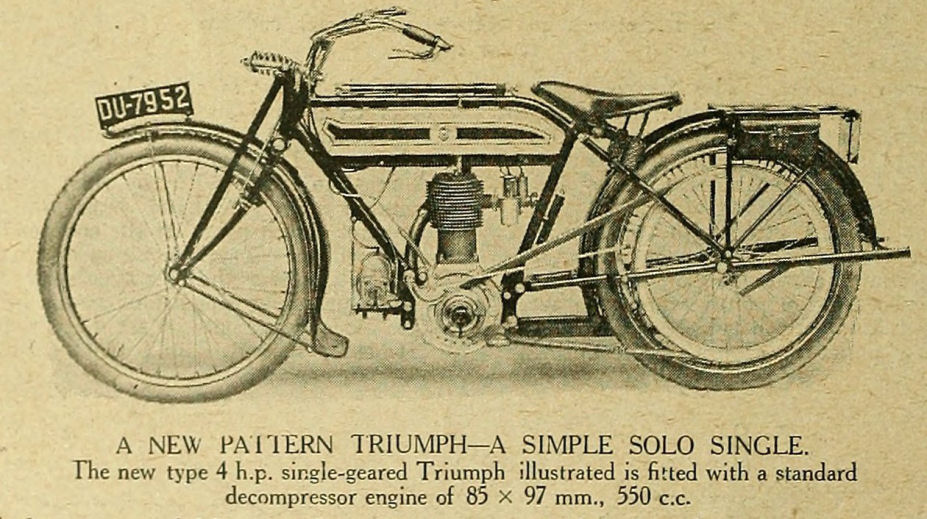
A NEW PATTERN TRIUMPH– A SIMPLE SOLO SINGLE
The new type 4 h.p. single-geared Triumph illustrated is fitted with a standard decompressor engine of 85 x 97 mm, 530 c.c.
Mere Soloists Neglected.
The cry for the double purpose mount for solo and sidecar work has resulted in the creation of a magnificent machine answering that requirement, but obviously a compromise cannot be ideal for one purpose or the other. Mere soloists are not being catered for as they were years ago, passenger carrying being the vogue in these days.
Do I despise the variably-geared machine? Not a bit, even though its riders will have the laugh of me when I get stuck on a hill. Change-speeders are magnificent, as I have already said, and they are undoubtedly the machines for everyday riders, but there is a class of sporting young rider, agile and keen, who, I know, would cherish a mount on the lines of the 160 lb. 3 ½ h.p. solo bicycles of ten years ago. So pleasant were my recollections of long runs, including ascents of noted hills – such as Sutton Bank – that I brooded over what a modern 3 ½ h.p. engine should do with its ten years' advancement in design and general efficiency if fitted in a bicycle shorn of a clutch, gear box, chains and chain case, and dynamo. The removal of these items would represent possibly a 100 lb. weight reduction, a considerable relief to any engine, and render the bicycle a thoroughbred indeed. Those broken exhaust valves of olden days can now be cured by the adoption of tungsten or stainless steel, and the second bug-bear of belts pulling through at the fastener never occurs with modern belts.
I would risk it, I thought, and experiment, the final consideration being the saving of £25 or so in cost and a reduction in petrol consumption. So I commenced enquiries for a 3 ½ h.p. T.T. mount of pre-war days, but nothing attractive coming my way, I laid my troubles before the Triumph Co., and (joy!) my order for a simple single was accepted, the memories of the old enthusiasm for T.T. mounts years ago still being fresh in the manager's memory. I have got the machine – fitted with a 4 h.p. engine, though I would have preferred a modern 3 ½ h.p. on the score of lightness – and it can be described in a twinkling.
Page 343
It has a new rear frame, direct belt drive from an adjustable pulley – and that's all! At first I thought of a Philipson governor pulley, but have postponed that idea in the interests of weight reduction. It is merely an engine in a frame. Some will say that this is a retrograde design, but I do not think so, for engine efficiency has made marked advances, and in any case the experiment is fascinating. Those riders who dislike the snatch of a "double" drive should try a plain belt again. That is but one good point to set against the disadvantages of a gearless and clutchless machine. Starting troubles of olden days have, as I imagined, almost disappeared. Thanks to the convenient primer and the decompressor, I can walk beside my machine with the engine firing regularly, and I can turn in the space of an ordinary road without dismounting. This is with a gear of 4 7/8 to 1, on which ratio hills such as Edge and Tysoe are easy work, and Newnham could be ascended faster than the rider can negotiate the top corner. All these gradients are about 1 in 6. In the Lake District or Devonshire the single-geared machine would be napoo but how many long gradients of 1 in 5 does a rider meet in a year's riding? The acceleration is remarkable. Though I have not been timed, my "walking pace" gear ratio gives me a speed approaching 53 m.p.h. – not so bad.
Engine Snatch on Greasy Surfaces.
It is only when passing over treacherous surfaces that one automatically feels for the clutch lever to cushion the drive. It is bound to be wanted – as well as a gear – many times yet, for I have not sought for freak hills; but to determine the limitations and possibilities of a modern single-cylinder for solo work was partly the object of the experiment. If readers want to know more I shall be pleased, in the light of extended experience, to record subsequent impressions: but a word to novices – a single-geared machine is not your ideal. Only if you are experienced and take an interest in keeping your engine in the best of condition, and further if you are nimble, can the essentially sporting single-geared machine make a strong appeal to you.
Specification of a 3 ½ h.p. Solo Mount.
Had I a works at my disposal, and for the moment ignoring the cost of production, I should have drawn up a specification somewhat as follows for my most simple solo mount:
Engine. – 85x88 mm., medium compression, outside flywheel, cast iron liner in an aluminium shroud, as in the B.R. aero engines of Capt. W. O. Bentley's design, but extended to include the top half of the crank case. This would enable one to drop the lower half of the crank case and thus expose the big end, or even remove the connecting rod and piston complete if necessary. Detachable cylinder head, and Ricardo slipper type aluminium piston. Decompressor operated by a convenient toe and heel pedal, as on the Ariel motor bicycle.
D.U.
The Motor Cycle April 3rd, 1919. PP 342, 343.