


Triumphs at the Olympia Motor Cycle Show, Melbourne Town Hall, September 1937
FIRST SHOWING AT THE MOTOR CYCLE SHOW.
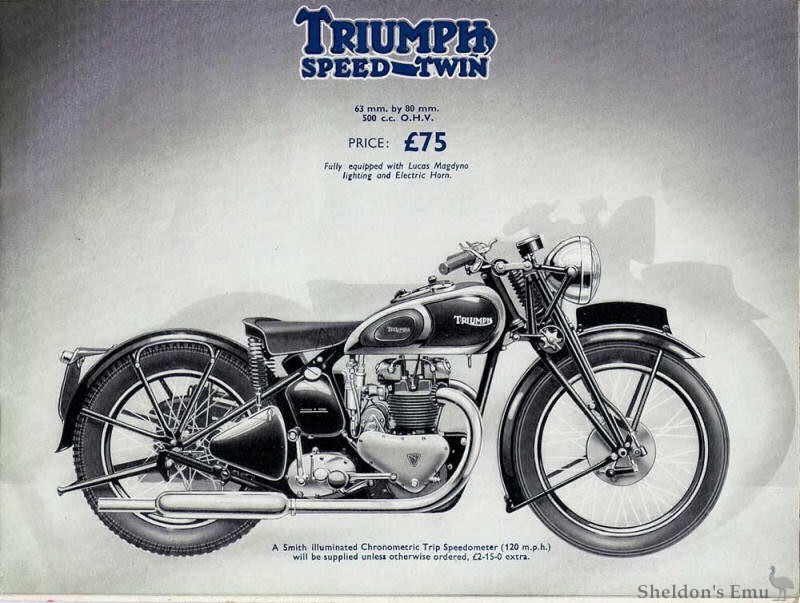
A new 500 c.c. vertical twin Triumph of exceptional interest is being given its first showing at Rhodes Stand at the Motorcycle Show. The machine is neat, simple and sturdy and has been tested abroad to a degree that is little short of extraordinary. It is a true Sports model, but with the excellent road manners associated with twins of the even firing type.
THE features of the vertical twin are that it does not protrude from the frame (in side elevation a 500 c.c. unit is equal to one of 250 c.c.), the firing intervals are even and there is an even pull on the carburettor, perfect cooling, extreme rigidity which is the essence of high power output, the engine will go into a smaller frame without loss of accessibility, the two cylinders do precisely the same amount of work, and the engine is amenable to all single-cylinder tuning technique.
The engine is of the high-camshaft type with the cylinders cast in one block and with a one-piece cast-iron cylinder head. The crankcase can probably be best described as being barrel shaped, but with domed ends. It is thus exceptionally rigid and provides particularly good support for the ingenious built-up crankshaft.
A single flywheel is employed, and to this are bolted two single-piece stampings, which form the cranks, bobweights and main-shafts. The flange which bolts on to the flywheel is ribbed to increase the rigidity. The flywheel it self corporates a bobweight. Heavy duty ball races, one each side and each 2 ¾in. diameter over all, carry the crank shaft which has a 1 7/16in. crankpin diameter. The journals are, of course, hardened and ground.
This sturdy form of built-up crank shaft is rendered possible by the use of split big-ends. The connecting rods are light alloy forgings—RR56 alloy, which is itself an excellent bearing metal and which has the same tensile strength as mild steel for a third the weight. In stead of the lower half or cap of the big-end bearings being of light alloy, which would increase the dimensions of the bearing and cause it to protrude more, it is of manganese-molybdenum steel of a tensile strength of 80 tons/sq./inch, with a central rib and incorporating the two fixing bolts. Thus the construction is light, yet rigid. This cap is white-metal lined.
The rod is of heavy H-section and has 9/16in. flanges and a width of over an inch at the big and little ends. Lubrication is by a double-plunger pump with the feed pump forcing oil through the timing-side mainshaft to the big ends and also direct to the rockers. Oil is supplied at 60 lb./sq. in. when the lubricant is cold. This pressure drops to 40 and the factor of safety is such that the engine will run satisfactorily at 15.
Only five pinions are employed in the timing gear. This is the same number as in the standard Triumph singles, although the twin is of the high-camshaft type. The front camshaft is, of course, the exhaust one and runs across the crankcase almost immediately below the front cylinder-base studs. Each camshaft is carried in phosphor-bronze bushes, which are 7/8in. diameter on the drive side and 13/16 in. on the other.
The plunger pump is driven off the inlet camshaft pinion, which also drives the Magdyno. This last is mounted behind the cylinder, and is therefore well out of harm's way.
In plan view the cylinder block and cylinder head are very much like the figure "8," with the push-rod tubes running up the two sides of the "8." This absence of finning between the cylinder barrels is compensated for by the out-way. which prevents any blanketing.
Flat-base tappets, operating in detachable tappet guides of close-grained cast-iron, are employed and the short tubular steel push-rods run in tubular housings.
An eight-stud fixing is employed for the one-piece cylinder head, which incorporates special wells for the totally enclosed valve springs and has the exhaust ports set an angle outwards. The sparking plugs are on the outside of the head and very accessible. The heads themselves have the valves set at 90 degrees and a full 5/8in. between the seats. The valves are some 4in. long and carried in very long cast-iron guides.
A detachable die-cast aluminium rocker box is fitted, with the hollow rocker spindles carried in phosphor bronze bushes. Screwed-in caps give access to the rocker-end adjusters provided for setting the valve clearances.
It was mentioned earlier that the rockers are pressure-fed from the oil pump. The oil, after emerging from the rocker bearings, drains into the valve spring wells and is then led by external pipes to the rocker tubes. It next drains through the tappet-guide block and on in the cams, which in view of the oil thrown up by the crank-shaft assembly thus have a double supply. In order still further to ensure that the cams are oil flooded, the cams are mounted in what might be termed a semi-tunnel.
Produces 26 B.H.P.
A single Amal carburettor is employed. This feeds into a T-shaped induction manifold. The compression ratio is 7.2 to 1, and the pistons are of the flat topped type with small cutaways for valve head clearance and three rings, the bottom one of the slotted scraper type. An interesting point is that whereas with this compression ratio of 7.2 to 1, the 250 c.c. engine develops 11 b.h.p., the twin produces some 26 b.h.p.
The power curve ratings of one of the engines are also interesting, for they show the high torque at low speeds and the way the engine holds its power— -3,000 r.p.m.. 14 b.h.p.; 4,000, 19.1; 5,000. 23.6; 5,200, 24.3; 5,400, 24.5; 5,600. 25.5; 6,000, 25.2. The gear ratios decided upon solo work are 5.23. 6.28, 9.05 and 13.3 to 1.
Speeds in excess of 90 m.p.h. have been achieved on test, and the acceleration is also claimed to be exceptional. Of special interest was the tests to which the machine has been submitted by the Triumph factory before production in volume was attempted.
The most important is probably that in which the endeavour has been to equal three or four years' riding on the road. This has been a destruction test on the bench with a special device that continually opens and closes the throttle. Another test comprised 10,000 miles thrashing with a loaded sidecar, plus three and four-hour spells at 5,800 r.p.m. on the brake.
Altogether, the new Triumph is one of the neatest and sturdiest twins imaginable and the result is a machine of exceptional interest.
A full range of Triumphs are on display at this attractive Stand:—
The centre of attraction is the 6 S. 600 c.c. S.V. outfit that set new world's non-engine stop records —incidently, this outfit run [sic] in the recent Hartwell Motorcycle Club Cross Country Trial.
Australian Cycling & Motor Cycling, September 28th 1937. Trove NLA
Rhodes Motorcycle Co. Melbourne