This page lists brand names beginning with the letter "D" for which we currently have only an historical precis.
For a more complete listing visit the German Index.
Dalli 1922-1924
Danubius
1923-1924
Ganz & Co of Ratibor constructed conventional machines using a 198cc sidevalve engine.
Source: Tragatsch p112
Danziger
Manufactured by Felix Danziger, Berlin-Charlottenburg, 1925.
Presented at the Berlin Motor Show in Berlin of 1925 the Transport-Motordreirad (motor tricycle) was powered by a Rinne engine of 7.94 h.p. with a Hurth three-speed gearbox.
Source: Axel Oskar Mathieu Archive
Deloma
Manufactured by Deloma Kraft-Werke, 1923-1924
Oskar de Lobert of Magdeburg built motorcycles powered by two-stroke Rohöl (crude-oil) engines designed by Julius Löwy and supplied by Albertus Schweröl Einbaumotor. These engines proved problematical and may have contributed to the short life of the marque.
At the 1924 Leipzig Spring Fair (Leipziger Frühjahrsmesse) the Deloma B was displayed. Fitted with an Albertus engine it had flywheel magneto ignition, belt drive to the rear wheel, and a foot and clutch brake.
Sources: Tragatsch p112; Motopedia.
Delphin
Constructed by Kurt Schirakowski of Kassel who built a variety of Delphin sidecar combinations using mostly Moto Guzzi and BMW machines as the basis, beginning in 1973 when he bought Zweirad Schira from Ferdinand Klinge.
The Bunny scooter sidecar was built by his son Dirk Schirakowski from about 1990 to 1994. Dirk had taken over the business after Kurt died. Uwe Schütze joined the firm in 2006, and became the owner when Dirk left in late 2020.
Sources: Gespann-Lexikon; shira.de.
Delta
1924
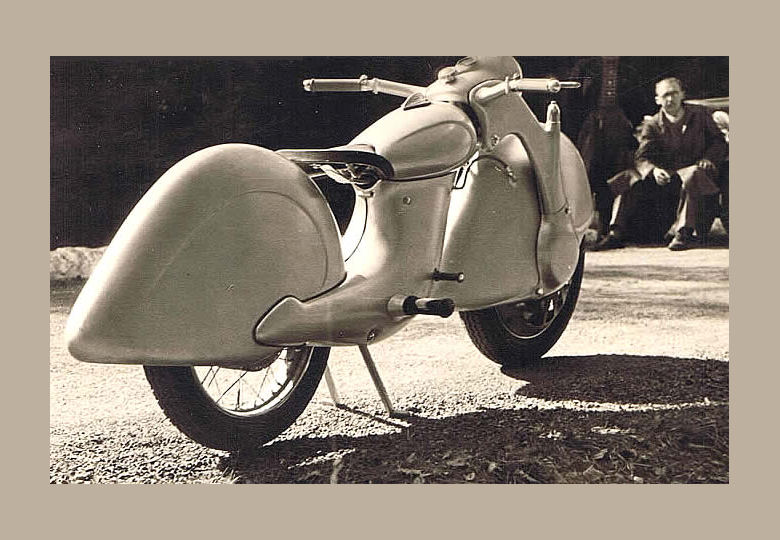
An unusual design, the fully-enclosed motorcycle had a dual seat, rear suspension using leaf springs, and was powered by a 499cc two-stroke engine.
Built by Delta-Werk, a company run by Hugo Linder in Solingen established in the 1870s and famed for its blades. In the period when the motorcycle was produced the company had 500 employees.
Source: Tragatsch p113, rheinische-industriekultur.com
Dessauer Sidecars 1929-1936
Deutschland
Early 1920s
At least two models were built, each with a 198cc four-stroke engine mounted quite high, and pedals. Models Nr. 100 and Nr. 101.
Source: motor-hist-foto.de.
DFB
1922-1925
Built 159cc two-stroke bicycle attachment engines and complete machines using the same engine.
Source: Tragatsch p113
DGW
1927-1928
Displayed at the 1927 Olympia in London, this was actually a DKW which had been rebranded due to the use of the DKW marque by another German firm which had trademarked the name.
Source: Tragatsch p115
Diana Sidecars 1952-1954
Dick 1926-1933
Diel
A water-cooled OHV machine of this brand from 1927 is in the collection of Motorrad Museum Ibbenbüren - see museums-germany
Source: nl.wikipedia.org
Dieterle-Dessau 1921-1925
Difra
Manufactured by Difra Fahrzeugwerke, Frankfurt/Oder, 1923-1925
Fitted 1.8ps Namapo engines to their own frames. The machines had pedals and direct belt-drive.
Source: Tragatsch p115, et al.
Dobben
Manufactured by Bernhard Dobben in the early 1990s. He developed sidecar chassis for sporting sidecars in collaboration with Lefèvre and VMC, and built machines based on Honda fours, Suzukis, and the BMW K100.
The firm became Dobben & Steinbuß - Steido.
Source: Gespann-Lexikon
Dobro-Motorist 1923-1925
Dohle 1950s
Dolf 1922-25
Döring Spatz 1951
DRC
Manufactured by Auto Däschlein Zweirad,
Ansbacher Str. 57, 91572 Bechhofen, Germany
daeschlein.de
Founded in 1982, their website states, "For over 25 years, the name Theo Däschlein has been known in professional circles, all sidecar drivers, especially scooter sidecar drivers and the trade press."
Sidecar models include: Roadster, Streetjet, S 100, S 200.
Sources: daeschlein.de; Gespann-Lexikon
DSW
Manufactured by Deutsche-Motorenbau AG, Berlin, 1922-1923
The D.S.W. Light motorcycles were powered by a 150 cc engines of their own construction which had an external flywheel and belt drive. After a year of production, the company was taken over by Bismarck-Motoren GmbH of Berlin, and the brand vanished.
Source: GTU Oldtimerservice
Duro
Enduro sidecars manufactured in Welling in the 1990s designed to fit the MuZ Country model.
Source: Gespann-Lexikon
N.B. No other reference to this marque has been found as of Sept 2025.
DWB Dorko-Werke 1924-1926
Rarer German Marques