
This page lists brand names beginning with the letter "K" for which we currently have only an historical precis.
For a more complete listing visit the German Index.
K&K
Manufacturers of motorcycles powered by 170cc & 289cc three-port two-strokes of their own manufacture, active 1924-1925.
Source: Tragatsch p185.
KADI
Manufactured 1924-1930
Built motorcycles using 198cc and 498cc 3 valve OHC Küchen engines.
Source: Tragatsch p181
Kaha Electric Tricycles 1920-1924
Kalkhoff
1950s
Kalkhoff-Werke GmbH., bicycle manufacturer of Cloppenburg, built mopeds with JLO engines in the 1950s.
The firm was operating in the mid-1930s and in 1977.
Sources: mo-ped-se; velopedia.online
Condor (Karstadt) 1970s .
Karü 1922-1924
Katho
Manufactured 1923-1925
Built lightweights with 198cc Alba engines.
Source: Tragatsch p181
Kayser 1899~1903
KC 1921-24
Keni 1921-25
Kessel
1923-1925
Kessel & Schmidt; - Maschinenfabrik, Pößneck in Thür., Neustädterstr. 51
Source: motor-hist-foto.de
King-JAP
Manufactured 1928-1931
Assembled machines using 196, 346, 490 and 545cc JAP engines. Most of the chassis and running gear components were also made in England.
Source: Tragatsch p184
Klotz 1923-1926
KM
1924-1926
Built lightweight motorcycles using 142 and 1959cc two-stroke engines of their own manufacture.
Source: Tragatsch p185
KMB Franz Becker 1922-1925
KMS
1922-1924
Kunz & Müller Motorradwerk,, Militärstraße 88b Stuttgart.
Models included a 196cc OHV single with inclined valves using an engine of their own design, and a 142cc model with a Grade two-stroke engine. There was also a Kraftrad model with a 2.5ps DKW engine.
Sources: Tragatsch p185, wirtemberg.de, motor-hist-foto.de.
KMS Kindermann Sidecars
Manufactured by KMS Motorrad Service, 31606 Warmsen
Moto Guzzi and Ducati specialist.
Website: kms-motorrad.de
Knauss
Knaus-Sidecar-Technik
Max-Eyth-Straße 19
73095 Albershausen, Germany
knaus-sidecar-technik.com ✝
Sidecars manufactured from 2012 to 2015. Developed from the EZS Summit sidecar, the Knaus ST-2 was fitted to three Moto-Guzzis and one BMW S1000R.
Sources: Gespann-Lexikon, et al.
KÖBO
Manufactured 1923-1926
Emil Köhler & Hermann Bovenkamp were partners in the company established in 1894 and became well-known for their chains, having developed a manufacturing process which is in use to this day. Emil departed before WWI.
Both Wuppertal and Barmen-Hatzfeld are associated with the history of the marque.
The company built motorcycles using their own 276cc two-stroke engines but ceased production during the period of hyperinflation, as did a great many other motorcycle manufacturers in Germany.
Source: Tragatsch p185
Koch Seitenwagen 1960s~1990s
Kofa
Kofa AG, Neutorstraße 10, Nuremberg, 1923 - 1925
Built motorcycles with 289cc single-cylinder two-stroke engines
Source: meisterdinger.de
Komet 1902-1905
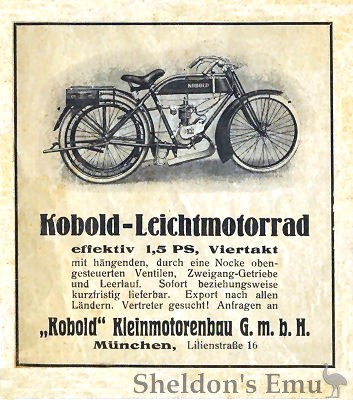
Kobold
Manufactured by A. Burkhardt, Kobold Kleinmotoren GmbH, München, Lilienstr. 16, 1924-1925.
Address also given as München, Trogerstr 19.
Source: motor-lit-berlin.de
Kondor Sidecars
Manufactured by Kondor Fahrzeugbau Gelsenkirchen, 1920 to c.1936.
The firm built aircraft from 1912 to 1919 and from 1920 onwards produced furniture and sidecars for motorcycles. Their sidecars are discussed in an article in ADAC Motorwelt No. 26, June 1933, and another article mentions them in Motor und Sport in 1935.
Josef Suwelack founded Kondor Werke in 1912, and their first aircraft flew in 1913. At the end of the war in 1918, the company had 1,200 employees.
The firm had factories and offices in Essen and Nordhausen. The sidecars were built in the aircraft factory at Gelsenkirchen-Essen-Rotthausen aerodrome.
Source: gelsenkirchener-geschichten.de
Kondor
Manufactured in Berlin 1924-1925
The firm built two models, the two-stroke Simplex, and the four-stroke Ideal, both with a 2-speed gearbox integral with the unit-construction engines, and was available with electric lighting.
Source: GTU Oldtimerservice
Kosmos
Manufactured by Euroimport Schlich of Mayen from 1985.
In the years 1985 and '86 the firm produced 12 different models enduro and motor-cross machines using mostly Italian components and modified Sachs two-stroke engines. Later machines were the KSR175 and KSR250, both powered by Moto Morini. Series production ceased in the early 1990s but the KSR250 remained available on special order for some time.
Source: GTU Oldtimerservice
Koster (KS)
Manufactured 1923-1925
A lightweight with pressed metal and tubular frame, it was fitted with 123cc Bekamo and 144cc Cockerell engines. It had disc wheels, used both chain and belt drive which were fully enclosed. The fuel tank was integral with upper frame.
Source: Tragatsch p186
Ko-Wu Lieferwagen 1926-1929
KR 1924-1925
K.R. (1930s)
Manufactured in München 1930-1933.
Unrelated to the KR marque of the previous decade built by Karl Rühmer, these machines were assembled using JAP 198cc SV and OHV engines, and JAP 298cc engines.
Source: Tragatsch p186.
KRS
Manufactured 1921-1926
Built motorcycles with 148 and 198cc ohv Paque engines, and 293cc Bosch-Douglas HO twins supplied by SMW.
Source: Tragatsch p187

Kraemer
Manufactured by Kraemer MC
Gewerbepark Lindach B5
84489 Burghausen
Website: kraemer-motorcycles.com
Facebook: fb.com/KraemerMotorcycles
Krämer Motorcycles is a specialist for purpose built race bikes. Models include APX 350-MA, Super Duke Race Kit, GP2-890 XX, GP2-890RR, EVO2-690S and EVO2-690R.
Kratmo by Kratzsch 1948~1952
Krause Racer
The machine appeared in race reports of 1926 and 1927, and is believed to have been a 175cc motorcycle. It is not known if it was related the Krause sidecar manufacturer.
This probably refers to the FKS by Franz Krause.
Source: motorräder-aus-leipzig.de
Krause Seitenwagen
Built by Gustav Krause, it possibly used Stoye components
Source: motorräder-aus-leipzig.de
KSB Kurt Schieback, Bautzen, 1924-1929
Kuli
Manufactured by Georg Kulitzky of Berlin, 1922-1924, who also built the Argeo.
Built lightweight motorcycles using engines from Bekamo, DKW, Beuker, Snob and Alba.
Source: GTU Oldtimerservice
N.B. There was also a Swedish motorcycle engine manufacturer named Kuli.
Kurras
Built from 1925 to 1927
These lightweight sports machines had triangulated frames with watercooled Bekamo 173cc two-stroke engines. Production was very limited.
Source: Tragatsch p188
KV / KVS
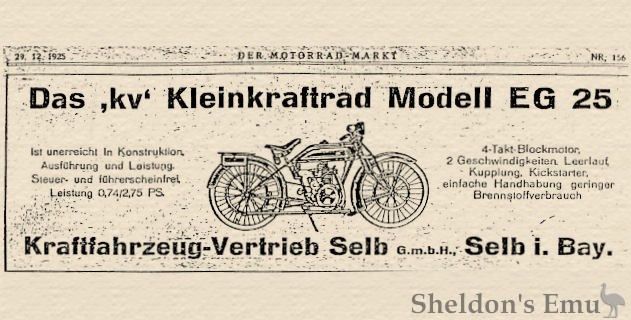
Kraftfahrzeug-Vertrieb Selb GmbH, founded in 1921, built motorcycles using their own OHV engines of 160cc and 197cc.
The EG 24 of 1924 was destined for the tax-free sector, and in 1925 the capacity was increased from 160 to 197cc for the model EG 25 to make it more competitive in the market. It had a two-speed gearbox with neutral, a clutch, and kickstarter.
Although the brand was KV, the motorcycles had KVS on the fuel tank. Manufacture continued until perhaps 1927. The firm had a branch in Hof which sold American automobiles until 1931.
Sources: Tragatsch p188; Motopedia.
N.B. There was a KV/KVS microcar built in France by New Map of Lyon in the 1980s.
Kynast 1974-
K.Z.
1924-1925. Another product of the Krieger-Gnadig firm, KZ machines were powered by Alba 198cc single-cylinder four-strokes with a two-speed gearbox, V-belt drive, parallelogram fork and block brakes. There was also a sports machine with 350 cc Kühne engine and final drive by chain.
Source: Tragatsch p188, et al.
Rarer German Marques