
This page lists brand names beginning with the letter "H" for which we currently have only an historical precis.
For a more complete listing visit the German Index.
Haenel
The firm named Carl Gottleib Haenel of Suhl began producing bicycles and weapons in 1840. A superbly restored example of a Haenel 98 Modell 32 Leichtmotorrad at the Fahrzeugmuseum Suhl is plated:
Hagel
Hagel Kraftradbau AG, Nuremberg, 1923 to 1925
Built limited numbers of 247cc motorcycles with engines of their own design, and others, using an inexpensive frame.
Source: meisterdinger.de
Haja
1924-25
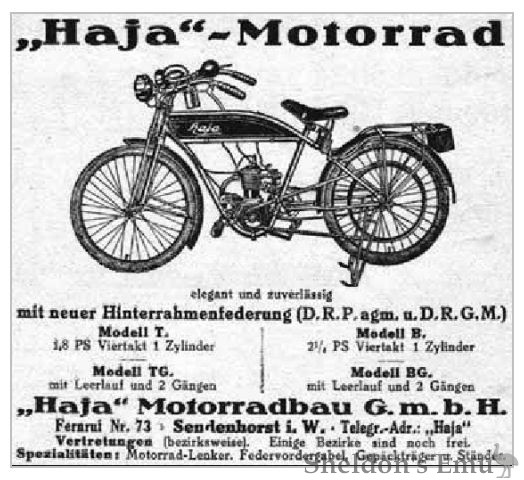
Haja Motorradbau GmbH, Sendenhorst in Westfalen
Hansa and F&S 1.8 and 1/4 hp engines, some with gears. One was described as having "rear frame suspension".
Sources: Tragatsch p154, motor-hist-foto.de.
Hako / HKR
Manufactured by Hans Korn Motorradbau, Galgengasse 25, Rothenburg ob der Tauber, 1923-1925.
His first Hako machines appeared in 1923 with 1.5 h.p. DKW engines, single speed or optional 2-speed F&S gearbox. This was joined in 1924 by models powered by 3hp DKW and 350cc sidevalve JAP engines. It is thought that only 10 machines were built under the Hako brand.
The company was renamed in 1925 and became H.K.R.. The two-strokes were dropped, and two new sports motorcycles were presented. These were similar to the famed Howard R. Davies machines, using the same JAP 348cc and 490cc ohv engines and Burman 3-speed gearbox.
The HKR did well in sporting events that year, but the economic situation was tumultuous and Hans Korn, like so many other German motorcycle manufacturers of the time, faced ruin. He was bankrupted in November 1925.
He continued in the trade, opening a motorcycle and automobile repair workshop in 1929. The company survives to this day as Central-Garage Korn GmbH & Co. KG.
Sources: Tragatsch p154 & p163; motorradphoto.de; Motopedia; mercedes-benz-korn.de.
Halumo
1923-26
Hasselmayer & Luber GmbH, München, Mozartstraße 13
Built motorcyclew with 147cc two-strokes and 146cc and 198cc ohv engines of their own manufacture.
The Type C had a 2 1/2 ps engine available with a 2-speed gearbox.
Sources: Tragatsch p154, motor-hist-foto.de.
Haza
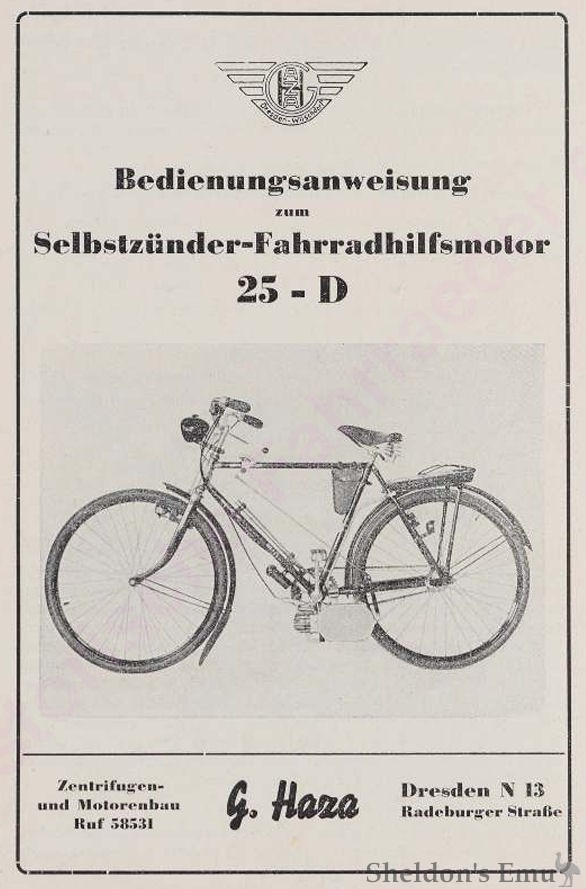
Manufactured by G. Haza, Dresden, 1950s.
Bicycle attachment two-stroke engine (hilfsmotor) with compression ignition derived from the Lohmann design. The engine could be run on petroleum, kerosene or diesel.
Controls consisted of two twist grips, one for compression adjustment and the other for throttle. It proved both difficult to use and unreliable, and only about 1300 were produced.
Hanke & Warneke
Bremer Fahrzeugbau, Rembertistraße 28 Bremen
Built the Helios de Luxe JLO-powered moped in the 1950s
Possibly related to H&W.
Source: Moped Archive
Hansa 1922-1926
Hanseat 1927-1928
Hapamee
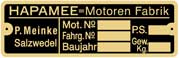
Hans and Paul Meinke, from whose names the brand name was derived, built some 800 motorcycles in Salzwedel from 1922 to 1926. The machines had tubular frames and were powered by 196cc and 246cc engines with magneto ignition and a two-speed gearbox.
Source: GTU Oldtimerservice
Harborn
Also known as the Berliner this was an electric runabout built around 1909. It was marketed in the UK as the Swan Electric.
Harlé
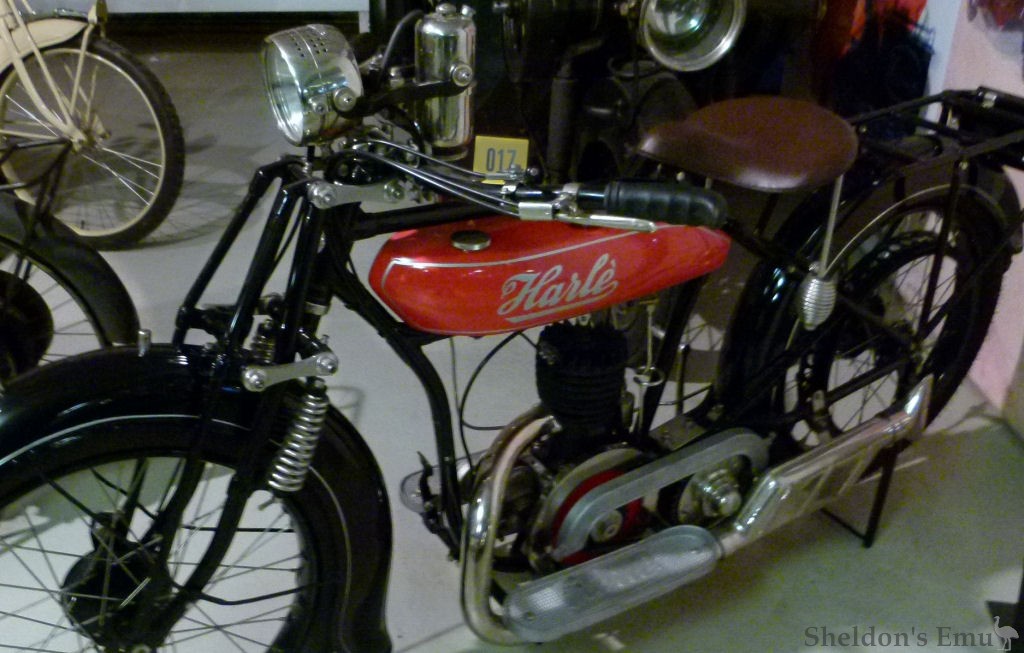
Harnisch & Lehmann, Mozartstraße 29, Plauener
Built ca 1925-27, Harle motorcycles were mostly fitted with 350cc Bark two-stroke engines, with clutch and two-speed gearbox driving the rear wheel by belt.
Source: freiepresse.de
Harras 1922-1925
Hartmann
Manufactured by the Hartmann company in Eisenach around 1901. The firm built bicycles and motorcycles, and later produced small cars powered by Fafnir 4.5 hp engines. Production ceased in 1906.
Source: Wikipedia DE
Haruhschi
Manufactured in Neumünster by Wolfgang Uhlig, Harms and Schimkowski 1971-1978
Long-track speedway, ice-racing and motocross machines powered by JAP, ESO and Norton engines ridden by Bobby Schwartz, Kai Niemi and Hans-Otto Pingel, among others. They also built a gearbox which was well received. The firm is still in business as of 2018.
Sources: GTU Oldtimerservice, bahnsporttechnik.de
Hascho
Manufactured by Halbritter & Schollmeyer of Mühlhausen, Thuringia from 1923 to 1926 using DKW engines, and from 1925 Villiers. They presented a small car at the 1924 Berlin Motor Show.
Sources: Tragatsch p158, Wikipedia.de, motor-car.net.
Haschüt
Manufactured by Motorradhaus Hans Schütze, Dresden A-16, Hammerstraße 6.
Lightweight motorcycles with Bekamo and 173cc Villiers engines produced 1929 to 1932.
Sources: Tragatsch p158, motor-hist-foto.de.
Haussherr 1902-12
Haweka
1923-26
Hamburg firm built sports machines using JAP 348, 490 and 678cc sv and ohv engines, and MAG IOE V-twins of 497cc. Raced by Bremer and Shultz.
Source: Tragatsch p158
HBJ Sidecars
Manufactured in Bergneustadt, DE, 50km E. of Cologne. HBJ is derived from the initials of three racers who designed a sports sidecar for the road at the end of the 1980s: Hans-Gerd Reichler, Bernd Dawicki and Jesko Höckert. Reichler made the wide-tire sidecar acceptable for the road. He also developed a hub steering system for road sidecars in 1991. The rights to the name were temporarily transferred to Bode in 2005.
Reichler had many years experience as a designer and racer of sidecars, and created a machine powered by the Yamaha FJ 1100/1200 engine which has three-piece BBS rims and 195/50 VR 15 tyres, four-piston brake calipers, and a sump guard, with optional tonneau and second fuel tank.
Sources: Gespann-Lexikon; Sidecar Club Praha
HBS Sidecars
Gespann- und Beiwagenbau
Unter den Eichen 28a
32423 MINDEN / Päpinghausen
hbs-bmw.de
The helicopter mechanic started his motorcycle repair shop, "HBS," in the Bückeburg district of Cammer in the summer of 1981.
Heinz Bals fits sidecars from various manufacturers to BMW and other motorcycles. He has two similar models built under the HBS name which are designed for the BMW Boxer. The chassis may be adapted to many makes and models at no extra cost, and a stable connection is guaranteed.
Sources: Sidecar Club Praha; hbs-bmw.de; winni-scheibe.com.
Heidemann 1950-53
Heigl Sidecars
Fritz Heigl, Osterseeon 17, D- 85614 Kirchseeon
heigl-fritz.de
Manufactured by Fritz Heigl Fahrzeugkonstruktionen.
Fritz launched into the sidecar business in 1946, and later with the strong involvement of his wife Frieda and other women in the family, began production in earnest in 1976.
The firm built steel-bodied sidecars and did many scooter conversions. Models include the Chip, a lightweight with a seat width of 54 cm. It was manufactured from 1997 to around 2013.
Sources: Gespann-Lexikon; heigl-fritz.de.
Heitmann & Wittler 1938~1953 (H&W)
Heilo 1924-1925
Heli
Built by Herbert Lindner in Berlin, 1923-1925.
The motorcycle had a liquid-cooled two-stroke engine with unit-construction two-speed gearbox. It was quite an advanced machine but being relatively expensive could not survive the chaotic years of the mid-twenties.
Source: GTU Oldtimerservice
Helios by BFW
Heller
Heller Motorradfabrik, Siegfriedstrasse, Nürnberg, 1923 - 1926
The brothers Hans and Fritz Heller ran a bicycle and motor vehicle store with Josef Esser in 1921-1922.
All three separated, with each forming their own businesses. Josef Esser established a similar business on Engelhardsgasse. Johann (Hans) Heller also began a business nearby.
Fritz Heller began vehicle and frame construction, and in about 1924 moved to a new premises where he built motorcycles powered by
Maschinenfabrik Immendingen (Mehne) sidevalve flat twins which were very similar to the BMW M2B15.
The machines had a three-speed gearbox and belt drive to the rear wheel and a block brake on the front wheel only.
Sources: meisterdinger.de, Tragatsch p159, Motopedia.
Heller, Hans
Johann (Hans) Heller separated from his brother Fritz and partner Joseph Esser, and in 1924 advertised lightweight motorcycles of 2 and 3 h.p. These bore some resemblance to the boxer twins built by his brother, so there is a possibility that the chassis were supplied by Fritz.
Due to the economic conditions sales were slow, and Hans began to build motorized delivery vans in 1928. He died three years later at the age of just 31.
Source: Motopedia.
Helo
Manufactured by Hermann & Lommatzsch of Köpenicker Strasse Nr. 5, Berlin-Köpenick, 1923-1925, it was a Bekamo-powered two-stroke which competed in the market with the similarly named Heli.
The firm also built three-wheelers powered by a 147cc DKW engine mounted above the front wheel.
Sources: GTU Oldtimerservice, Wikipedia DE.
Henkel 1927-32
Heos (1920s)
Kaulsdorf, Heos-Fahrzeugwerk GmbH, Berlin, 1923-1926, sidecar construction.
Another Heos sidecar was built much later by Willi Heitmann. See below.
Sources: GTU Oldtimerservice
Heos (1980s)
Willi Heitmann built competition sidecars and motocross machines with a variety of engines including Yamaha and Honda during 1970s and 1980s.
Models included an off-road solo powered by Yamaha 4T singles and twins, and others are race-tuned motocross outfits with engines up to 1000cc. In the early 1980s he introduced the idea of mounting the fuel tank on the sidecar chassis, thus lowering the C of G. This system was soon adopted by others.
Heos-Yamaha outfits won the German sidecar-cross championship in 1978, 1981, and 1982, and a Heos-Zabel won in 1990.
Sources: fb.com/HE069OS; de.wikipedia.org; et al
Herko 1922-1925
Herkra
Built by Heinz Blume in Cologne 1922-1923, this was a light belt-driven motorcycle with a two-stroke 141cc engine mounted high in the frame and well forward of the pedal crank.
Source: GTU Oldtimerservice
Herma
Manufactured a 148cc Hilfsmotor which could be fitted to either the front or rear wheel of a bicycle.
Sources: Tragatsch p162, motor-hist-foto.de.
Hermeling
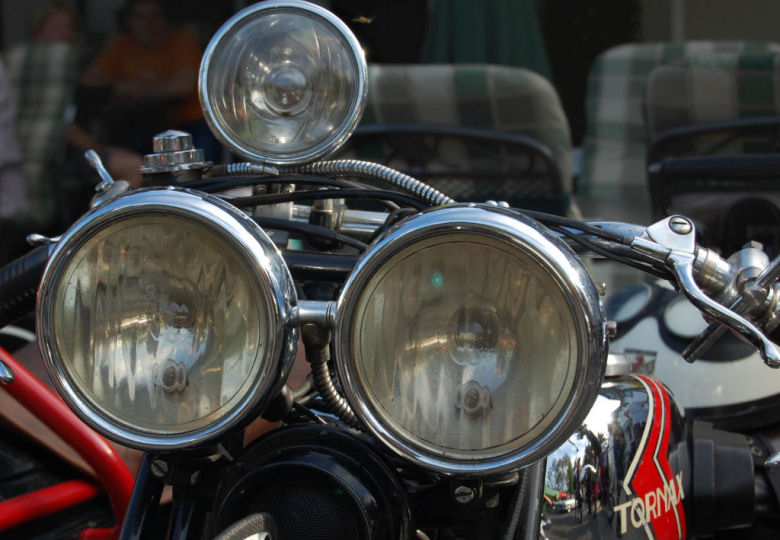
Sidecars manufactured in Freilingen/Eifel from 1978 by Otto Hermeling, who died in 2011. He began his career in motocross in the late 1960s. In 1970 became associated with Robin Rhind, owner of Wasp in England. From 1974, he shared racing successes with Friedhelm Zabel. In 1978, the first Wasp road sidecar was presented at the IFMA with a BMW R 100 fitted with the "Sport" sidecar. The most famous sidecar project was the Tornado, which was fitted to the BMW K1100, amongst others.
An owner of a Honda ST1100 by Hermeling describes it thus:
Sources: Gespann-Lexikon; pan-european-forum.de.
Hermes 1922-1925
Heros, H&R and Ares 1921-1929 (Saxony)
Heros (Berlin)
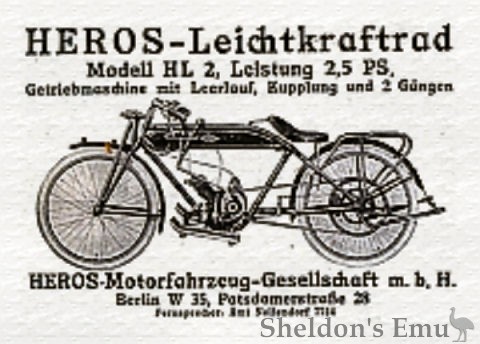
Heros Motorfahrzeug GmbH of Berlin built light motorcycles powered by 142cc DKW engines, 1923-1924.
Source: GTU Oldtimerservice, wikipedia.nl
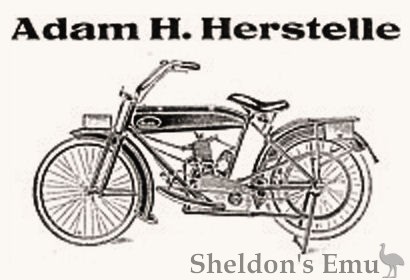
Herstelle
Manufactured by Adam H. Herstelle of Bielefeld 1923-1924
In addition to two-stroke and four-stroke motorcycles, one of which was powered by a Hansa engine, the firm produced components for other marques in the Bielfeld area, particularly front suspension.
Source: GTU Oldtimerservice
Hertha
Manufactured by Hagemann & Vogler, Leichtmotorenfabrik, Berlin, 1924-1925
Fitted DKW 142cc two-strokes to lightweight machines similar to those from Eichler, also of Berlin.
Sources: Tragatsch p162, motor-hist-foto.de.
Hesco
Manufactured by HS-Metallbau GmbH of Salzgitter 1984-1988
Powered by a Rotax 504 and fitted with quality components - Marzocchi forks, Koni rear suspension, TZ Yamaha wheels and the like - the Hesco-Rotax 560 sports machine proved quite popular in the German market.
Source: GTU Oldtimerservice
Hess
Eberstadt, 1925
Valentin Hess built a remarkable 799cc inline four fitted longitudinally, FN fashion. Available in any colour as long as it was red, the cost was 1600 marks. Hess also supplied components to HAG in the way of crankshafts and other engine components. HAG in turn manufactured a new type of steel piston for Hess, of which he was the inventor, but the popularity of steel pistons was fast waning.
Sources: Tragatsch p162, darmstadt-stadtlexikon.de
Hessrad
Marketed by Carl Hess of Mannheim in 1924 and 1925, the machine was a rebadged Harso manufactured by Hartmann & Sohn. Of 250cc, with a Sturmey-Archer gearbox, it had Druid-style front forks and chain drive to the rear wheel.
The Hessrad was advertised by Wilh. Mobnen & Co., G. m. b. H., Mannheim, c.1924.
The firm appears to be unrelated to Hess-Fahrradwerke GmbH of Mannheim, a bicycle manufacturer in the early 1900s.
Sources: Motopedia, et al.
HFG
Manufactured by H. F. Günter GmbH, Düsseldorf, 1923-1924
In early 1923, the company retailed the Mabeco and D-Rad marques. Günter had worked with D-Rad in Berlin, and is believed to have been the designer of the D-Rad predecessor, the Star.
The HFG was offered around mid 1923 with a 1.5 hp Snob engine, later enlarged to 2 h.p.
Source: Motopedia
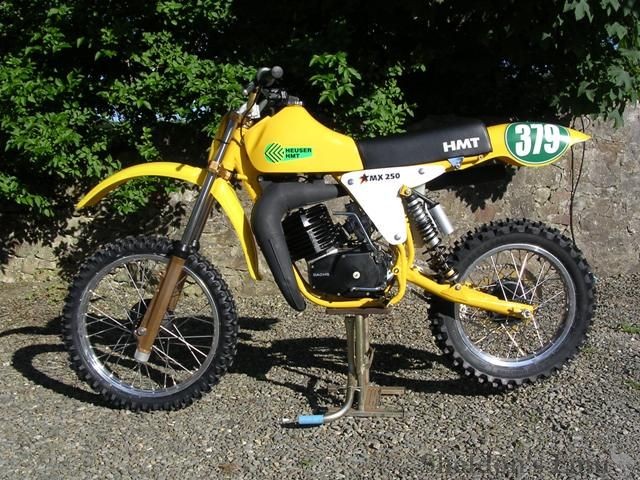
Heuser HMT
Manufactured by Peter Heuser of Troisdorf 1980-1982
The firm produced a variety of off-road machines of 50cc, 80cc and 250cc using modified Sachs engines and mainly Italian chassis components. The firm was associated with the Italian AMR.
Source: GTU Oldtimerservice
Hexe (English: Witch)
Three different German firms built machines of this name.
1. Dorko of Bamberg firm produced belt-driven Hexe motorcycles of up to 500cc from 1924 to 1926. See Dorko-Werke.
2. Achenbach of Hamburg built Hexe automobiles 1905-1907.
3. Hexe 1950s (Amelung)
Hiekel 1925-1932
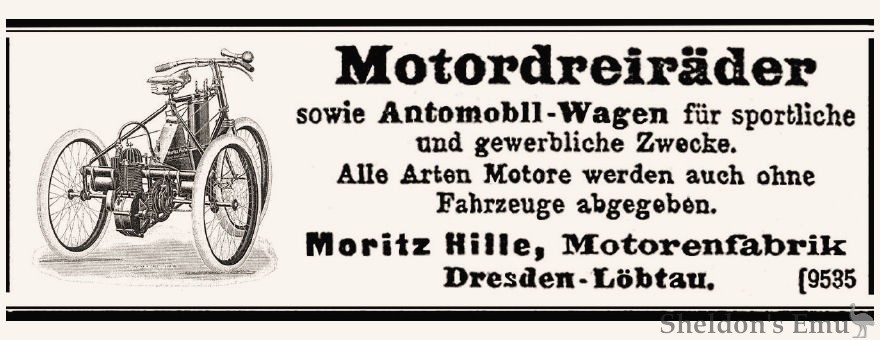
Hille
Manufactured by Moritz Hille in Dresden. Company founded 1884
In 1898 the firm's first vehicle was produced, a motor tricycle. This was followed by four-wheeled commercial vehicles which they continued to build until the late 1920s.
Source: Axel Oskar Mathieu Archive
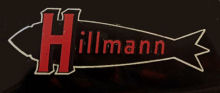
Hillmann
Heinrich Hillmann of Brandende began building bicycles in 1929. Moped production using 98cc JLO and Sachs engines commenced in the late 1940s and some 150 were built.
Early in the 1950s motorcycles were constructed using JLO engines of 98, 125 and 200cc but sales were very slow. Some 50 machines left the factory, 10 of which had 200cc engines.
The firm remained in the bicycle trade until 1997.
Only one of the post-war mopeds survives, along with two or more of the larger machines.
The Hillmann logo features a Zeppelin.
Sources: kradblatt.de, uni-hamburg.de, et al.
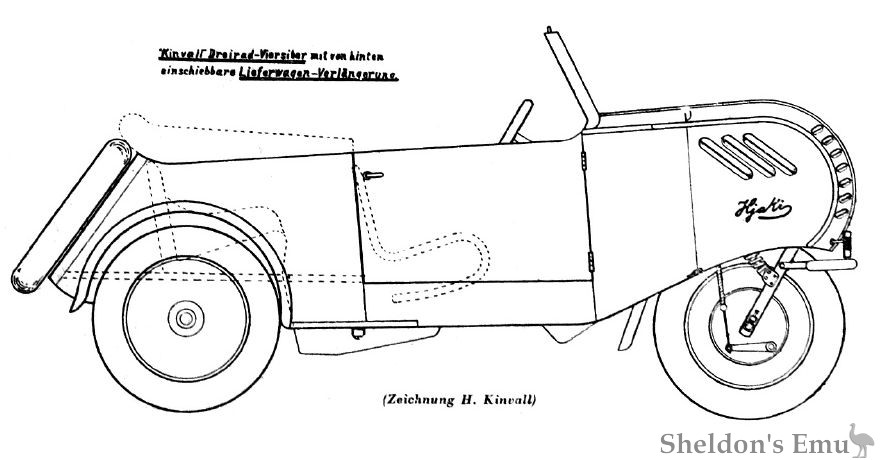
Hjaki
The engineer H. Kinvall was mentioned in an article in "Motor und Sport" magazine as having designed a three-wheeler.
Details were sparse, and it seems likely that few, if any, were built.
Source: Axel Oskar Mathieu Archive
HMA
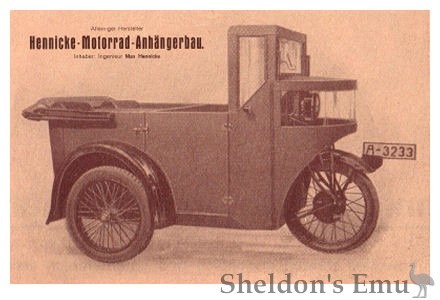
The Hennicke Motorrad Anhänger was termed a motorcycle trailer, but was actually a motorized tricycle with one wheel at the front. It seated three, driver in front and two passengers behind, and was provided with a folding cover.
Source: motor-lit-berlin.de
HMW
Manufactured by Hasper Motorrad Werk of Westfalen.
1923-1928. Heavy single-cylinder machines with their own SV engines.
Not related to the Austrian marque, nor to the machines built in post-war East Germany.
Sources: Tragatsch, Wikipedia NL
Hochland 1924~27
Hoco 1924-1928
Hoffmann & Seidel
Built in Saarbrücken by bicycle manufacturer Hensler in the 1950s. Hoffmann & Seidel was also a clothing brand.
Machines of this marque were almost identical to the Saarperle, also built by Hensler.
Source: saar-nostalgie.de
Hollweg
Roadracing sidecars manufactured by Reinhold Hollweg from 1996 to c.2010, powered in the main by ADM engines from Switzerland.
Hollweg was very active in the sport and took 5th place in the 1994 FIM European Sidecar Championship.
Sources: Gespann-Lexikon, et al.
Hoock
Manufactured by Hoock & Co. of Cologne, 1926-28
Hoock was a main agent for Villiers in Germany. Using their 342cc engines and a variety of other British components he built a number of motorcycles.
Source: de.wikipedia.org
Hookie
Manufactured by Hookie Co. GmbH
Moto Design Company, Dresden.
Website: hookie.co ✝
Facebook: fb.com/hookieco
Horst Kloppe
Built in Berlin in 1958, the scooter combination had a 97cc two-stroke engine. The sidecar was from Stoltz. The homebuilt machine was a one-off.
Source: auto-und-uhrenwelt.de.
Horex Röth 1979~1986
HTH
From 1924 to about the mid-1970s Hans Tautenhahn Hartenstein of Saxony built sidecars along with motorcycle components and vehicles for the disabled. Pre-war sidecars are believed to have been modelled after the Stoye. During the Soviet occupation, some models resembled the GeWo and Wünsche but were not built with wooden chassis components.
Dr Pál Négyesi writes:
From Fahrzeugmuseum Chemnitz, clearing up the mystery of two fellows with the same name.
"There were two Hans Tautenhahn. One lived in Zwickau and was responsible for HATAZ (HAns TAutenhahn Zwickau) cars in the 1920s. The other man lived and worked in Hartenstein and built sidecars and the small car you mentioned in the 1950s (HTH: Hans Tautenhahn Hartenstein). Our museum used to show a HATAZ car and the remains of a HTH 200. Both exhibits have since been given back to their owners and are no longer on display. Both men were not related, just shared the same name and worked in similar trades at different points in time. There is also very little information on either of them, I'm afraid"
Reply: "I don't know if they were not related because:
1 Hartenstein is near Zwickau
2 The second company was called Fahrzeugbau HTH, Hans Tautenhahn Jun. This implicates that there was a Hans Tautenhahn senior, which could be our Hataz-man."
Sources: Projekt Eindruck, et al.
HU Sidecars
Manufactured by Horst Ullrich in Germany 1987 to 2010.
Obertorstraße 32 - 34, 63688 Gedern - Wenings
HU Built enduro and long-distance touring sidecars including the Voyage (1992) and the Feng Bao (2003). Sidecar construction appears to have ceased in 2010, but the firm continued in the motorcycle trade as a supplier of suspension from Mash and SWM.
Sources: Gespann-Lexikon; hu-sidecars.de.
HUC
Produced by Maschinenfabrik M. Hecker & Co. of Berlin, 1924-1926
145cc and 175cc DKW two-stroke engines powered these utilitarian motorcycles which did well on the local market until the financial crisis.
Source: GTU Oldtimerservice
Hucke-Rinne
Manufactured by Max Hucke Fahrgestellbau, Berlin-Neukölln. 1924-26
Used 124, 173 and 247 cc engines from Berlin engine builder Rinne
Sources: de.wikipedia.org, Tragatsch p169
Hüffer
Manufactured by Hüfferwerke, Abt. Kraftfahrzeugbau, Münster in Westphalia, 1923-25
Built lightweight motorcycles using 150 to 200cc engines from the likes of DKW, Lorenz (Rapid) and Baumi.
Sources: Tragatsch p169, de.wikipedia.org
Husar
Manufactured from 1923 to 1925 by Husar Leichtmotorrad GmbH (Husar Motorfahrzeug AG, Munich).
The firm built motorcycles using 296cc and 500cc engines which had leaf spring front and rear suspension, quite advanced but not yet popular in with the consumer. They had stiff competition from BMW, also of Munich.
Sources: Tragatsch p169, de.wikipedia.org
Huy 1923-1926
Rarer German Marques