
At the age of 12 Bruno Rossati began working eleven hour days.
"Now, approaching 91, I find myself reminiscing about my youth, still riding my motorcycle every day.
Letter re Ladetto

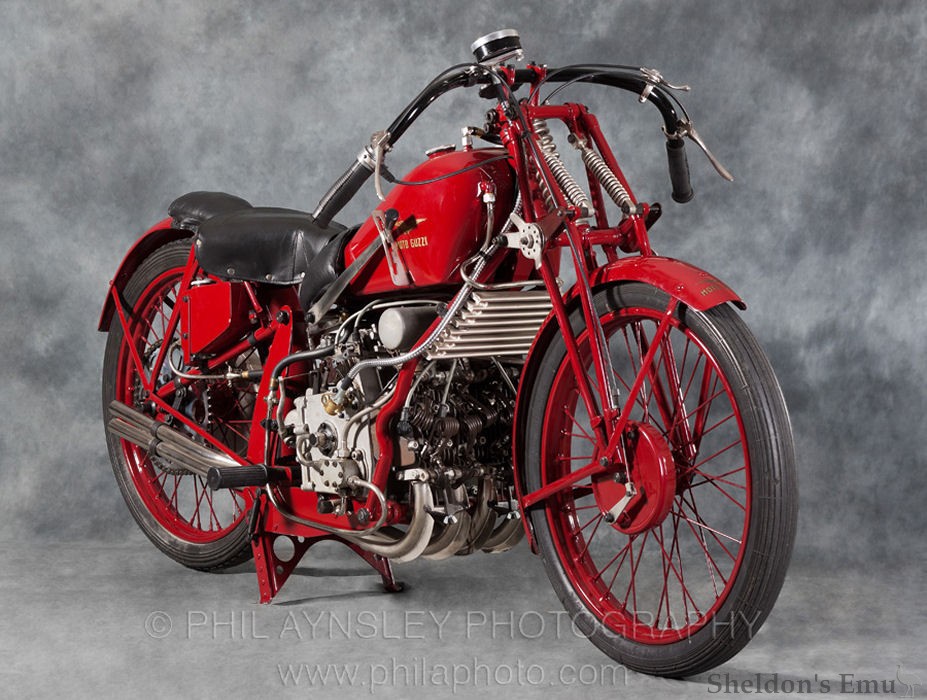
Although the "hush-hush" 500 c.c. four-cylinder Guzzi did not compete in the Monza Grand Prix last week, it is almost certain (reports The Motor Cycle correspondent in Milan) that the machine will be seen in the Isle of Man T.T. next year. The official reason given for its non-appearance at Monza was that some tar had been sucked through the air intake into the Cozette supercharger with which the machine is fitted. The whole idea of the Guzzi supercharged four is the production of a racing machine with better acceleration and higher maximum speed than are obtainable with a single.
Like the standard Guzzi singles, the four-cylinder has unit-construction of the engine and gear box. The cylinder arrangement is unusual; the four barrels, arranged in a straight line across the frame, are slightly inclined upwards from the horizontal, Thus, the cylinder heads are well exposed to the cooling draught.
Three-bearing Crankshaft.
A short stroke has been adopted, the bore and stroke being 55 x 50 mm. The crankshaft is of the three-bearing type — all roller bearings, incidentally — with ducts in the shaft for the force-feed lubrication. A dry-sump system has been adopted, and a special aluminium oil cooler or radiator is mounted at the front end of the fuel tank. All told, there is almost a gallon of oil in circulation. The pump is of the gear type, mounted on the off side, and driven from the end of one of the two camshafts. Push-rod operation is used for the eight inclined overhead valves. These push-rods, due to the small dimensions of the engine, are, of course, unusually short. The valve springs are of the hairpin variety.
The valve timing is by no means out of the ordinary: the inlet valves open 10 degrees early (that is, before top dead centre) and close 50 degrees after bottom dead centre; the exhaust valves open 50 degrees early and close 10 degrees late. The nominal compression ratio is 5 to 1: Both the carburetter and supercharger are of Cozette design. The former is mounted near the rear mudguard, and the mixture passes through the supercharger to a form of balancing chamber fitted immediately above the ports. A relief valve is fitted in this chamber to overcome the possibility of the supercharger becoming damaged through a backfire. A separate oil pump with its own supply is mounted on the end of the supercharger.
The Motor Cycle, October 1st, 1931. Page 475
Specification
Engine: transverse inline OHV four-cylinder.
Valve train: push rods and rockers, hairpin valve-springs
Bore/stroke: 56 x 50
Capacity: 492 cc
Induction: Cozette supercharger and carburettor
Cooling: air-cooled
Transmission: 3-speed gearbox
Power: 45 CV @ 7800 r.p.m.
Maximum speed: 175 km/h

